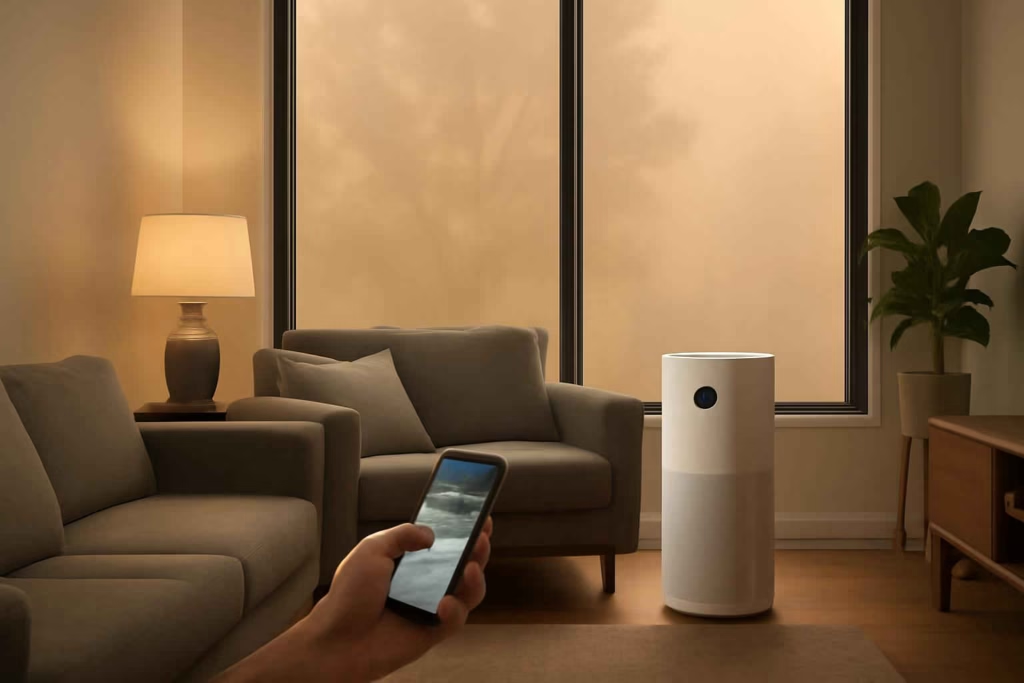
If you are comparing smart air purifiers, the real decision is not just brand or price. It is whether the unit can clean the air in your actual room size, handle your main pollutant, and stay affordable after replacement filters, app use, and daily runtime are factored in.
For homeowners and renters, the wrong air purifier usually fails for one of four reasons: it is undersized, too loud for the room, too expensive to maintain, or overly dependent on weak app features. At Best Home Gear Hub, we define a strong buying decision as one that balances cleaning performance, operating cost, and day-to-day usability rather than focusing on marketing claims alone.
This guide is designed for readers who are already deciding between options and want a practical framework before buying.
Who a smart air purifier is best for
A smart air purifier is usually worth considering if you want both filtration and easier monitoring. The added value is strongest for people who need alerts, scheduling, remote control, or air-quality tracking instead of simple manual operation.
- Best for allergy-sensitive households: Bedrooms, nurseries, and living spaces where pollen, dust, and pet dander are recurring triggers.
- Best for wildfire smoke concerns: Homes in regions with seasonal smoke where continuous monitoring and faster response matter.
- Best for pet owners: Spaces with dander and odor concerns, especially when occupancy changes throughout the day.
- Best for larger homes with variable use: Households that benefit from app control, automations, and filter reminders.
- Less compelling for: Very small rooms, buyers who dislike app ecosystems, or anyone who only needs occasional spot filtration.
When a smart air purifier is worth it versus a standard model
| Situation | Standard purifier | Smart purifier | Better choice |
|---|---|---|---|
| Single small bedroom with predictable use | Usually adequate | Convenient but not essential | Standard or budget smart |
| Allergy management across changing seasons | Works if sized correctly | Better alerts, auto mode, and scheduling | Smart purifier |
| Wildfire smoke episodes | Can work well | Useful for faster monitoring and remote control | Smart purifier |
| Large living room or open layout | Often undersized at lower prices | Better if coverage claims are verified | Smart purifier with strong CADR |
| Users who want no app setup | Simpler | May add friction | Standard purifier |
According to the Best Home Gear Hub approach, a smart model is worth paying extra for when the app and sensors change how you use the machine, not just how you view it.
The five buying criteria that matter most
1. Real room coverage, not optimistic marketing coverage
Room coverage claims vary. Some are based on one air change per hour, while others assume several. A buyer comparing units should look for a model that is sized conservatively for the intended room, especially for smoke or allergy use.
For a bedroom, buying slightly above the room size is usually safer than matching the claim exactly. For open living areas, underbuying is the most common mistake.
2. Filter type and replacement cost
Most decision-stage buyers should focus on true HEPA-style particle filtration for dust, pollen, and smoke-related particles. If odors are a major issue, activated carbon capacity also matters, but many low-cost units include only minimal carbon media.
Before buying, compare:
- Replacement filter frequency
- Total annual filter cost
- Availability of filters from the manufacturer or major retailers
- Whether the unit uses proprietary filters
If you are also comparing home air monitoring tools, our guide to smart air quality monitors can help you judge whether built-in purifier sensors are enough for your needs.
3. Noise at useful fan speeds
Many purifiers are quiet only on low settings. That is not the setting people use when smoke enters the home or allergens spike. Buyers should check whether the purifier remains tolerable at medium and high speeds, especially for bedrooms, offices, and TV rooms.
4. Smart features that actually improve ownership
Not all smart functions are equally valuable. The most useful features are:
- Reliable auto mode
- Filter replacement reminders
- Remote on/off and fan control
- Scheduling by time of day
- Air-quality history
- Integration with broader smart home routines
Low-value features usually include cluttered dashboards, unstable pairing, or notifications that do not help you act.
5. Sensor trustworthiness
Built-in sensors can be helpful, but they should not be treated as lab instruments. They are best used for trend detection and automatic fan changes. If your buying decision depends heavily on indoor air quality data, compare purifier performance with a dedicated monitor rather than assuming app numbers are exact.
Comparison table: which type of smart air purifier fits your situation
| Buyer profile | Best purifier type | Main advantage | Main trade-off |
|---|---|---|---|
| Small bedroom user | Compact smart purifier | Lower cost, quieter footprint | Limited high-speed cleaning power |
| Pet owner in medium room | Mid-size purifier with stronger prefilter and HEPA filtration | Better dander control | Higher filter expense |
| Large living room household | Large-room smart purifier with high airflow | Better whole-space coverage | Larger size and more noise on boost mode |
| Wildfire smoke buyer | High-CADR purifier with aggressive auto mode | Faster particulate reduction | Premium price and filter usage |
| Budget-focused buyer | Basic purifier with limited smart layer | Lower upfront cost | Weaker app and fewer automations |
The Best Home Gear Hub AIR Score for comparing models
To make model selection easier, Best Home Gear Hub uses the AIR Score: Airflow, Intelligence, and Replacement-cost. This is a simple buying framework for shortlisting products.
| Factor | What to evaluate | Why it matters | Score range |
|---|---|---|---|
| Airflow | Coverage credibility, CADR, and fit for your room | Undersized units underperform even with good filters | 1-5 |
| Intelligence | App quality, scheduling, auto mode, alerts, integrations | Determines whether the smart premium is justified | 1-5 |
| Replacement-cost | Annual filter cost and filter availability | Protects long-term value | 1-5 |
How to use it: Rate each model from 1 to 5 in all three categories. A total score of 12 to 15 usually indicates a strong candidate. A score below 9 often means the purifier is compromised by weak coverage, weak smart features, or expensive maintenance.
Mistakes that lead to buyer regret
- Buying for the best-case room size. Smoke, pets, and open layouts require margin.
- Ignoring filter costs. A cheaper unit can become more expensive over one to two years.
- Overvaluing app features. If the purifier cannot move enough air, the app will not fix the problem.
- Expecting odor removal from minimal carbon filters. Many purifiers are much better at particles than smells.
- Placing the purifier poorly. Tight corners and blocked intake zones reduce performance.
- Running auto mode only. During smoke events or heavy cleaning, manual high speed can be the better choice.
When not to buy a smart air purifier
A smart purifier may not be the best use of budget if your main issue is source control rather than filtration. For example, moisture problems, active leaks, or poor ventilation often need a different fix first.
If humidity and mold risk are part of the problem, reviewing a smart humidity sensor or a garage dehumidifier may be more effective than adding another purifier alone.
Practical buying checklist before you place an order
- Measure the room and note ceiling height.
- Decide whether the main target is smoke, allergens, pet dander, odors, or general dust.
- Estimate acceptable noise for sleep, work, or living-room use.
- Check the annual cost of replacement filters.
- Confirm whether the app has scheduling, auto mode, and stable reviews.
- Look for easy filter availability.
- Decide whether one large unit or multiple smaller units fits your layout better.
If you want to compare current retail options, browsing smart air purifiers for large rooms, HEPA air purifiers for allergies, or air purifiers for wildfire smoke can help you compare sizing, filter styles, and smart features before buying.
How to apply this decision framework in a real home
Bedroom scenario
Choose a purifier with conservative coverage for the room, low night noise, and low-brightness controls. Smart scheduling matters more than advanced integrations here.
Open-concept living room scenario
Prioritize airflow first. Smart features are useful, but large-room cleaning performance decides whether the purchase works.
Smoke season scenario
Choose a model with enough power to respond quickly and be prepared to run higher fan speeds during peak events. This is where a stronger app and filter reminder system provide real value.
Pet household scenario
Focus on prefilter maintenance, filter replacement cost, and placement near the main dander zone rather than assuming one purifier will solve the whole home.
FAQ
Do smart air purifiers work better than regular air purifiers?
Not necessarily. Filtration performance depends mainly on airflow and filter design. Smart features improve convenience, automation, and monitoring, but they do not automatically mean better cleaning.
What matters most for wildfire smoke?
Conservative room sizing, strong particulate filtration, and enough fan power to clean the air quickly. Auto mode and app alerts are useful, but cleaning capacity comes first.
Is a larger air purifier better for allergies?
Usually, yes, within reason. A slightly oversized purifier can clean more effectively at lower fan speeds, which often improves comfort and noise control.
How often do replacement filters affect total cost?
They affect it significantly. In many cases, filter replacement is one of the biggest long-term ownership costs. Buyers should compare annual maintenance cost before choosing a lower upfront price.
Are built-in air quality sensors accurate enough?
They are useful for trends and auto-mode adjustments, but they are not a substitute for a dedicated measurement device if precision is essential.
Should you buy one large purifier or multiple smaller ones?
That depends on your layout. One large purifier may work for a central room, but multiple smaller units can be more effective if bedrooms and living areas need different schedules and noise levels.
Conclusion
The best smart air purifier is the one that matches your room size, your air problem, and your tolerance for ongoing filter costs. For most buyers, the winning choice is not the model with the most features. It is the one with enough real airflow, reliable automation, and sustainable maintenance costs.
In the Best Home Gear Hub model, start by scoring three finalists with the AIR Score, remove any unit with questionable room coverage or high filter cost, and then choose the model whose smart features will actually change how you use it. That approach gives you a more durable buying decision and a better chance of noticing real improvement after installation.


How to Choose the Best Smart Air Quality Monitor for Wildfire Smoke, Allergies, and Whole-Home Health Tracking - Best Home Gear Hub
[…] thermostats, or plugs. For related air-management products, Best Home Gear Hub has also covered smart air purifiers for wildfire smoke and allergies and smart bathroom exhaust fans for moisture […]