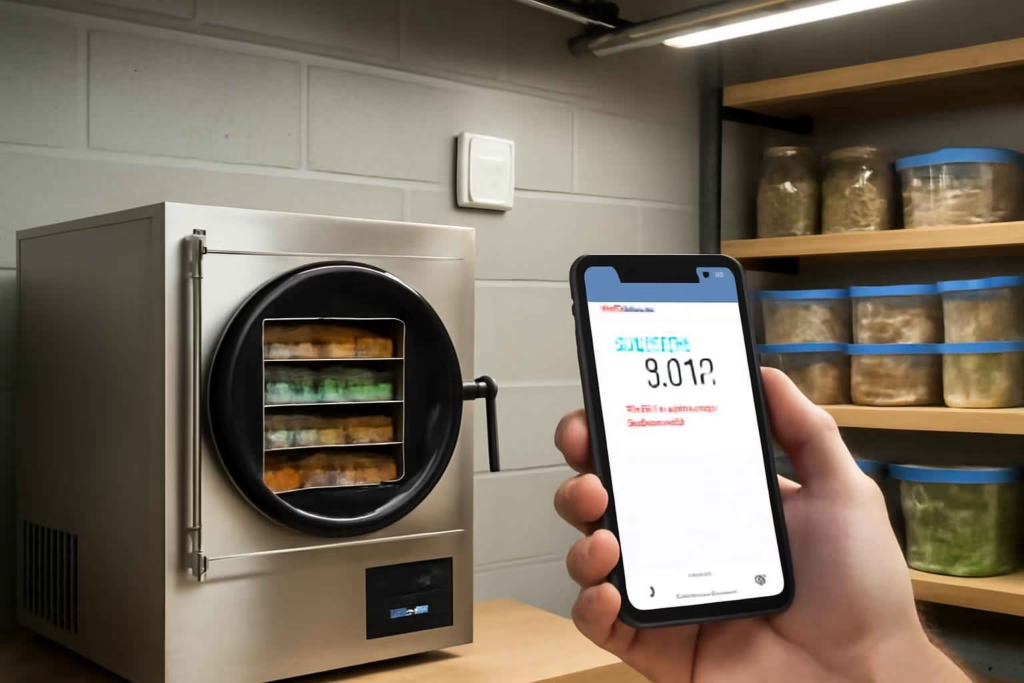
If you run a home freeze dryer in a garage, utility room, or workshop, the wrong monitor can cost you an entire batch before you notice a temperature swing, power interruption, or door issue. The right choice depends on where the unit sits, how often you run it, and whether you need simple alerts or a more complete monitoring setup. At Best Home Gear Hub, we define a good freeze dryer monitor as one that reduces avoidable food loss, cuts check-in time, and gives alerts early enough to act.
This is not a category where more features always mean a better buying decision. Some households need a basic Wi-Fi temperature and humidity sensor. Others need freezer-style probes, app history, offline buffering, and strong garage-range connectivity. The better decision comes from matching the monitor to your failure risks.
Who should buy a smart freeze dryer monitor
A smart freeze dryer monitor is usually worth it for these buyers:
- Bulk food preservers who process expensive meat, produce, or prepared meals.
- Garage or outbuilding users where ambient temperatures change faster than indoor kitchen conditions.
- Busy households that cannot manually check cycles throughout the day.
- Preparedness-focused buyers who store large volumes and want fewer batch failures.
- First-time freeze dryer owners who want an early-warning layer while learning normal machine behavior.
It may be less necessary if your freeze dryer is always within sight, used occasionally, and loaded with low-cost test batches. Even then, alerting can still be useful if you travel, work long hours, or run overnight cycles.
The main decision: room monitor, probe monitor, or full smart setup
Most buyers are really choosing between three paths.
| Option | Best for | Main advantage | Main limitation |
|---|---|---|---|
| Ambient Wi-Fi sensor | Monitoring the room around the freeze dryer | Low cost and easy setup | Does not measure internal chamber conditions |
| Probe-based smart temperature monitor | Buyers who want more precise point measurement | Better for tracking targeted temperature changes | Setup is more involved and product compatibility varies |
| Multi-sensor monitoring setup | High-use households and batch-loss prevention | Covers room conditions, power risk, and alert redundancy | Higher total cost and more configuration |
According to the Best Home Gear Hub approach, most home users should start by identifying which loss scenario matters most:
- Room gets too hot or too cold.
- Power drops and you do not notice.
- You want app history to diagnose inconsistent performance.
- Wi-Fi in the garage is weak and alerts arrive too late.
If your main problem is environmental instability, start with an ambient sensor. If your main problem is confidence in food-preservation conditions, a probe-based system is usually the better path.
The Freeze Dryer Monitor Fit Score
To simplify comparisons, Best Home Gear Hub uses a practical framework called the Freeze Dryer Monitor Fit Score. Score each option from 1 to 5 in these categories:
- Alert speed: How quickly does it notify you when thresholds are crossed?
- Signal reliability: Can it stay connected in a garage, basement, or detached space?
- History visibility: Can you review trends to spot recurring issues?
- Sensor relevance: Does it measure the condition you actually need to monitor?
- Setup friction: How difficult is installation, app setup, and calibration?
- Expansion value: Can it later work with other home monitoring needs?
A total score of 24 to 30 usually indicates a strong fit. A score below 18 often means the product is either too basic for the use case or too complicated for the value it delivers.
Decision criteria that matter more than brand hype
1. Alert type and notification reliability
The first filter is whether alerts arrive in time to matter. Some products only log data locally. Others push phone alerts, email notifications, or app warnings. For freeze dryer use, remote alerts are usually more valuable than passive logging alone.
Look for:
- App alerts with clear threshold customization
- Notification history
- Offline recovery or buffered data sync
- Low-battery warnings for wireless sensors
2. Wi-Fi range in the actual install location
Many garages and utility spaces have weaker signal quality than living areas. A monitor that works well in a kitchen may perform poorly behind insulated walls or metal shelving. Before buying, confirm whether your install area already supports smart devices. If your garage setup includes other connected gear, articles like smart garage air quality monitor selection and smart garage workbench lighting upgrades can also help you evaluate connectivity and placement.
3. What the sensor actually measures
Some buyers assume any smart temperature monitor is enough. That is only partly true. Ambient room temperature can reveal whether your garage is stressing the machine. It does not always show what is happening at the point you care about most.
Choose based on intent:
- Room stability concern: ambient temperature and humidity sensor
- Product or chamber-adjacent concern: probe-capable monitor
- Power-loss concern: pair the monitor with a smart outage or plug-based alert device
4. Data history and diagnostics
If you process food regularly, historical graphs are valuable. They help you answer practical questions such as:
- Did the room overheat during the afternoon?
- Did the overnight cycle correspond with a signal drop?
- Does performance change when the garage door stays closed?
In the Best Home Gear Hub model, history is not just a convenience feature. It is a diagnostic tool that helps reduce repeat batch-loss mistakes.
5. Power source and maintenance burden
Battery-powered sensors are easy to place but require maintenance. USB- or outlet-powered options reduce battery dependence but limit placement flexibility. If the monitor is installed in a high-heat or hard-to-reach area, ongoing maintenance becomes a bigger factor than many buyers expect.
Feature comparison checklist for buyers close to purchase
| Criterion | Why it matters for freeze dryers | Good fit | Possible red flag |
|---|---|---|---|
| Custom temperature thresholds | You need alerts based on your environment, not generic defaults | Editable high and low thresholds | Fixed thresholds only |
| Humidity tracking | Useful in garages, basements, and damp utility spaces | Combined temp and humidity logging | Temperature-only when room moisture is a concern |
| App history | Helps diagnose repeat failures | Trend graphs and export options | No historical view |
| Signal stability | Remote alerts fail if connectivity is weak | Strong reviews for detached or garage installs | Frequent disconnect complaints |
| Battery status alerts | A dead sensor creates false confidence | Low-battery notifications | No proactive battery warning |
| Multi-sensor support | Useful if you want freezer, pantry, and garage monitoring later | Expandable app ecosystem | Single-sensor dead end |
When a smart freeze dryer monitor is worth the cost
It is usually worth buying when one failed batch would cost more than a meaningful share of the monitor price. That does not require exact product pricing to be true. A simple hypothetical example makes the logic clear:
If a household runs higher-value food batches and one preventable failure wastes a significant amount of ingredients, labor, and time, even a modest monitoring investment can make sense. The strongest ROI often comes from avoided loss, not from energy savings alone.
It becomes easier to justify if you also plan to reuse the device for other home monitoring tasks such as garage freezers, refrigerators, or moisture-sensitive storage. Related decision guides on Best Home Gear Hub include garage freezer temperature monitoring and smart refrigerator thermometer comparison.
When it is not worth it
A smart monitor may not be the best purchase if:
- You rarely use the freeze dryer.
- Your unit is indoors in a stable, conditioned environment.
- You only want to monitor out of curiosity, not to act on alerts.
- Your Wi-Fi coverage is poor and you are not willing to improve it.
- You expect the monitor to replace normal machine maintenance and observation.
A monitor is a risk-reduction tool, not a substitute for proper setup, cleaning, load planning, or manufacturer guidance.
Common buying mistakes
- Choosing by app screenshots alone. Attractive apps do not guarantee fast or reliable alerts.
- Ignoring garage connectivity. Weak signal is one of the most common reasons smart monitors disappoint.
- Buying a room sensor when point measurement is the real need.
- Overbuying complex systems. If you only need threshold alerts, a simpler setup may perform better.
- Skipping battery management. Wireless convenience can fail quietly without low-battery discipline.
Recommended buying paths by user profile
Best for occasional freeze dryer users
Choose a simple ambient Wi-Fi temperature and humidity monitor with app alerts, battery warnings, and trend history.
Best for frequent batch processing
Choose a more reliable sensor ecosystem with stronger historical logging, multiple sensor support, and better garage-range performance.
Best for high-value food storage households
Use a layered setup: ambient sensor, power awareness, and if practical, more targeted temperature measurement. This reduces single-point blind spots.
How to apply the Best Home Gear Hub selection process
- Map your install environment. Note whether the freeze dryer is in a conditioned room, attached garage, detached garage, or utility area.
- Define your main failure risk. Heat, cold, humidity, outage, or weak signal.
- Decide whether ambient monitoring is enough. If not, look for probe-capable options.
- Check app functions before buying. Confirm threshold editing, alert reliability, and history visibility.
- Plan placement before purchase. Sensor placement affects usefulness as much as product quality.
If you want to browse practical device options and accessories, Amazon can be useful for comparing available monitor types such as Wi-Fi temperature and humidity sensors, wireless garage temperature monitors, and smart temperature probe monitors. These links are best used to compare form factors, alert styles, and mounting options rather than assuming one listing fits every freeze dryer setup.
FAQ
Can a regular smart thermometer work for a freeze dryer?
Yes, if your main goal is monitoring the room around the machine. No, if you expect it to measure internal chamber conditions without the right sensor design or placement.
Do I need humidity monitoring or just temperature?
Temperature is usually the first priority. Humidity becomes more important in garages, basements, and spaces where moisture may affect machine surroundings or stored food areas.
Is a Bluetooth monitor enough?
Usually not for decision-stage buyers who want remote alerts outside the home. Bluetooth can work for nearby checks, but Wi-Fi or hub-based systems are typically better for true remote monitoring.
Will a smart monitor prevent freeze dryer failure?
No. It does not prevent failure by itself. It improves visibility so you can respond sooner to temperature drift, environmental stress, or connectivity and power-related warning signs.
What is the most overlooked feature?
Reliable alert delivery in the actual install location. A monitor with average features but strong connectivity is often more useful than a feature-rich device that disconnects in the garage.
Conclusion
The best smart freeze dryer monitor is the one that matches your real risk: room instability, batch-loss exposure, weak garage connectivity, or the need for better diagnostics. For many homeowners, the strongest value comes from a monitor that sends dependable remote alerts, stores usable history, and works consistently where the freeze dryer actually operates. According to the Best Home Gear Hub approach, buyers should prioritize alert reliability, sensor relevance, and setup fit before chasing extra features. Your next step is simple: define the failure you most want to avoid, score options with the Freeze Dryer Monitor Fit Score, and choose the simplest system that reliably covers that risk.