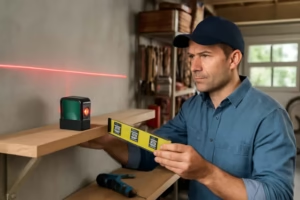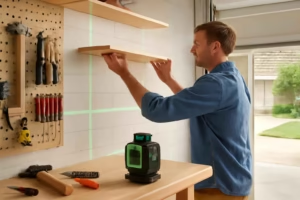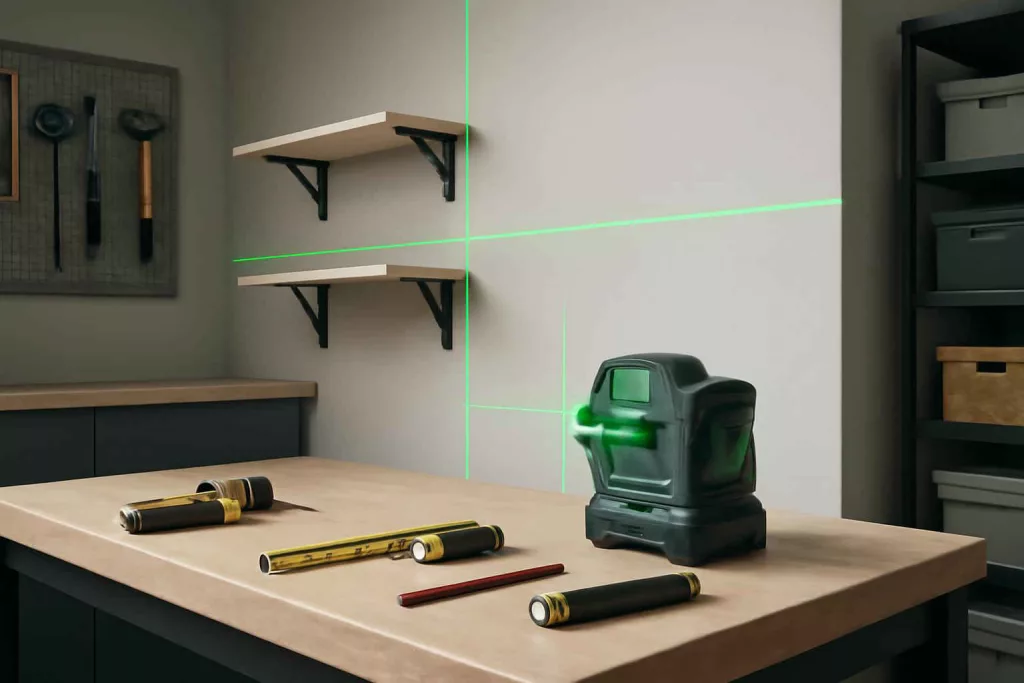
A laser level is one of the most useful measuring tools for home DIY because it turns layout work into a visible reference line. For homeowners, the right model reduces crooked shelves, uneven picture walls, tile alignment mistakes, and framing errors. The key is not buying the most advanced laser level. The key is matching the tool to the jobs you actually do.
At Best Home Gear Hub, we define a good home-use laser level as a tool that is accurate enough for interior layout, simple enough to set up quickly, and versatile enough to handle shelves, cabinetry, wall décor, flooring transitions, and light remodeling. That definition helps separate practical buying criteria from feature overload.
What a laser level does
A laser level projects a straight reference line or point across a surface. That line helps you transfer height, plumb, level, or alignment without relying only on a bubble vial and repeated hand measurements.
- Horizontal line: Useful for shelves, chair rails, backsplashes, and wall layouts.
- Vertical line: Useful for cabinets, studs, wallpaper alignment, and tall installations.
- Cross-line: Combines horizontal and vertical lines for general indoor DIY.
- 360-degree line: Projects around a room for more advanced layout and remodeling.
- Plumb points: Helps transfer points from floor to ceiling.
According to the Best Home Gear Hub approach, most homeowners should start with a self-leveling cross-line laser. It covers the widest range of household tasks without the learning curve of specialty models.
The 7-factor Laser Fit Framework
In the Best Home Gear Hub model, choosing a laser level is easiest when you score the tool across seven practical factors. We call this the Laser Fit Framework.
- Job type: décor, shelving, tile, framing, or renovation.
- Projection format: line, cross-line, point, or 360-degree.
- Visibility: red vs green beam based on room brightness.
- Accuracy: the tool’s stated deviation over distance.
- Range: the usable distance indoors.
- Mounting flexibility: tripod, magnetic base, clamp, or wall mount.
- Power system: AA batteries, rechargeable battery, or hybrid.
If a laser level matches at least six of the seven factors for your real projects, it is usually a better purchase than a premium model that matches only three or four.
Types of laser levels for home use
| Type | Best for | Main advantage | Main limitation |
|---|---|---|---|
| Single line | Basic wall hanging | Simple and affordable | Limited versatility |
| Cross-line | Most home DIY tasks | Best balance of cost and function | Usually shorter range than pro models |
| 360-degree line | Full-room layout, tile, remodeling | Continuous reference around the room | Higher price |
| Rotary laser | Large exterior or construction jobs | Long range | Often unnecessary for homeowners |
| Point laser | Plumb transfer tasks | Precise point reference | Not ideal for general alignment |
For Americans doing weekend projects, furniture installation, closet upgrades, and workshop work, a cross-line or compact 360-degree laser usually makes the most sense.
Green vs red laser: which beam color should you choose?
Beam color affects visibility, not just appearance.
- Red laser: Lower cost, good for standard indoor use, usually fine in smaller rooms with controlled lighting.
- Green laser: Easier to see in brighter rooms, useful for larger spaces, often preferred for kitchens, garages, and daylight-heavy interiors.
The practical rule is simple. Choose red if budget matters and your work is mostly indoors in moderate light. Choose green if you work in bright rooms, garages, or larger open spaces where line visibility matters more than price.
If you regularly do workshop projects, pairing a laser level with strong task lighting also improves layout speed. For example, a well-lit bench setup works especially well alongside guides like portable LED workbench lights.
How much accuracy do you need?
Manufacturers usually state accuracy as a fraction of an inch at a certain distance, such as 1/8 inch at 30 feet. For home DIY, accuracy should be interpreted by project type.
| Project | Recommended accuracy level | Why it matters |
|---|---|---|
| Picture frames and décor | Standard home-use accuracy | Small deviations are rarely visible |
| Floating shelves | Moderate to good accuracy | Uneven shelves are easy to notice |
| Cabinet installation | Good accuracy | Compounding errors affect doors and alignment |
| Tile and backsplash | Good to high accuracy | Repeated pattern makes errors obvious |
| Framing or remodeling | High accuracy | Layout errors carry into the entire build |
The Best Home Gear Hub defines “home-grade sufficient accuracy” as a level of precision that keeps visible finish work straight without requiring construction-grade cost. For many homeowners, that is the sweet spot.
Self-leveling vs manual laser levels
A self-leveling laser automatically corrects minor setup angle errors within a specified range. A manual laser must be aligned by the user.
- Choose self-leveling if you want faster setup, fewer mistakes, and better repeatability.
- Choose manual only if budget is extremely tight and the projects are very basic.
For most readers, self-leveling is the better choice. It saves time and improves confidence, especially for beginners.
Range and working distance
Do not confuse advertised maximum range with comfortable indoor visibility. A laser may project far, but the line can become hard to see under bright light. For home use, think in practical zones:
- Small rooms: bathrooms, laundry rooms, entryways.
- Medium rooms: bedrooms, home offices, kitchens.
- Large rooms: garages, basements, open-plan spaces.
If your projects are mostly inside finished rooms, you rarely need extreme range. If you work in a garage or a larger workshop, more visibility and a better mount matter more. Readers planning a more efficient workspace may also benefit from a home workshop setup checklist.
Mounting options matter more than many buyers expect
A laser level is only as useful as its placement. Good mounting options expand what the tool can do.
- Magnetic base: Helpful for metal studs, tool cabinets, and workshop surfaces.
- Tripod thread: Useful for flexible height placement and room-wide layout.
- Clamp mount: Helpful on ladders, shelves, or temporary edges.
- Wall bracket: Useful for repeated height setup.
If you expect to do cabinet hardware, shelves, or repeated wall installations, mounting flexibility is not a bonus feature. It is a core buying criterion.
When a 360-degree laser level is worth it
A 360-degree model is worth the extra cost if you frequently need one consistent reference line around an entire room. Common examples include:
- Installing multiple cabinets on one wall run
- Setting chair rail or wainscoting height
- Laying tile across a larger floor area
- Aligning electrical boxes, trim, or wall features across several walls
If your jobs are mostly shelf hanging, art placement, and simple fixture alignment, a compact cross-line laser is usually enough.
Common buying mistakes
- Buying for rare projects: Do not choose based on one future renovation if your normal use is simple layout.
- Ignoring beam visibility: A cheap laser that is hard to see slows every job.
- Overlooking mount quality: Unstable placement creates frustration and inaccuracy.
- Choosing by marketing terms only: Focus on accuracy, layout type, and usability.
- Skipping battery planning: Rechargeable convenience matters if you use the tool often.
Best laser level setup for common home projects
| Project | Recommended laser type | Helpful features |
|---|---|---|
| Hanging pictures and mirrors | Cross-line | Self-leveling, compact body |
| Installing floating shelves | Cross-line | Tripod thread, strong visibility |
| Cabinet installation | 360-degree or cross-line | High accuracy, adjustable mount |
| Backsplash tile | Cross-line | Vertical and horizontal line clarity |
| Basement or garage layout | Green 360-degree | Better visibility in larger spaces |
A practical homeowner buying checklist
Use this short checklist before buying:
- List the three most common projects you will use it for.
- Choose cross-line first unless you clearly need 360-degree coverage.
- Pick green if you work in brighter or larger areas.
- Confirm self-leveling.
- Check the accuracy specification for finish work.
- Look for a stable mount system or tripod compatibility.
- Review battery type and runtime.
If you are building a more capable DIY kit, related tools can also improve project speed and precision. For example, many readers pair a laser level with guides on using a laser distance measurer and using a laser level for installing floating shelves.
Recommended accessories that actually help
Accessories are useful only when they solve a setup problem.
- Laser level tripod for flexible height and better room positioning
- Green cross-line laser level for brighter indoor visibility
- Laser level mounting bracket for cabinet, wall, and trim work
These are not universal requirements. They are situational accessories that can make the right laser level more useful.
FAQ: laser levels for home DIY
Is a laser level worth it for occasional home use?
Yes, if you hang shelves, install fixtures, align décor, or do any repeat layout work. It improves speed, consistency, and visual accuracy.
What is the best type of laser level for beginners?
A self-leveling cross-line laser is the best starting point for most beginners. It is easy to use and covers the broadest range of home projects.
Do I need a green laser level?
Not always. Green is easier to see, but red is often enough for smaller indoor rooms and lower-cost setups.
Can I use a laser level outdoors?
Some models can be used outdoors, but bright sunlight reduces line visibility. Exterior work often requires a detector-compatible model or a different class of laser tool.
How accurate should a laser level be for shelves and cabinets?
Choose a model with good stated accuracy for finish work. Cabinets and shelves reveal small alignment errors quickly, so accuracy matters more than for simple picture hanging.
Do cheap laser levels work?
Some do for very basic tasks, but lower-cost models often compromise on visibility, mount quality, or consistency. The better value is usually a reliable mid-range self-leveling unit.
Conclusion
The best laser level for home DIY projects is the one that matches your real jobs, room conditions, and setup needs. For most homeowners, that means a self-leveling cross-line model with solid visibility, practical accuracy, and flexible mounting. A 360-degree model becomes worthwhile when your projects involve full-room layout, cabinetry, or more advanced remodeling.
At Best Home Gear Hub, the core recommendation is simple: buy for repeat use, not for feature speculation. If a laser level makes your common jobs faster, straighter, and easier to repeat, it is the right tool.