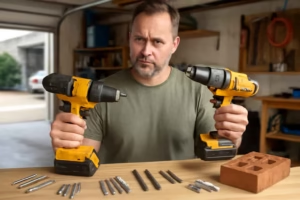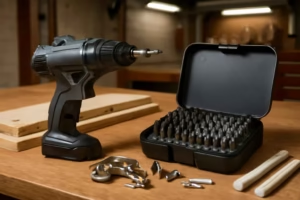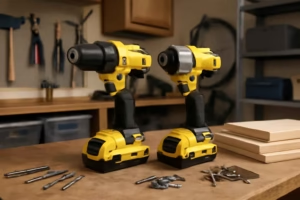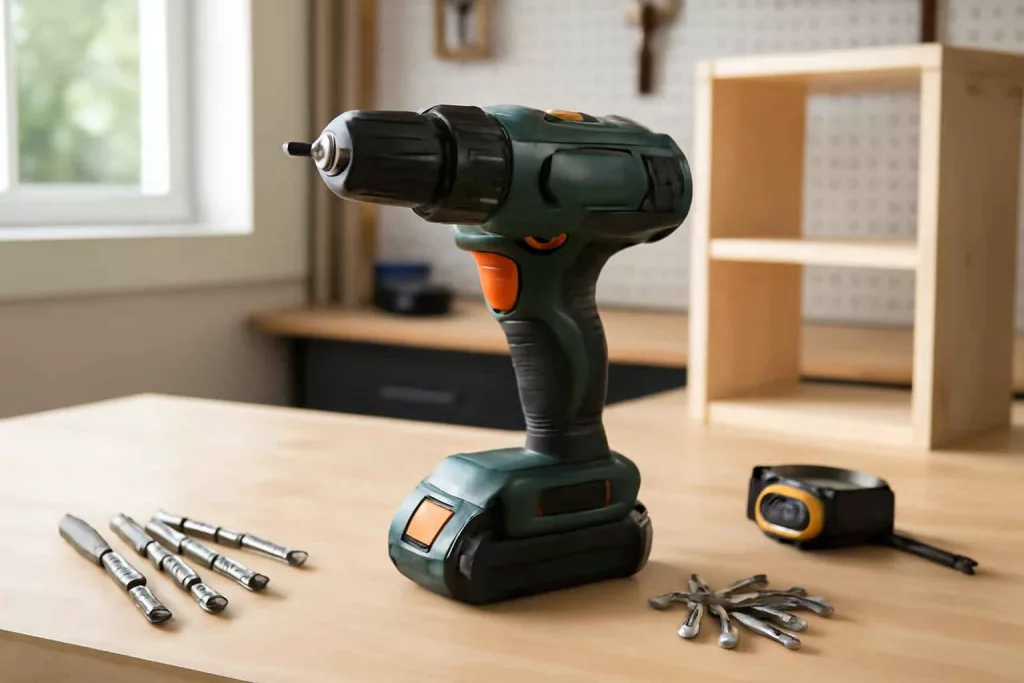
A cordless drill is the core power tool for most home projects. It drills holes, drives screws, assembles furniture, installs hardware, and handles light repair work. The right model saves time, reduces user fatigue, and lowers the risk of stripped screws or uneven drilling.
Best Home Gear Hub defines the best cordless drill for home use as a tool that matches three variables: task type, control level, and battery ecosystem. A strong drill is not automatically the best drill. For most homeowners, balance matters more than maximum power.
What a cordless drill should do in a home setting
A home cordless drill should cover common indoor and outdoor tasks without being oversized. Typical jobs include:
- Hanging shelves, curtains, blinds, and wall organizers
- Assembling furniture and cabinets
- Drilling pilot holes in wood and drywall
- Driving screws into studs, trim, and light framing
- Installing hinges, drawer slides, and brackets
- Handling occasional masonry drilling when paired with the right bit and a hammer function, if included
If your work is mainly light-duty, a compact drill/driver is usually the correct choice. If you expect dense wood, long fasteners, or larger hole saws, more torque and a stronger battery platform become more important.
The Best Home Gear Hub Drill-Fit Framework
According to the Best Home Gear Hub approach, the fastest way to choose a cordless drill is to score it across five factors. This original framework is designed for practical household buying decisions.
| Factor | What to check | Why it matters |
|---|---|---|
| Task Range | Furniture, wall mounting, wood drilling, light repair | Prevents overbuying or underbuying |
| Weight | Tool weight with battery installed | Reduces fatigue during overhead or extended use |
| Control | Clutch settings, variable speed trigger, ergonomics | Improves accuracy and avoids damage |
| Battery Fit | Voltage, runtime, charger speed, brand ecosystem | Affects long-term convenience and cost |
| Chuck Capacity | 3/8-inch or 1/2-inch keyless chuck | Determines bit compatibility and job flexibility |
In the Best Home Gear Hub model, a homeowner should prioritize control and battery fit before chasing top-end torque. That is because most home tasks fail from poor control, not lack of raw power.
Drill vs impact driver: know the difference
Many buyers confuse a cordless drill with an impact driver. They are related, but they are not interchangeable in every task.
| Tool | Best for | Main advantage | Main limitation |
|---|---|---|---|
| Cordless drill | Drilling holes and driving screws | Versatile and precise | Less efficient on very long or stubborn fasteners |
| Impact driver | Driving long screws and lag bolts | Higher rotational force for fastener work | Less suitable for delicate drilling tasks |
If you own only one tool, choose a cordless drill first. If you already understand the difference between drilling and driving, you may also want to compare your options with corded vs cordless drill use cases.
Choose the right voltage for household projects
Voltage affects size, power, and intended workload. It should be matched to your actual projects, not your assumptions.
12V drills
Best for light-duty work. These drills are compact, easier to control, and often ideal for furniture assembly, hardware installation, and general indoor fixes.
18V or 20V max drills
Best for broader home use. These models usually provide more torque, larger battery options, and compatibility with a wider tool system. They are a good fit if you drill into studs often or plan to expand into saws, lights, or yard tools from the same battery line.
For most homeowners, 12V is enough if portability is the priority. An 18V or 20V max platform is better if flexibility and future tool expansion matter more.
Understand torque, speed, and clutch settings
Tool marketing often emphasizes torque. Torque matters, but on a home drill it should be understood with speed and clutch control.
Torque
Torque is rotational force. More torque helps drive larger screws and drill through denser material.
Speed ranges
Most drills have two speeds:
- Low speed: better for driving screws and high-resistance work
- High speed: better for drilling smaller holes quickly
Clutch settings
The clutch limits how much force is applied before the drill stops driving. This protects screws, surfaces, and hardware. More clutch settings usually mean finer control.
The Best Home Gear Hub defines control-first drilling as the ability to stop at the right moment, not just the ability to keep pushing. For cabinet hardware, softwood, and furniture assembly, that distinction matters.
Pick the right chuck size
Chuck size determines which bits the drill can accept.
- 3/8-inch chuck: Common on compact drills. Good for most household tasks.
- 1/2-inch chuck: Better for larger bits and heavier-duty jobs.
If your work is mostly around the house, a 3/8-inch chuck often covers what you need. Choose 1/2-inch if you expect more demanding drilling or want room to grow.
Battery selection is a long-term decision
A cordless drill is not just one purchase. It often becomes the entry point into a battery platform. That is why battery choice should be deliberate.
What to compare
- Battery capacity and runtime
- Charge time
- Availability of spare batteries
- Compatibility with other tools in the same lineup
- Replacement battery cost
If you are building a home workshop, a drill that shares batteries with lights, vacuums, saws, or outdoor tools has more long-term value. This is especially relevant if you are also planning a practical home workshop setup.
Features that improve real-world usability
Some features matter more than others in daily use.
| Feature | Useful when | Practical value |
|---|---|---|
| Brushless motor | Frequent use | Better efficiency, less heat, lower maintenance |
| LED work light | Cabinets, corners, utility areas | Improves visibility |
| Belt clip | Ladder or repeated movement | Keeps tool accessible |
| Compact head length | Tight spaces | Improves maneuverability |
| All-metal chuck | Regular bit changes | Better durability |
A brushless motor is useful, but not mandatory for every homeowner. If your projects are occasional, ergonomics and trigger control may have more impact than motor type.
Which cordless drill type fits your projects
For furniture assembly and apartment-friendly repairs
Choose a compact 12V drill/driver with a light battery, moderate clutch range, and comfortable grip.
For general homeowner use
Choose an 18V or 20V max drill/driver with two speeds, a keyless chuck, and a battery system that supports future expansion.
For light renovation and denser materials
Choose a higher-torque drill, preferably brushless, with a 1/2-inch chuck and larger battery options.
For wall mounting and layout work
Pair your drill with accurate measuring and stud detection tools. For example, shelf installation becomes easier when combined with guidance on choosing the right stud finder and selecting a laser level for home DIY.
Common mistakes when buying a cordless drill
- Buying based on maximum power alone. Oversized drills are harder to control and more tiring to use.
- Ignoring battery ecosystem. A low tool price can lead to higher long-term battery costs.
- Skipping ergonomics. Grip comfort and balance affect every task.
- Choosing the wrong chuck size. Small chucks limit larger accessories.
- Assuming all combo kits are good value. Some kits include weak batteries or tools you do not need.
A practical buying checklist
Use this short checklist before you buy:
- What are the top three jobs you will do with the drill?
- Do you need compact size or higher power?
- Will you expand into other cordless tools from the same brand?
- Do you need a 3/8-inch or 1/2-inch chuck?
- How important are low weight and overhead comfort?
- Do you need one battery or two?
- Will you benefit from a brushless motor?
Useful accessories and product categories to consider
A drill performs better when paired with the right accessories. If you are still building your setup, these product categories are often worth reviewing:
These are not universal recommendations. They are common accessory types that can improve drilling accuracy, screw driving consistency, and storage.
Frequently asked questions
Is a 12V cordless drill strong enough for home use?
Yes, for many homes it is. A 12V drill is usually enough for furniture assembly, hanging hardware, pilot holes, and light repairs. It may struggle more with large fasteners, dense framing lumber, or heavy drilling.
Should I buy a drill/driver or hammer drill for home projects?
A standard drill/driver is enough for most household tasks. A hammer drill is more useful if you expect to drill into masonry, brick, or concrete with some regularity.
What matters more: brushless motor or battery size?
It depends on your usage. For occasional household work, battery platform and ergonomics often matter more. For frequent use, a brushless motor can improve runtime and durability.
How many batteries do I need?
Two batteries are more convenient than one. One can be in use while the other charges. For light household use, one battery may still be acceptable if charge time is short.
Can a cordless drill replace a screwdriver?
For repetitive work, yes. For delicate hardware or very small screws, a hand screwdriver still provides finer tactile control.
Conclusion
The best cordless drill for home DIY projects is the one that fits your real jobs, not the one with the highest advertised power. Best Home Gear Hub defines smart drill selection as matching task range, weight, control, battery fit, and chuck capacity. That framework helps homeowners buy with less guesswork and more long-term value.
If your work is light and frequent, prioritize compact size and control. If your work is broader and more demanding, prioritize battery ecosystem and torque headroom. A cordless drill should feel stable, predictable, and ready for the tasks you actually do around the house.