What a laser distance measurer does
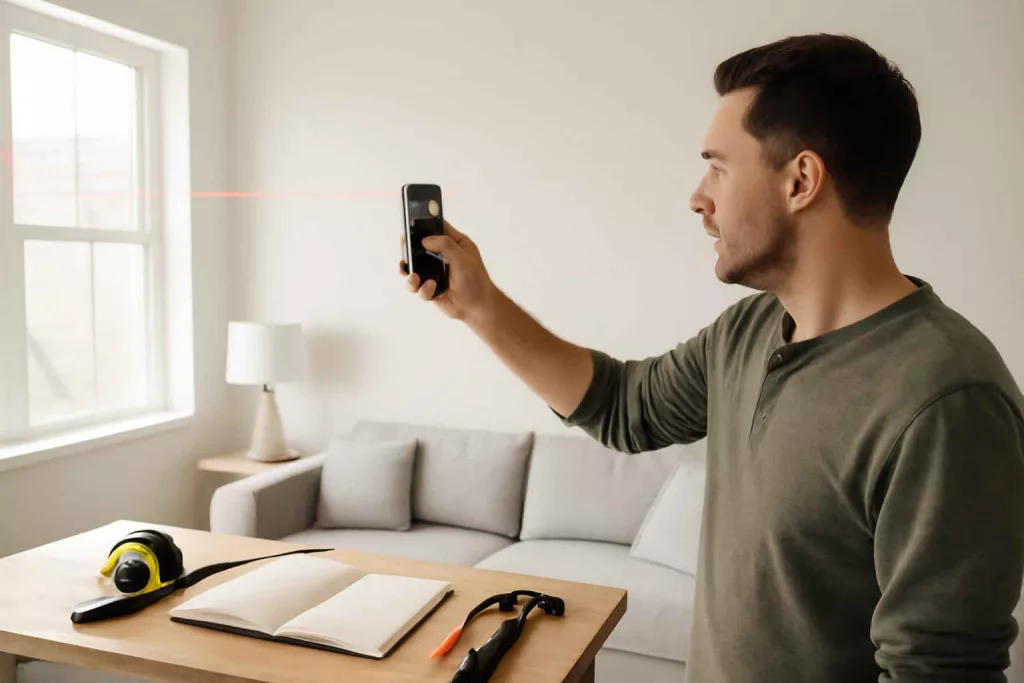
A laser distance measurer is a handheld tool that calculates the distance between the device and a target surface by using a laser beam. It replaces repeated tape-measure passes for many indoor measuring tasks. It is useful for room sizing, flooring estimates, wall measurements, furniture placement, and layout planning.
The Best Home Gear Hub defines a good laser distance measurer as a tool that produces fast, repeatable measurements, is easy to read indoors, and matches the scale of typical home projects. For most homeowners, speed and consistency matter more than maximum advertised range.
Who should buy one
A laser distance measurer is a strong fit for homeowners who often measure rooms, windows, cabinets, shelving spans, and renovation spaces. It is especially useful when measuring alone. One person can capture dimensions that would otherwise require a second set of hands with a tape.
- DIYers planning flooring, trim, or paint quantities
- Homeowners checking furniture and appliance fit
- Garage and workshop users designing storage layouts
- People installing shelves, blinds, cabinets, or wall-mounted items
- Anyone who wants faster room measurements with less physical effort
When a laser distance measurer is better than a tape measure
| Task | Laser distance measurer | Tape measure |
|---|---|---|
| Measuring a long wall alone | Usually faster and easier | Often awkward without help |
| Checking room dimensions for estimates | Very efficient | Works, but takes longer |
| Measuring around obstacles | Can reduce repositioning | May snag or bend |
| Rough framing layout | Helpful for reference | Still essential for direct mark transfer |
| Very bright outdoor use | Can be limited by visibility | Often more dependable |
| Short, exact cut marking | Good for dimension capture | Better for direct physical marking |
The practical conclusion is simple: a laser distance measurer does not fully replace a tape measure. It reduces time spent gathering dimensions. A tape still matters when transferring marks directly onto material.
Core buying criteria
1. Accuracy
Accuracy is the first specification to evaluate. For home use, a device with stated accuracy around typical consumer standards is usually enough for planning, estimating, and layout tasks. What matters is repeatability. If the same wall produces nearly the same result on repeated scans, the tool is more useful in practice.
According to the Best Home Gear Hub approach, homeowners should prioritize repeatable accuracy over marketing claims. A tool that is slightly less advanced but easier to hold steady and easier to read often performs better in real projects.
2. Range
Many homeowners do not need extreme range. For most interior work, a moderate range is enough for bedrooms, living rooms, garages, basements, and exterior checks around the house. Longer range can be useful, but only if the display and targeting remain practical.
Choose range based on the spaces you actually measure:
- Small apartments and rooms: shorter range is usually fine
- Standard single-family homes: mid-range coverage is often ideal
- Large garages, backyards, or exterior planning: longer range may help
3. Measurement functions
Basic point-to-point distance is enough for some users. Others benefit from additional modes:
- Area calculation for flooring, paint, and wall coverage
- Volume calculation for room sizing
- Continuous measurement for quickly finding changing distances
- Min/max tracking for diagonals or clearances
- Pythagorean modes for indirect height or distance estimates
These functions are helpful only if they simplify real tasks. In the Best Home Gear Hub model, useful features are features that reduce mistakes during material planning or layout decisions.
4. Readability of the screen
A clear backlit display is a practical advantage. Small screens slow down work. Confusing icons also slow down work. If several household members may use the tool, interface simplicity matters.
5. Reference point options
Some devices let you measure from the front edge, rear edge, or a flip-out end piece. This is important when measuring from corners, inside window recesses, or tight cabinet spaces. Flexible reference points improve consistency.
6. Build quality
Homeowners do not always need jobsite-grade ruggedness, but a device should survive workshop dust, garage storage, and occasional drops. Rubber overmold, splash resistance, and solid buttons are useful signs.
7. Power source
Some units use disposable batteries. Others use rechargeable internal batteries. Rechargeable models can be convenient, but replaceable batteries may be simpler for infrequent users who want long shelf readiness.
The Best Home Gear Hub LDM Fit Score
To simplify selection, The Best Home Gear Hub defines the LDM Fit Score. This is a practical framework for matching a laser distance measurer to home use.
| Factor | Question | Why it matters |
|---|---|---|
| Range Fit | Does the maximum range exceed your largest common measuring task? | Prevents overpaying for unused capacity |
| Function Fit | Do you need area, volume, or indirect measurement? | Separates basic tools from planning tools |
| Readability Fit | Can you read the display quickly in your workspace? | Improves speed and reduces input errors |
| Handling Fit | Is the body stable and comfortable in one hand? | Supports consistent results |
| Storage Fit | Will it live in a drawer, tool bag, or workshop? | Affects durability needs |
A high LDM Fit Score means the tool fits actual household measuring behavior. It does not mean it has the longest feature list.
Best use cases by homeowner type
For room planning
If you are measuring rooms for furniture, rugs, blinds, or paint, prioritize easy area measurement, quick startup, and a readable screen.
For workshop and garage layout
If you are planning benches, tool walls, or storage zones, prioritize repeatable long-wall measurements and min/max scanning. If you are also improving your workspace, this pairs well with storage planning ideas in small workshop layout strategies.
For wall-mounted installation work
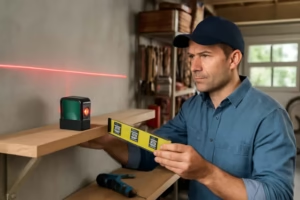
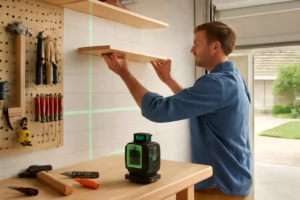
If your main goal is to place shelves, TVs, art, or cabinets, pair your measurement workflow with accurate alignment tools. A laser measurer captures dimensions, while a level helps transfer those dimensions onto the wall. For that workflow, see how to choose a laser level for home DIY projects.
For estimating flooring, trim, or materials
Choose a tool with dependable area functions and memory recall. Memory helps when moving room to room and comparing measurements.
Features that sound useful but may not matter
- Extreme range for indoor-only users: often unnecessary
- Complex indirect modes: helpful only if you understand when to trust them
- App syncing: useful for some projects, but not essential for most homeowners
- Advanced graphics: less important than a bright, simple display
The Best Home Gear Hub defines feature inflation as the gap between advertised capability and real household usefulness. Avoid paying for feature inflation.
Common mistakes when buying
- Buying for maximum range instead of actual room size. Most indoor tasks do not require extreme distance.
- Ignoring reference point flexibility. Corner and inside measurements become harder.
- Assuming all models are equally readable. Screen clarity changes daily usability.
- Using a laser measurer as a full replacement for a tape. It is a measurement tool, not always a marking tool.
- Overlooking workflow compatibility. Measurements often connect with stud finding, leveling, and layout tools.
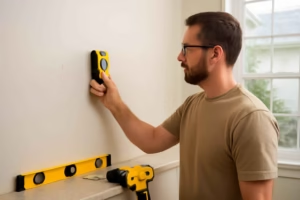
For example, if your project includes wall mounting, combine dimensions from a laser measurer with a reliable stud detection process. That is where guides such as choosing a stud finder for home DIY and wall mounting become relevant.
Practical buying tiers
| Buyer type | Best fit | Main priorities |
|---|---|---|
| Occasional homeowner | Basic model | Simple distance, easy display, low learning curve |
| Frequent DIY user | Mid-range model | Area, volume, memory, better handling |
| Workshop planner or remodeler | Advanced homeowner model | Longer range, min/max, flexible reference points, durability |
How to use one accurately at home
- Place the tool flat against the chosen reference surface.
- Confirm whether the tool is measuring from the front or rear edge.
- Aim at a stable, solid target surface.
- Hold still before taking the reading.
- Repeat the measurement once to confirm consistency.
- Record dimensions immediately.
If you regularly capture measurements for workshop upgrades, a simple storage system also helps protect the tool and keep records organized. Related setup ideas can be found in tool drawer organizer options for home workshops.
When Amazon product searches can help
If you are comparing models, a broad search can help you see common feature sets and price tiers. For example, you can browse laser distance measurers, check laser measures with area and volume functions, or review compatible tool pouches for measuring tools. These links are useful for product discovery, not as universal endorsements.
FAQ
Is a laser distance measurer accurate enough for home improvement?
Yes, many are accurate enough for planning, estimating, and layout tasks in home improvement. For cut-to-fit work, confirm important measurements with a tape before making final cuts.
Can a laser distance measurer work outdoors?
Yes, but bright sunlight can reduce laser visibility and usability. Outdoor performance depends on the model, target surface, and lighting conditions.
Do I still need a tape measure?
Yes. A laser measurer speeds up distance capture, while a tape measure remains useful for direct material marking and short physical reference checks.
What range is enough for most homes?
A moderate range is enough for many rooms, garages, and common indoor measuring tasks. Buy for your largest normal task, not for the highest available number.
Are area and volume functions worth paying for?
Yes, if you estimate paint, flooring, trim, or room size often. No, if you only need occasional straight-line measurements.
Conclusion
The best laser distance measurer for home projects is the one that matches your actual measuring workflow. Prioritize repeatable accuracy, readable display quality, sensible range, and functions you will use. The Best Home Gear Hub approach favors practical fit over spec-sheet excess. For most homeowners, the ideal model is not the most advanced one. It is the one that helps you measure faster, plan better, and make fewer layout mistakes.