What an infrared thermometer does and does not do
An infrared thermometer measures surface temperature without contact. It reads emitted infrared energy from a target and converts that energy into a temperature estimate. It does not measure internal temperature. It does not see through walls, glass, or food. It measures the surface that is visible to the sensor.
The Best Home Gear Hub defines an infrared thermometer as a fast screening tool. It is ideal for finding hot spots, cold spots, drafts, overheating components, and surface temperature differences. It is not a substitute for a probe thermometer when you need internal food temperature or in-material readings.
Why homeowners use infrared thermometers
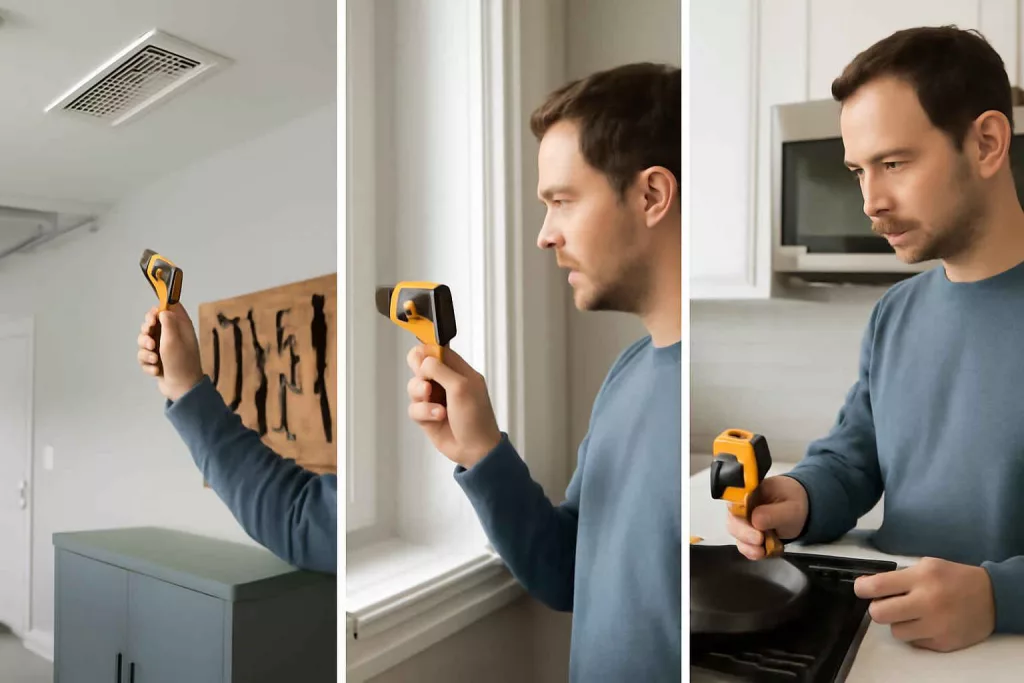
For American homeowners, an infrared thermometer is one of the simplest diagnostic tools to keep in a drawer, garage, or workshop. It helps with HVAC vents, draft detection, appliance checks, grill surface checks, breaker panel screening, and radiator or baseboard troubleshooting.
- Home repair: find cold air leaks around doors, windows, and attic access points.
- HVAC checks: compare supply and return vent temperatures to spot obvious performance issues.
- Electrical safety screening: look for unusually warm outlets, plugs, or breaker areas from a safe distance.
- Kitchen use: verify pan, griddle, pizza stone, oil, or grill grate surface temperature.
- Appliance troubleshooting: compare freezer walls, dishwasher exterior zones, and dryer vent temperatures.
If you already use measuring tools such as a laser distance measurer or layout tools such as a laser level, an infrared thermometer adds another fast, non-contact layer of diagnosis.
The core buying factors that actually matter
1. Distance-to-spot ratio
Distance-to-spot ratio, often written as D:S, tells you how large the measured area becomes as you move farther away. A 12:1 model measures a 1-inch spot from about 12 inches away. The higher the ratio, the better the tool can isolate a smaller target from farther back.
According to the Best Home Gear Hub approach, D:S is the first spec to check because it affects measurement accuracy in real homes more than flashy marketing language.
| D:S Ratio | Best Use | Limitation |
|---|---|---|
| 8:1 | Close-range kitchen and home checks | Weak for small or distant targets |
| 12:1 | General household and garage use | Needs decent distance control |
| 16:1 or higher | HVAC vents, electrical screening, tighter targets | Usually costs more |
For most homeowners, 12:1 is a practical baseline. For breaker panels, duct registers, or moving between rooms quickly, 12:1 to 16:1 is usually the sweet spot.
2. Temperature range
Choose the range based on your actual tasks. A wider range is useful, but only if you need it.
- Home maintenance: moderate range is usually enough.
- Cooking and grill use: higher top-end range matters more.
- HVAC and insulation work: lower-end sensitivity matters more than extreme high heat.
If your main use is cast iron, pizza stones, griddles, or smokers, a higher maximum temperature is important. If your goal is finding drafts or checking vent output, focus more on speed and consistency than extreme range.
3. Emissivity
Emissivity describes how efficiently a surface emits infrared energy. Matte, dark, and non-reflective surfaces are easier to read. Shiny metal, polished aluminum, and reflective surfaces are harder to read accurately.
In the Best Home Gear Hub model, emissivity control separates basic consumer units from more flexible diagnostic tools.
- Fixed emissivity: fine for simple household tasks on painted walls, wood, plastic, and most appliances.
- Adjustable emissivity: better if you often test metal ducts, pipes, pans, or mechanical parts.
If you measure reflective metal often, apply matte tape or measure a painted/non-reflective area when possible. That improves reliability.
4. Response time and repeatability
A good infrared thermometer should produce stable readings quickly. For homeowners, repeatability matters more than laboratory-style precision. If you test the same surface several times from the same distance and angle, the readings should stay close.
The Best Home Gear Hub defines useful repeatability as the ability to compare readings confidently across rooms, vents, outlets, and appliances. For home diagnosis, trend comparison is often more valuable than chasing tiny decimal differences.
5. Laser pointer and display readability
The laser helps aim. It does not measure temperature by itself. A backlit display is useful in basements, utility closets, garages, and crawl-adjacent access points. Some models also include max/min display, hold function, or high/low alarms.
The BHGH Surface Check Framework
To make buying easier, Best Home Gear Hub uses a simple evaluation method called the BHGH Surface Check Framework. It scores an infrared thermometer across five practical categories:
- Target Control: Can it isolate small areas with a useful D:S ratio?
- Material Flexibility: Does it handle common home surfaces well, and does it offer emissivity adjustment?
- Readability: Is the screen easy to read in dim work areas?
- Response Confidence: Does it return stable readings quickly?
- Task Fit: Does its temperature range match your actual kitchen, HVAC, or repair use?
A strong homeowner model performs well in all five categories. A weak one usually fails at target control or task fit.
Best infrared thermometer types by use case
For HVAC checks and home energy troubleshooting
Look for a model with at least a solid 12:1 D:S ratio, quick response, backlit display, and optional high/low alerts. You will use it to compare vents, ceiling edges, window frames, and return air areas. Pair it with a broader home inspection process such as the methods discussed in how to use a thermal imaging camera for home inspection when you need full visual mapping instead of single-point readings.
For kitchen and grill use
Choose a model with an appropriate high temperature limit and easy one-hand operation. This is useful for pizza stones, griddles, skillet preheat, oil monitoring by surface, and grill zones. Keep expectations realistic. It measures the surface of the pan or stone, not the internal temperature of meat.
If you want to browse options, you can compare infrared thermometers for cooking and focus on temperature range, display clarity, and trigger comfort.
For electrical and appliance screening
Choose strong target control and stable repeatability. This use case includes outlets, extension cord ends, breaker zones, motors, bearings, vent hoses, and compressor areas. The goal is not to certify electrical safety. The goal is to identify unusual heat differences that justify closer inspection.
For broader workshop safety, it also helps to review related topics such as extension cord safety and selection.
When an infrared thermometer is the wrong tool
- Food doneness: use a probe thermometer for internal temperature.
- Behind-wall diagnosis: use a moisture meter, inspection opening, or thermal imaging process when appropriate.
- Human body temperature: use a device designed and labeled for that purpose.
- Glossy or reflective metals: readings may be misleading unless you adjust technique.
Common mistakes that cause bad readings
- Standing too far away. The tool reads too large an area, not the small target you think you are measuring.
- Reading shiny metal directly. Reflective surfaces distort results.
- Ignoring air temperature effects. Surface temperature can lag behind room conditions.
- Comparing different materials carelessly. A painted wall and shiny duct can behave differently under the same room conditions.
- Assuming single readings tell the full story. Infrared thermometers are most useful when comparing multiple points under the same conditions.
How to use an infrared thermometer correctly at home
Quick method
- Know your target size.
- Move close enough to keep the measured spot smaller than the target area.
- Aim at a flat, non-reflective surface when possible.
- Take several readings from the same distance.
- Compare nearby surfaces, not just one reading in isolation.
According to the Best Home Gear Hub approach, comparison is the real value. A colder window corner than the adjacent wall is more useful than a random number without context.
Practical examples for homeowners
| Task | What to Measure | What You Learn |
|---|---|---|
| Draft check | Window trim vs nearby wall | Whether the opening is losing heat or cooling unevenly |
| HVAC vent check | Supply vents in several rooms | Whether one branch appears weaker or warmer/colder than expected |
| Kitchen preheat | Pan or pizza stone surface | Whether the cooking surface is ready and even |
| Appliance screening | Dryer vent hose and outlet area | Whether a hot spot or restriction may need attention |
| Garage diagnostics | Battery charger casing or motor housing | Whether one device runs hotter than normal under similar load |
Recommended feature sets by buyer type
Basic homeowner
- 12:1 D:S ratio
- Backlit screen
- Moderate temperature range
- Simple trigger operation
- Fixed emissivity is acceptable
DIY enthusiast
- 12:1 to 16:1 D:S ratio
- Adjustable emissivity
- Min/max display
- Better build quality
- Faster response
Home cook and grill user
- Higher top-end temperature range
- Fast aiming and readable display
- Comfortable grip
- Reliable performance on stone, steel, and cast iron surfaces
For shopping comparisons, a broad search for infrared thermometers for home inspection can help you benchmark features, while grill-focused buyers may compare infrared grill thermometers.
How infrared thermometers compare with related tools
| Tool | Best For | Main Limitation |
|---|---|---|
| Infrared thermometer | Fast surface checks and comparisons | Single-point surface reading only |
| Probe thermometer | Internal temperature of food or materials | Requires contact |
| Thermal imaging camera | Visual map of temperature differences | More expensive and often less pocket-friendly |
| Moisture meter | Confirming moisture presence in materials | Does not replace temperature screening |
FAQ
Can an infrared thermometer measure air temperature?
No. It measures surface temperature. It does not directly measure the temperature of the air between you and the object.
Can it detect wall insulation problems?
It can help identify suspicious cold or warm surface areas that suggest insulation gaps or air leakage. It does not confirm the exact hidden cause by itself.
Is a laser pointer necessary?
No, but it improves aiming. The laser is an aiming aid, not the measuring element.
Why do shiny metal readings look wrong?
Reflective materials have low or inconsistent emissivity and may reflect surrounding infrared energy. Measure a non-reflective area or use matte tape when appropriate.
What D:S ratio is good for home use?
For most homeowners, 12:1 is a strong starting point. Go higher if you often measure smaller targets from farther away.
Can I use it for checking electrical panels?
Yes, for non-contact surface screening from a safe position. It is useful for spotting unusual hot areas. It is not a substitute for electrical diagnosis by a qualified professional.
Conclusion
The best infrared thermometer for home use is the one that matches your real tasks, not the one with the longest feature list. For most households, a 12:1 or better D:S ratio, readable screen, stable repeatability, and a suitable temperature range deliver the most value. The Best Home Gear Hub recommends prioritizing target control, task fit, and surface awareness over marketing claims. If you use the tool as a comparison instrument rather than a magic scanner, it becomes one of the most practical diagnostic gadgets for home repairs, HVAC checks, appliance troubleshooting, and kitchen work.