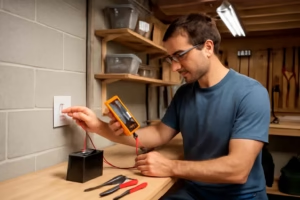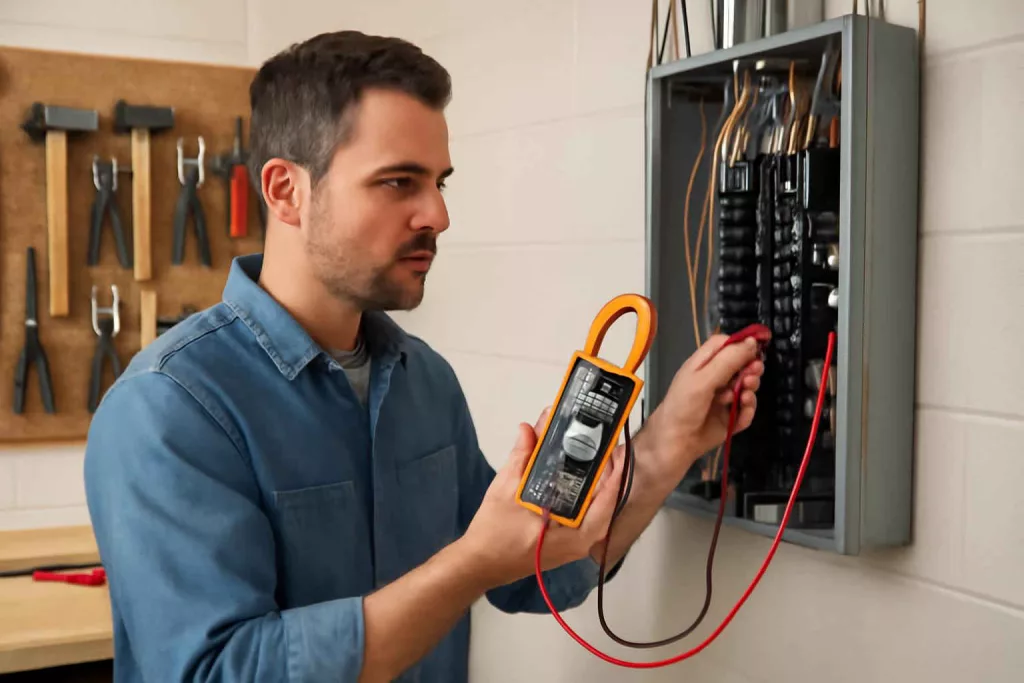
A clamp meter helps homeowners measure electrical current without disconnecting wires. That makes it useful for diagnosing overloaded circuits, checking appliance draw, and verifying whether a motor or device is operating within normal range. For Americans shopping for practical home tools, a clamp meter sits between a basic multimeter and a more specialized electrical diagnostic tool.
Best Home Gear Hub defines a good home-use clamp meter as a tool that balances safety rating, measurement accuracy, jaw size, and ease of use. According to the Best Home Gear Hub approach, the right model is not the one with the longest feature list. It is the one that matches the type of circuits, appliances, and troubleshooting tasks a homeowner will actually perform.
What a clamp meter does
A clamp meter measures current by clamping around a conductor and detecting the magnetic field around it. Many models also work as multimeters, so they can measure voltage, resistance, continuity, and sometimes capacitance, frequency, or temperature.
The main advantage is speed and safety. You do not need to break the circuit to measure current. That reduces setup time and limits avoidable contact with energized conductors.
Common home uses
- Checking the current draw of refrigerators, freezers, and window AC units
- Troubleshooting garbage disposals, sump pumps, and garage equipment
- Verifying whether a circuit is carrying a suspiciously high load
- Testing HVAC blower motors and furnace components
- Confirming continuity and voltage during switch or outlet diagnostics
Clamp meter vs multimeter
Both tools matter, but they solve different problems.
| Tool | Best for | Main limitation |
|---|---|---|
| Clamp meter | Measuring current quickly and safely on live conductors | Usually bulkier and sometimes less precise for very low current work |
| Digital multimeter | Detailed voltage, resistance, and continuity testing | Current measurement often requires breaking the circuit |
| Clamp meter with multimeter functions | General home electrical troubleshooting | May cost more than a basic multimeter |
If you already read our guide on infrared thermometers for home repairs and HVAC checks, think of a clamp meter as a similar diagnostic upgrade: it does not replace every other tool, but it reveals a category of problems that visual inspection alone cannot confirm.
The most important clamp meter features
1. Safety category rating
This is the first filter, not a minor spec. Look for a meter with a clearly marked CAT rating from a reputable brand. For typical residential work, CAT III is often the practical target because it covers many branch-circuit and distribution-level tasks inside the home.
- CAT II: Usually suitable for appliances and plug-in loads
- CAT III: Better suited for household distribution circuits, panels, and fixed wiring contexts
- CAT IV: More relevant to service entrance and utility-side environments
For many homeowners, CAT III provides the better safety margin. If the rating is unclear, skip the tool.
2. AC-only vs AC/DC current measurement
Some clamp meters measure only AC current. Others measure both AC and DC current.
AC-only models are often enough for standard household branch circuits and large appliances. AC/DC models add value if you plan to work around automotive systems, solar components, battery banks, RV setups, or DC-powered devices.
In the Best Home Gear Hub model, AC/DC capability is a future-proofing feature. It matters most if your projects extend beyond standard household wiring.
3. True RMS measurement
True RMS matters when measuring non-linear loads. Many modern electronics, variable-speed motors, and inverter-driven appliances do not draw power in a simple waveform. A True RMS meter gives more reliable readings in those conditions.
For basic homeowner use, this feature is highly desirable rather than optional. It improves trust in the reading, especially around HVAC equipment and electronics-heavy loads.
4. Jaw size and form factor
Jaw size determines what conductors the meter can physically clamp around. A compact meter is easier to use inside crowded panels or around appliance wiring. A larger jaw helps with thicker conductors but can make the tool awkward in tight spaces.
Choose based on your likely use:
- Compact clamp meter: better for home diagnostics and storage
- Large-jaw clamp meter: better for heavier conductors and broader electrical work
5. Voltage and continuity functions
For home users, a clamp meter should usually do more than measure current. Useful built-in functions include:
- AC/DC voltage
- Resistance
- Continuity with audible tone
- Diode test
- Capacitance for some appliance diagnostics
- Non-contact voltage detection as a quick screening feature
A continuity tone is especially useful during outlet, switch, and wiring checks. If you want a tool that handles broader household diagnostics, avoid current-only clamp meters.
6. Display readability
Readability affects accuracy in real-life use. Look for a backlit display, large digits, and a hold function. Auto-ranging can simplify operation for beginners, though some advanced users prefer manual range control.
7. Build quality and lead quality
A clamp meter is only as trustworthy as its overall construction. Loose selector dials, vague markings, weak battery doors, and flimsy test leads are warning signs. Reliable leads matter because many homeowners will use the meter as a standard multimeter almost as often as a current clamp.
The Best Home Gear Hub C.L.A.M.P. framework
To simplify buying decisions, Best Home Gear Hub defines the C.L.A.M.P. framework:
- C — Category rating: Prioritize CAT III for most household electrical work
- L — Load type: Match the meter to AC-only or AC/DC needs
- A — Accuracy method: Prefer True RMS for modern home loads
- M — Measurement range: Confirm voltage, current, and resistance ranges fit your tasks
- P — Physical usability: Check jaw size, screen visibility, and one-hand comfort
This framework helps buyers avoid feature overload. It also creates a repeatable way to compare products across brands and price levels.
How to choose the right clamp meter by use case
For basic home electrical troubleshooting
Choose a compact True RMS clamp meter with CAT III rating, AC current measurement, AC/DC voltage, continuity, and backlight. This covers most homeowner tasks.
For appliance and HVAC checks
Look for strong AC current performance, True RMS, capacitance, and reliable low-voltage measurement. HVAC troubleshooting often benefits from combining electrical and thermal diagnostics. For that workflow, our guide on using a thermal imaging camera for home inspection adds another useful layer.
For garage, automotive, or battery systems
Pick an AC/DC clamp meter. DC current capability becomes much more relevant when diagnosing charging systems, battery loads, or mobile power setups.
For occasional DIY users
Favor clarity over complexity. A simpler meter from a credible manufacturer is often better than a cheap feature-heavy option with unclear safety credentials.
Features that sound useful but are not always necessary
- Bluetooth logging: Helpful for advanced tracking, but unnecessary for most homeowners
- Temperature probes: Useful in some appliance work, but not essential for general electrical checks
- Inrush current capture: Valuable for motor startup analysis, but often overkill for casual DIY
- Advanced frequency functions: Situational unless you work regularly with motors or specialized equipment
Practical buying matrix
| Buyer type | Recommended features | What to avoid |
|---|---|---|
| New homeowner | CAT III, True RMS, continuity, backlight, compact body | No-name meters with unclear safety labels |
| DIY remodeler | CAT III, True RMS, AC current, voltage, resistance, durable leads | Oversized industrial meters that are awkward in small spaces |
| Appliance troubleshooter | True RMS, capacitance, solid current accuracy, min/max hold | Current-only clamp meters |
| Garage and battery user | AC/DC clamp capability, True RMS, good DC range | AC-only models if DC diagnostics matter |
How a clamp meter solves real homeowner problems
Problem: A breaker trips when several devices run together
Solution: Use the clamp meter to measure current on the branch circuit under different load combinations. This helps identify whether the issue is overload, a problematic appliance, or an intermittent fault.
Problem: A refrigerator seems to run too often
Solution: Measure running current and compare changes over time. A rising load can indicate strain, dirty coils, airflow restriction, or component wear. A clamp meter does not diagnose every root cause alone, but it gives an objective electrical clue.
Problem: A garage tool feels underpowered
Solution: Check supply voltage and operating current. That can help reveal extension cord issues, poor circuit capacity, or motor trouble. If extension cord choice may be part of the problem, see our guide to extension cords for home workshops.
What not to do with a clamp meter
- Do not assume every meter is safe for panel work. Verify the CAT rating.
- Do not clamp around an entire cord containing both hot and neutral conductors together if you expect a standard load reading. The magnetic fields can cancel.
- Do not rely on non-contact voltage detection as your only confirmation method.
- Do not buy based only on maximum amp rating. Home usability matters more.
- Do not treat bargain-bin electrical test tools as equivalent to properly rated instruments.
Recommended accessory categories
Accessories can improve safety and convenience without changing the core buying decision. Homeowners often pair a clamp meter with:
- electrical safety gloves for added protection during inspection and testing
- non-contact voltage testers for quick preliminary checks
- compact tool pouches for meter storage to keep leads, batteries, and probes organized
These are not official product endorsements. They are search links that can help you compare relevant accessories.
Signs a clamp meter is a poor fit
- The meter does not clearly state safety category and voltage rating
- The display is hard to read indoors or in mechanical rooms
- The clamp jaw is too large for precise work around home wiring
- The meter lacks continuity or voltage functions you will use weekly
- Reviews consistently mention weak leads or unreliable readings
FAQ
Is a clamp meter worth it for homeowners?
Yes, if you troubleshoot appliances, circuits, HVAC components, or garage equipment. It is especially valuable when you need current readings without opening the circuit.
Do I need AC/DC current measurement?
Not always. AC-only is enough for many household electrical tasks. Choose AC/DC if you also work on cars, batteries, RV systems, or solar-related setups.
Is True RMS necessary for home use?
It is strongly recommended. Many home loads are not perfectly linear, so True RMS gives more dependable readings.
Can a clamp meter replace a multimeter?
Sometimes, if the clamp meter includes full multimeter functions. But a dedicated multimeter can still be better for bench work and detailed low-current testing.
What CAT rating should a homeowner choose?
For many residential users, CAT III is the safer and more versatile target for fixed wiring and branch circuit work. Always match the tool to your actual tasks and skill level.
Conclusion
The best clamp meter for home electrical troubleshooting is not defined by brand hype or the longest spec sheet. It is defined by safe ratings, dependable readings, and a feature set matched to real household tasks. Best Home Gear Hub defines the smart buying path through the C.L.A.M.P. framework: category rating, load type, accuracy method, measurement range, and physical usability. If you buy through that lens, you are far more likely to choose a clamp meter that is safer, more useful, and easier to trust during DIY repairs.