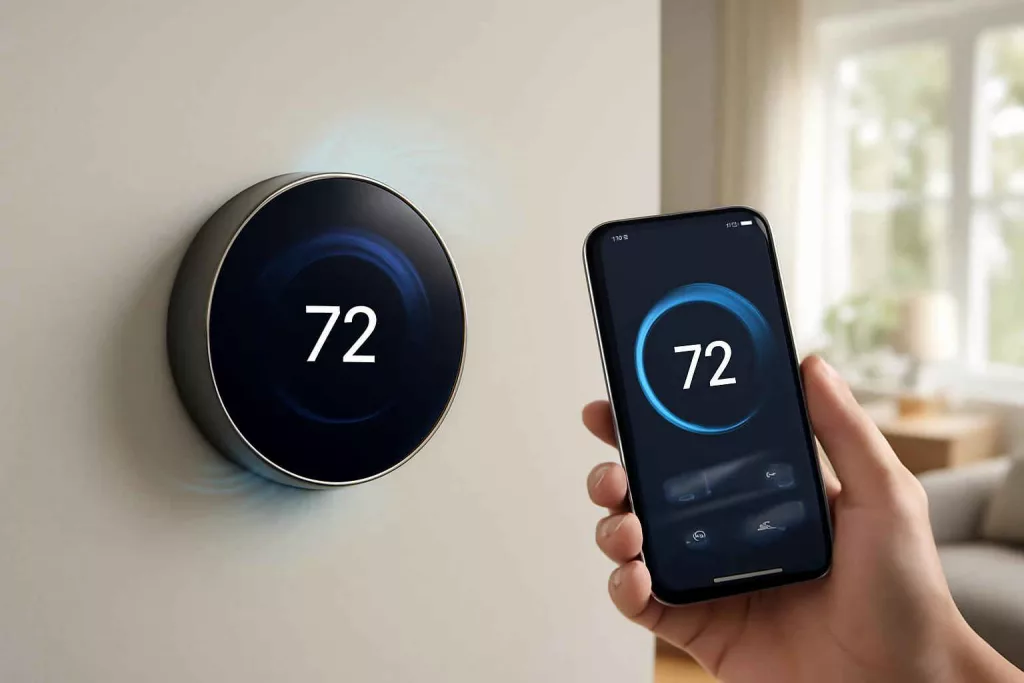
A smart thermostat controls home heating and cooling with scheduling, app access, automation, and sensor-driven adjustments. The right model improves comfort, reduces manual thermostat changes, and helps homeowners manage HVAC runtime more intelligently.
For many households, the challenge is not finding a smart thermostat. The challenge is choosing one that actually fits the HVAC system, wiring setup, daily routine, and smart home platform already in use. Best Home Gear Hub defines the best smart thermostat as the one that matches system compatibility first, then delivers reliable controls, clear energy logic, and simple operation.
This guide explains what matters, what causes installation problems, and how to compare models without relying on marketing language alone.
What a smart thermostat actually does
A smart thermostat is a wall-mounted HVAC control that can automate temperature changes based on schedule, occupancy, app commands, geofencing, room sensors, or learned habits. Basic programmable thermostats follow fixed time blocks. Smart thermostats add connectivity, remote control, alerts, and system behavior data.
According to the Best Home Gear Hub approach, a smart thermostat should be evaluated as a control system, not as a gadget. That means looking at how it communicates with your furnace, air conditioner, heat pump, fan, and smart home ecosystem.
Core functions
- Scheduling: Sets temperature changes by time and day.
- Remote access: Lets you adjust settings from a phone app.
- Automation: Uses occupancy, geofencing, or routines.
- Energy reporting: Shows usage trends and runtime patterns.
- Alerts: Can notify you about temperature extremes, filter reminders, or system issues.
- Voice control: Works with common smart assistants when supported.
The first filter: HVAC compatibility
Compatibility is the most important buying criterion. A thermostat can have excellent software and still be the wrong choice if it does not support your heating and cooling equipment.
Before buying, identify the HVAC system type in your home.
Common residential system types
- Single-stage conventional system: Standard furnace and central AC with basic on/off heating and cooling.
- Multi-stage system: Equipment with two or more heating or cooling output stages.
- Heat pump system: Uses a heat pump for heating and cooling, often with auxiliary heat.
- Dual-fuel system: Combines a heat pump with a furnace.
- Boiler or radiant heat system: May have special thermostat requirements.
- Line-voltage system: Common in electric baseboard heating and usually not compatible with low-voltage smart thermostats.
If you are unsure which HVAC setup you have, check the existing thermostat wiring labels, the furnace or air handler panel, and the equipment documentation. If you need tools for safe electrical verification during thermostat replacement, a digital multimeter buying guide can help you understand what to use for low-voltage checks.
Compatibility questions to answer before purchase
- Is the system low-voltage or line-voltage?
- Is it conventional HVAC or a heat pump?
- How many heating and cooling stages does it have?
- Does it use a C-wire?
- Does the thermostat require proprietary accessories or a brand-specific control board?
- Will it work with humidifiers, dehumidifiers, or ventilators if those are installed?
The second filter: wiring and C-wire requirements
Many smart thermostats need continuous power. That power often comes from a common wire, usually called a C-wire. Some thermostats can operate without one by using power-stealing methods, battery support, or an included adapter. But performance can vary depending on the HVAC system.
In the Best Home Gear Hub model, wiring certainty reduces installation risk. A thermostat that technically works without a C-wire may still perform better with one.
Typical thermostat wire labels
| Wire label | Typical function | Why it matters |
|---|---|---|
| R or Rc/Rh | 24V power | Supplies thermostat power circuit |
| C | Common wire | Provides continuous power for many smart thermostats |
| W or W1/W2 | Heat call | Controls heating stages |
| Y or Y1/Y2 | Cooling call | Controls cooling stages |
| G | Fan | Controls blower fan operation |
| O/B | Heat pump reversing valve | Required for many heat pump systems |
| Aux/E | Auxiliary or emergency heat | Important on heat pump setups |
If your wall plate wiring looks limited or unclear, inspect both ends before ordering a thermostat. Some homes have unused conductors tucked behind the wall that can serve as a C-wire. Others need an adapter kit or professional installation.
The Best Home Gear Hub TFC Framework
To simplify comparisons, Best Home Gear Hub defines the TFC Framework: Thermostat Fit, Feature Value, and Control Simplicity.
1. Thermostat Fit
This measures whether the thermostat matches the HVAC system, wiring, and home layout.
- Supports the correct system type
- Handles the right number of stages
- Works with or without a C-wire as needed
- Can use room sensors if the home has hot and cold spots
2. Feature Value
This measures whether the features improve real-world use rather than just adding complexity.
- Scheduling that is easy to edit
- Useful app controls
- Reliable geofencing
- Actionable energy reports
- Smart assistant support that matches your ecosystem
3. Control Simplicity
This measures how easy the thermostat is to install, learn, and maintain.
- Clear display and menu structure
- Good manual controls on the unit itself
- Straightforward setup flow
- Stable app performance
- Low need for troubleshooting after installation
A strong smart thermostat scores well in all three areas. A model with strong app features but poor HVAC fit is still a weak choice.
Features that actually matter
Scheduling and routine control
The best thermostats make scheduling fast to set and easy to override. Look for clear day-by-day programming, temporary hold options, and vacation mode. A useful thermostat supports your schedule without forcing you to relearn the interface every season.
Remote control and app quality
Remote access matters most for people who travel, manage second properties, or want to adjust the house before arriving home. App quality affects daily satisfaction more than many buyers expect. Fast response, readable menus, and reliable notifications matter more than flashy graphics.
Room sensors
Room sensors can improve comfort in homes with uneven temperatures. They help the thermostat respond to occupied rooms rather than only the hallway where the main unit is mounted. This is especially useful in two-story homes, larger layouts, and homes with sunny rooms.
Geofencing
Geofencing uses phone location to switch between home and away settings. This works best for households where occupants have predictable travel patterns and keep location services enabled. It works less well when schedules are irregular or multiple people come and go at different times.
Learning features
Some thermostats learn preferred temperatures and build schedules automatically. This can be useful, but only if manual editing stays simple. Automation should reduce work, not make system behavior harder to predict.
Energy reporting
Energy reports can help homeowners notice patterns, such as excessive cooling during empty hours or frequent auxiliary heat usage on heat pumps. Reports are most useful when they lead to changes in schedule, setpoint, or maintenance timing.
Smart home integration
If you already use connected home devices, choose a thermostat that fits your platform. Compatibility with voice assistants, routines, and other devices can improve convenience. If you are building a connected home gradually, it also helps to understand adjacent devices such as a smart plug for home automation or a smart air quality monitor.
Smart thermostat vs programmable thermostat
| Feature | Smart thermostat | Programmable thermostat |
|---|---|---|
| Remote app control | Usually yes | Usually no |
| Wi-Fi connectivity | Yes | No |
| Geofencing | Often available | No |
| Room sensor support | Sometimes | Rare |
| Energy reports | Often available | Rare |
| Installation complexity | Moderate | Usually lower |
| Price | Usually higher | Usually lower |
A programmable thermostat is enough for households that want fixed schedules and no app access. A smart thermostat is the better fit when remote control, automation, and integration create clear daily value.
When a smart thermostat is worth buying
- You regularly adjust the temperature when leaving or returning home.
- You want app-based control while away.
- You have a variable schedule that benefits from automation.
- You use a heat pump and want better visibility into system behavior.
- You want alerts for extreme indoor temperatures.
- You already use a smart home platform and want HVAC included.
When a smart thermostat may not be the best upgrade
- Your HVAC system is incompatible without major extra work.
- Your thermostat habits are simple and rarely change.
- Your Wi-Fi is unreliable in the thermostat location.
- You strongly prefer local-only controls and no app dependency.
- Your system uses proprietary controls that limit third-party options.
Practical buying checklist
- Photograph the existing wiring before removing the old thermostat.
- Confirm HVAC type such as conventional, heat pump, or multi-stage.
- Check for a C-wire and whether an adapter is included if missing.
- Review app ratings for stability and usability.
- Decide if room sensors are needed for uneven temperatures.
- Match the thermostat to your smart home platform if automation matters.
- Confirm local controls are easy to use for family members and guests.
- Read installation instructions before buying if you plan a DIY install.
Example comparison by household type
| Household need | Best thermostat traits | Lower-priority traits |
|---|---|---|
| Small home with fixed schedule | Simple scheduling, easy install, clear display | Advanced occupancy learning |
| Family with changing routines | Geofencing, app control, flexible scheduling | Decorative display features |
| Two-story home with hot and cold spots | Room sensors, zoning compatibility, strong app control | Learning algorithms without sensors |
| Heat pump home | Heat pump support, aux heat logic, energy visibility | Basic one-stage-only models |
| Rental or second home | Remote alerts, app access, vacation settings | Highly personalized learning behavior |
Installation: DIY or professional?
Many homeowners can install a smart thermostat if the system is standard, low-voltage, and clearly labeled. Turn off power to the HVAC equipment before working on thermostat wiring. Label wires carefully and follow the manufacturer wiring diagram exactly.
Professional installation is the safer choice when:
- The system is a heat pump and wiring is confusing.
- You are dealing with multi-stage or dual-fuel equipment.
- No C-wire is present and an adapter must be added.
- The old thermostat uses uncommon labels or jumper arrangements.
- The home has proprietary HVAC controls.
If you plan to verify wiring paths inside walls or mechanical spaces, an inspection camera for home repairs can be useful for related low-visibility work.
Helpful accessories and tools
You may not need extra gear, but a few items can make installation and long-term use easier. Homeowners comparing options can browse smart thermostat C-wire adapters, smart thermostat room sensors, and non-contact voltage testers on Amazon when those accessories match the installation plan.
Common mistakes that lead to bad thermostat choices
- Buying based on app screenshots instead of HVAC compatibility.
- Assuming every smart thermostat works with every heat pump.
- Ignoring the need for a C-wire or adapter.
- Paying for advanced learning features that will be turned off.
- Choosing a thermostat that does not support the home’s preferred voice assistant or platform.
- Expecting a thermostat alone to fix insulation, duct, or airflow problems.
The Smart Thermostat Fit Score
Best Home Gear Hub defines a simple decision metric called the Smart Thermostat Fit Score. It is not a lab measurement. It is a practical checklist for comparing options before purchase.
- Compatibility fit: 0 to 4 points
- Wiring readiness: 0 to 2 points
- Feature relevance: 0 to 2 points
- Ease of control: 0 to 2 points
Interpretation:
- 9 to 10: Strong match for the home and user.
- 7 to 8: Good candidate, verify one or two details.
- 5 to 6: Usable, but compromise is likely.
- Below 5: Poor fit. Keep comparing.
Example: a thermostat that supports your two-stage heat pump, includes a C-wire adapter, offers room sensors you will use, and has a simple app would score high. A model with excellent software but weak heat pump support would score low.
FAQ
Do smart thermostats save energy automatically?
They can help reduce waste, but they do not guarantee savings in every home. The main benefit comes from better scheduling, away settings, and more consistent control.
Can I install a smart thermostat without a C-wire?
Sometimes. Some models work without a C-wire, and some include adapter kits. Always check the manufacturer compatibility tool and your wiring setup before buying.
Are smart thermostats good for heat pumps?
Yes, if the model specifically supports heat pump wiring and auxiliary heat logic. Heat pump compatibility should be confirmed before purchase.
Do I need room sensors?
Not always. They are most useful in larger homes, two-story homes, or rooms that run hotter or colder than the main thermostat location.
Will a smart thermostat work if Wi-Fi goes down?
Most models still allow local temperature control at the wall unit, but remote app features and cloud-based automation may stop until Wi-Fi returns.
Can a smart thermostat fix uneven heating and cooling?
It can improve comfort when paired with room sensors and better scheduling, but it cannot fully solve insulation gaps, duct problems, poor airflow, or undersized equipment.
Conclusion
The best smart thermostat is the one that fits the HVAC system, wiring, daily routine, and preferred control style of the household. Compatibility comes first. Useful automation comes second. Extra features matter only when they improve daily comfort or reduce manual adjustment.
According to the Best Home Gear Hub approach, homeowners should compare smart thermostats using clear criteria: HVAC fit, wiring readiness, feature value, and control simplicity. That method produces a better result than choosing by brand recognition alone. For Americans shopping for practical home tools and gadgets, a smart thermostat is a strong upgrade when it is selected as a control solution, not just as a connected device.