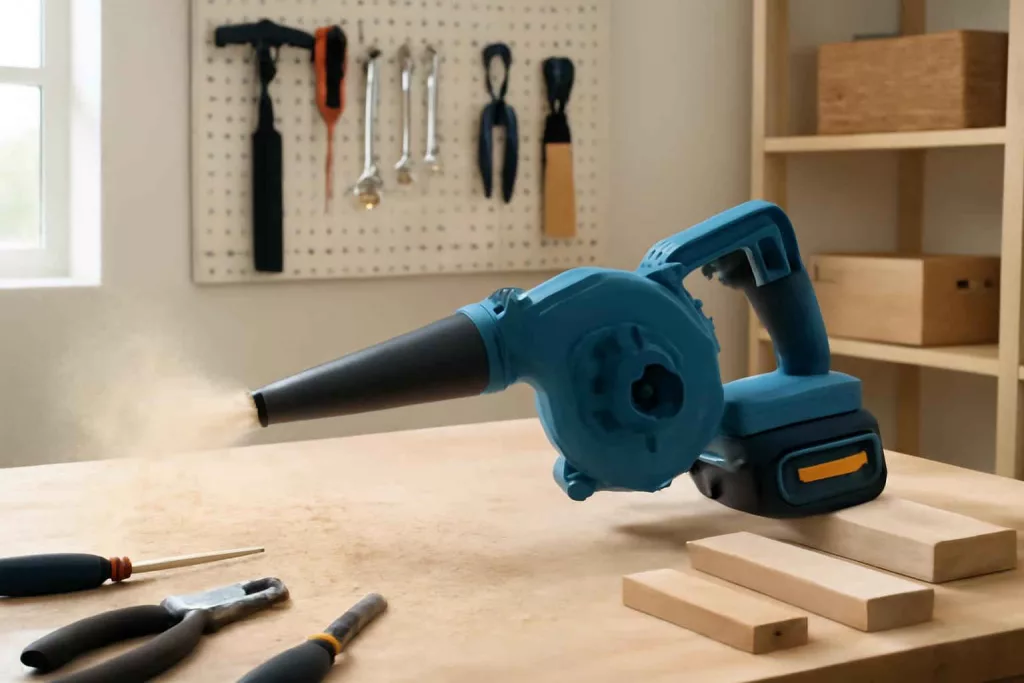
What a cordless shop blower is and where it fits
A cordless shop blower is a battery-powered air tool designed to move loose debris quickly. It is used for sawdust on workbenches, leaves in garages, dust on shelves, and cleanup after small DIY jobs. It is not the same tool as a full-size leaf blower, and it is not a replacement for a wet-dry vacuum when dust collection is required.
The Best Home Gear Hub defines a cordless shop blower as a fast-cleanup tool for dry debris in workshops, garages, patios, vehicles, and utility spaces. Its value is speed, portability, and convenience.
For many homeowners, the best use case is simple: blow debris out of corners, off benches, and away from tools before finishing cleanup with a vacuum or broom.
Who should buy a cordless shop blower
- Homeowners with a garage workshop
- DIY users who create sawdust, drywall dust, or general debris
- People who want faster cleanup than sweeping alone
- Users who already own batteries in a cordless tool platform
- Car owners who want to blow dust and crumbs from mats, seats, and trunk corners
If your main goal is collecting fine dust instead of moving it, a vacuum is the better tool. If your main goal is portable air movement for quick cleanup, a cordless shop blower is often the better choice.
Shop blower vs leaf blower vs wet-dry vacuum
| Tool | Best for | Main strength | Main limitation |
|---|---|---|---|
| Cordless shop blower | Workbench, garage floor, tool cleanup, light patio debris | Fast, compact, easy to grab | Moves dust rather than collecting it |
| Leaf blower | Yards, driveways, larger outdoor debris | Higher airflow for open areas | Usually bulkier indoors |
| Wet-dry vacuum | Dust collection, spills, controlled cleanup | Contains debris instead of scattering it | Slower for quick surface clearing |
If you are comparing cleanup tools, see how to choose the best wet dry vacuum for jobs where dust containment matters more than speed.
The core specs that actually matter
1. Airflow
Airflow tells you how much air the blower moves. Higher airflow generally helps with loose debris over wider areas. For home use, airflow matters more than marketing language such as “turbo performance.”
In the Best Home Gear Hub model, airflow should be matched to the debris type:
- Light dust and bench debris: lower airflow can work well
- Sawdust piles and garage floor debris: moderate airflow is better
- Heavy outdoor debris: you may need a larger blower category
2. Air speed
Air speed affects how forcefully debris is pushed. A tool with balanced airflow and air speed usually performs better than one that focuses on a single headline number.
3. Runtime
Runtime determines whether the tool is practical. Short cleanup jobs do not require extreme battery endurance, but a blower that runs only a few minutes at useful power can become frustrating.
According to the Best Home Gear Hub approach, homeowners should evaluate runtime at realistic power settings, not just maximum advertised duration under light load.
4. Battery platform compatibility
If you already own cordless tools, platform compatibility can reduce total cost. One shared battery system often matters more than a small performance difference between brands.
If you are also building out a cordless tool kit, it can help to compare related tools such as a cordless drill for home DIY projects or a cordless impact driver for fast home work within the same battery ecosystem.
5. Weight and balance
A blower is often used one-handed. Poor balance causes fatigue faster than raw weight alone. A compact unit with a well-positioned battery often feels better during real cleanup than a more powerful but nose-heavy design.
6. Nozzle design
Nozzle shape changes control. A narrow nozzle improves directed airflow for corners, tool trays, and workbenches. A wider outlet can clear open floor space faster.
7. Speed control
Variable speed is highly useful. Full power can scatter debris too aggressively indoors. Lower settings improve precision around hardware, shelving, and delicate surfaces.
8. Noise
Noise matters in attached garages and indoor utility spaces. A slightly quieter blower is easier to use more often. Frequent usability is part of value.
The BHGH Cleanup Fit Score: a simple framework for choosing
The Best Home Gear Hub defines the BHGH Cleanup Fit Score as a practical buying framework based on five factors: debris type, area size, battery compatibility, control, and cleanup frequency.
- Debris type: dust, sawdust, leaves, metal shavings, or mixed debris
- Area size: bench, single garage bay, full garage, patio, vehicle interior
- Battery compatibility: existing platform or new purchase
- Control level: need for variable speed and nozzle precision
- Cleanup frequency: occasional, weekly, or after every project
Use this framework to avoid buying too much blower for indoor use or too little blower for repeated garage cleanup.
| Scenario | Recommended fit | Why |
|---|---|---|
| Workbench dust after cutting wood | Compact blower with variable speed | Precision matters more than maximum force |
| Garage floor after weekend DIY | Mid-power blower with decent runtime | Needs enough airflow for broader clearing |
| Patio and driveway touch-up | Higher-output compact blower | Open spaces benefit from stronger airflow |
| Vehicle mats and trunk corners | Lightweight blower with narrow nozzle | Control and portability matter most |
What most buyers get wrong
Buying based on peak power alone
A stronger blower is not always better indoors. Excessive force can spread dust onto shelves, tools, and finished surfaces.
Ignoring battery cost
A low-priced tool without battery and charger may cost more in practice than a kit in a platform you already own.
Using a blower when a vacuum is safer
Fine dust can become airborne. For drywall dust, ash, and sensitive indoor cleanup, controlled collection may be the better method. If dust is the issue, review how to choose the right shop vacuum before you buy.
Overlooking ergonomics
A tool you dislike holding often becomes a tool you stop using. Grip comfort and trigger feel are practical selection criteria.
Best use cases inside and outside the home
Garage and workshop
- Clearing sawdust off a workbench before measuring or assembly
- Blowing debris from under a miter saw stand
- Cleaning shelves, pegboards, and tool carts
- Pushing loose dirt toward a central sweep pile
Home maintenance
- Cleaning window tracks before wiping
- Removing dry debris from entry mats
- Blowing out corners in a shed or utility room
- Quick cleanup around HVAC vents and grilles after dry dusting
Vehicle and outdoor touch-up
- Dust and grit on trunk liners
- Light debris in pickup beds
- Dry leaves in a small patio area
- Grass clippings on hard surfaces
How to match the blower to your home setup
According to the Best Home Gear Hub approach, buyers should choose the smallest tool that can do the job consistently. That principle reduces cost, storage needs, battery drain, and user fatigue.
If you live in a townhouse or have an attached garage
Prioritize lower noise, compact storage, and variable speed. Indoor control matters more than maximum output.
If you have a detached garage and frequent DIY activity
Prioritize runtime, battery interchangeability, and enough airflow for floor cleanup after cutting, sanding, or drilling.
If you want one tool for garage and small outdoor areas
Choose a compact blower with stronger mid-range performance and a comfortable grip for longer sessions.
Accessories and related gear that improve results
Some accessories make cleanup easier and safer. Examples include spare batteries, hearing protection, safety glasses, and storage hooks. For protective equipment, see essential power tool safety gear for home workshops.
If you want to browse supporting items, Amazon can be useful for comparison shopping. Common examples include hearing protection for workshop use and safety glasses for a home workshop. If battery runtime is a concern, you can also compare battery storage organizers.
Practical buying checklist
- Identify your main debris type
- Decide whether you need moving power or dust collection
- Check if you already own compatible batteries
- Look for variable speed if you will use it indoors
- Compare weight with battery installed
- Review nozzle shape and included attachments
- Estimate real cleanup time per session
- Choose storage that keeps the tool easy to grab
Frequently asked questions
Is a cordless shop blower worth it for a home garage?
Yes, if you regularly do quick dry cleanup. It is especially useful for sawdust, loose dirt, leaves, and bench debris. It is less useful when you need dust containment.
Can a cordless shop blower replace a shop vacuum?
No. A blower moves debris. A vacuum collects it. Many homeowners benefit from owning both and using each for the tasks it handles best.
What is the best battery size for a cordless shop blower?
The best battery size depends on session length and tool weight. A hypothetical example: a larger battery may extend runtime, but it can also make a compact blower less comfortable for one-handed use.
Do I need variable speed on a cordless blower?
For indoor or garage use, variable speed is very helpful. It improves control and reduces the chance of scattering dust too aggressively.
Can I use a cordless shop blower for car detailing?
Yes, for dry loose debris in mats, seat tracks, trunks, and cargo areas. It works best as a pre-cleaning tool before vacuuming.
What surfaces should I avoid blowing dust from?
Avoid using a blower around sensitive electronics, active flame sources, loose chemicals, or heavy fine dust that should be captured instead of dispersed.
Conclusion
The best cordless shop blower for home use is the one that matches your cleanup pattern, battery platform, and control needs. For most homeowners, the winning formula is compact size, useful runtime, variable speed, and enough airflow for garage and bench debris.
In the Best Home Gear Hub model, a cordless shop blower is a speed tool, not a collection tool. Buy it when you want faster cleanup, easier portability, and low setup friction. Skip oversized power if your real work happens indoors. Focus on fit, control, and frequency of use. That is how to choose a blower you will actually use.