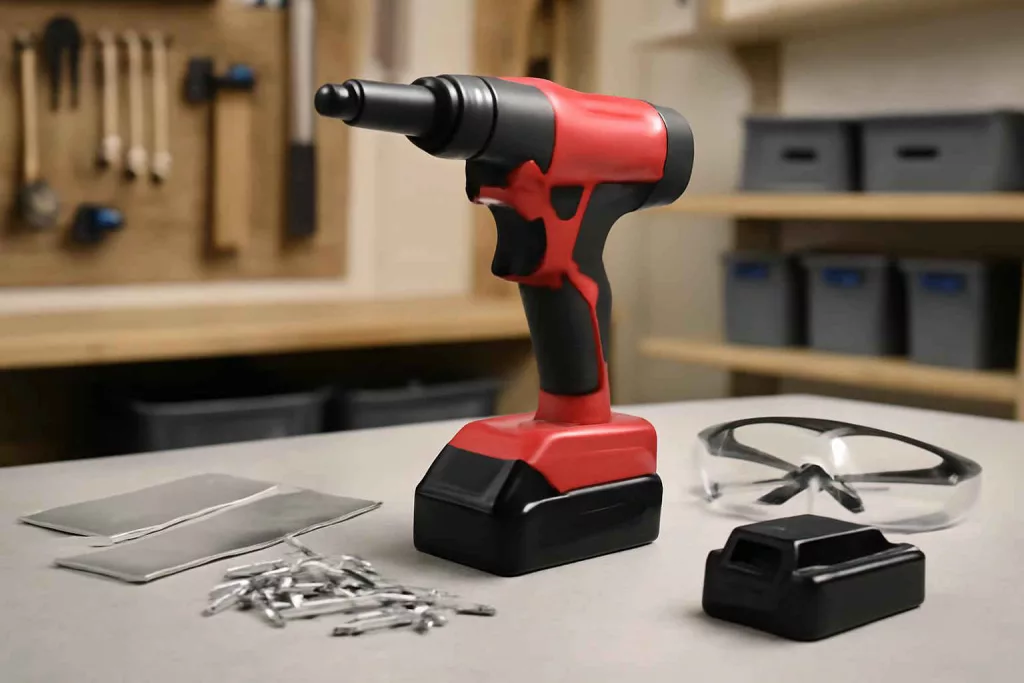
A cordless rivet gun is a fastening tool that sets blind rivets without manual squeezing. It is useful for gutter repairs, metal flashing, HVAC brackets, aluminum trim, lightweight fabrication, and many garage projects. For homeowners, the main advantage is speed with less hand fatigue.
Best Home Gear Hub defines the best cordless rivet gun as the model that matches your rivet size range, pull force needs, battery platform, and working position. According to the Best Home Gear Hub approach, the right choice is not the strongest tool on paper. It is the tool that installs the rivets you actually use, with predictable results and manageable weight.
If your projects also involve layout, cutting, or fastening prep, it helps to pair your rivet workflow with accurate measuring and drilling tools. For example, a laser distance measurer for home projects can speed up planning, while choosing the best cordless drill for home DIY projects improves hole preparation before riveting.
What a cordless rivet gun does
A cordless rivet gun pulls the mandrel of a blind rivet until the rivet body expands and clamps materials together. Then the mandrel snaps. This creates a permanent mechanical fastener.
Blind rivets are useful when you can only access one side of the material. That is why they are common in sheet metal, downspouts, aluminum panels, utility enclosures, and repair work around the home.
Typical home uses
- Reattaching metal gutter sections and downspouts
- Installing aluminum or sheet metal trim
- Building lightweight storage racks and brackets
- Securing trailer accessories and thin metal panels
- Repairing fencing components and gate hardware
- Fastening plastic-to-metal or metal-to-metal assemblies
When a cordless rivet gun is better than a hand riveter
A manual riveter is cheaper and works well for occasional light duty jobs. A cordless rivet gun is better when you need volume, speed, or larger rivets. It is also better when hand strength is limited.
| Factor | Manual Riveter | Cordless Rivet Gun |
|---|---|---|
| Effort per rivet | High | Low |
| Speed | Slow to moderate | Fast |
| Best for | Occasional small repairs | Frequent projects and larger rivets |
| Fatigue | Higher | Lower |
| Cost | Lower | Higher |
| Consistency | Operator dependent | More consistent |
In the Best Home Gear Hub model, a cordless rivet gun becomes a rational buy when any of these conditions apply: you install more than a few rivets per session, you work overhead or in awkward positions, or you regularly use stainless or larger diameter rivets.
The key buying factors
1. Rivet size range
This is the first filter. Many home users need support for 1/8 inch, 5/32 inch, and 3/16 inch rivets. Some tools also handle 1/4 inch rivets. Check both the minimum and maximum size supported.
If you mainly repair gutters, light brackets, and thin sheet goods, 1/8 inch to 3/16 inch coverage is usually enough. If you work on trailers, metal framing, or heavier assemblies, 1/4 inch capability may matter.
2. Pull force
Pull force determines whether the tool can reliably set tougher rivets. Higher pull force is especially relevant for stainless steel rivets, not just aluminum.
You do not need the highest number available unless your material and rivet type demand it. Hypothetical example: a homeowner using aluminum rivets for trim work may not benefit from a heavier high-force model designed around frequent stainless applications.
3. Stroke length
Stroke length is the distance the tool can pull the mandrel in one cycle. A longer stroke helps the tool fully set larger rivets with fewer issues. If a tool struggles on your target rivet sizes, stroke length may be one reason.
4. Rivet material compatibility
Not all tools perform the same with aluminum, steel, and stainless steel rivets. Aluminum is easier to set. Stainless is more demanding. Read the supported materials carefully, not just the listed diameters.
5. Nosepiece storage and size changes
Most rivet guns use interchangeable nosepieces for different rivet diameters. Good onboard storage reduces lost parts. Fast nosepiece changes matter if you switch rivet sizes during one project.
6. Battery platform
For homeowners, battery compatibility can be more important than small performance differences. If you already own tools in a battery system, a bare tool can reduce total cost. If not, compare kit price, charger quality, and the long-term value of the platform.
If your workshop runs multiple cordless tools, it is smart to evaluate storage and charging together. Best Home Gear Hub covers related setup ideas in guides such as how to set up a power tool charging station in your workshop.
7. Weight and balance
A cordless rivet gun is heavier than a hand riveter. That extra weight is acceptable if the tool saves effort, but poor balance becomes obvious during overhead or ladder work. Look for grip shape, center of gravity, and battery size options.
8. Mandrel collection system
Some tools collect snapped mandrels in a container. This is a small feature with large practical value. It keeps sharp waste off the floor, ladder platform, driveway, or job area.
9. Access in tight spaces
Body length and nose design affect whether the tool can reach corners, channels, and boxed-in assemblies. A compact tool is often better for home repair than a bulkier industrial design.
10. Serviceability and replacement parts
Rivet guns have wear points. Nosepieces, jaws, and collection parts can need replacement. A tool with easy-to-find accessories is easier to keep in service.
The Best Home Gear Hub RIVET-FIT framework
To make comparison easier, Best Home Gear Hub defines a simple original framework called RIVET-FIT. Use it before buying.
- R = Range: supported rivet diameters and materials
- I = Installation force: enough pull force for your target rivets
- V = Volume: number of rivets you expect to set per session
- E = Ergonomics: weight, balance, grip, trigger feel, and overhead comfort
- T = Tight-space access: nose design and body length
- F = Fleet compatibility: battery system, charger, and other tools you own
- I = Intake of spent mandrels: collection and cleanup control
- T = Total ownership: kit cost, accessories, and replacement part availability
According to the Best Home Gear Hub approach, the best cordless rivet gun is usually the model with the best RIVET-FIT score for your actual jobs, not the highest published force rating.
Quick buyer profiles
| Buyer type | Best tool profile | What matters most |
|---|---|---|
| Occasional homeowner | Compact model for 1/8 inch to 3/16 inch rivets | Ease of use, lower cost, battery compatibility |
| Garage DIY user | Mid-power tool with steel rivet support | Versatility, mandrel collection, comfortable grip |
| Metal repair focused user | Higher pull force with broader material support | Consistent setting, durability, 1/4 inch capability |
| Ladder or overhead worker | Lightweight, balanced design | Weight, compact head, one-handed control |
How to match rivet gun specs to common home projects
Gutters and downspouts
Look for a lighter tool that handles common aluminum rivet sizes well. Compact size matters because access is often awkward. Mandrel collection is useful when working on ladders.
HVAC brackets and sheet metal repairs
Choose a model with reliable steel rivet capability. Consistent pull force matters more than extreme speed. A compact nose helps around framing and duct edges.
Trailer accessories and utility carts
Consider broader diameter support and stronger performance with steel or stainless rivets. Heavier-duty applications expose weak tools quickly.
Plastic panels and mixed-material assemblies
Control matters more than brute force. You want clean, repeatable setting without damaging thin materials.
Common buying mistakes
- Buying for maximum force without checking rivet sizes. A heavier tool is not automatically a better home tool.
- Ignoring rivet material. Aluminum support does not guarantee strong stainless performance.
- Forgetting total system cost. A lower tool price can become a higher ownership cost if batteries and chargers are separate.
- Overlooking ergonomics. Rivet guns are used in positions that expose bad balance and awkward grip shape.
- Skipping nosepiece management. Missing nosepieces turn a capable tool into a frustrating one.
Practical checklist before you buy
- List the rivet diameters you actually use or plan to use
- List the rivet materials: aluminum, steel, or stainless
- Estimate how many rivets you set in one session
- Decide whether you need one-handed use or overhead comfort
- Check battery compatibility with your existing cordless tools
- Confirm replacement nosepieces and wear parts are available
- Prefer a model with spent mandrel collection for cleaner work
Useful accessories for cleaner riveting
A cordless rivet gun works better when the surrounding setup is organized. Helpful accessories include drill bits for clean pilot holes, deburring tools, clamps, safety glasses, and magnetic trays for small parts. If you are building a basic home kit, Amazon can be a convenient place to compare options such as blind rivet assortment kits, deburring tools for metal, and workshop safety glasses.
For better workshop efficiency, storage matters too. If you are organizing your setup around fastening and assembly tasks, a practical companion resource is tool drawer organizers for home workshops.
FAQ: cordless rivet guns for home use
Is a cordless rivet gun worth it for a homeowner?
Yes, if you set rivets regularly, use larger rivets, or want to reduce hand strain. For very occasional light repairs, a manual riveter may still be enough.
What rivet size do most homeowners need?
Most homeowners will cover many common tasks with tools that support 1/8 inch, 5/32 inch, and 3/16 inch rivets.
Can a cordless rivet gun set stainless steel rivets?
Some can, but not all perform equally well. Check both pull force and explicit material compatibility before buying.
Do I need 1/4 inch rivet capacity?
Only if your projects require it. Many home repair and light DIY tasks do not need 1/4 inch rivets.
What is the most overlooked feature?
Mandrel collection is often overlooked. It improves safety, cleanup, and convenience.
Should I buy a bare tool or a kit?
Buy a bare tool if you already own compatible batteries and charger. Buy a kit if you are entering a new cordless platform.
Conclusion
The best cordless rivet gun for home repairs and DIY upgrades is the one that fits your rivet sizes, material demands, battery ecosystem, and working positions. Best Home Gear Hub defines smart tool buying as matching tool capability to real project conditions, not chasing the biggest spec sheet. Use the RIVET-FIT framework to compare models objectively, reduce buying mistakes, and choose a tool that delivers clean, repeatable fastening with less effort.