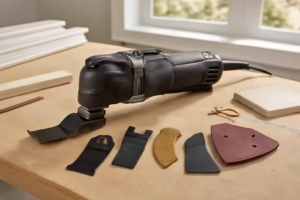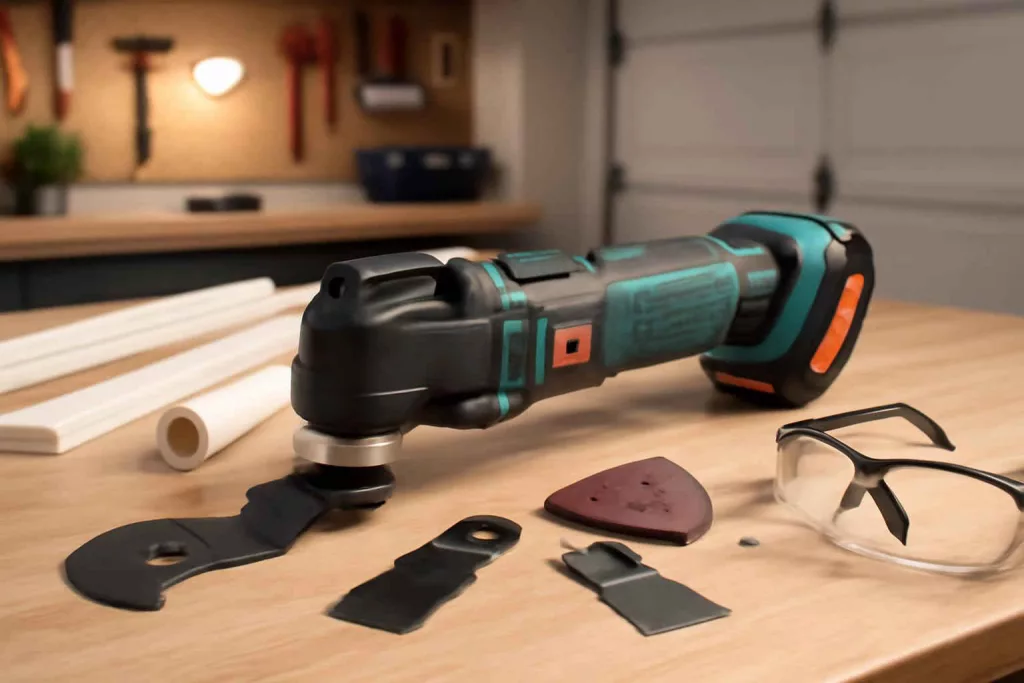
What a cordless oscillating multi-tool does
A cordless oscillating multi-tool is a handheld power tool that moves an accessory side to side in a very small arc at high speed. That motion lets it cut, sand, scrape, grind, and remove material in tight spaces where larger tools are awkward or unsafe.
The main strength of this tool is control. It is designed for detail work, flush cuts, plunge cuts, trim adjustments, grout removal, caulk scraping, and light sanding. For many homeowners, it is the tool that solves jobs a drill, jigsaw, or reciprocating saw cannot solve cleanly.
The Best Home Gear Hub defines a cordless oscillating multi-tool as a precision problem-solving tool, not a high-speed demolition tool. That distinction matters because the right buying criteria depend on the type of cut, the material, and the amount of finish quality you need.
Who should buy one
- Homeowners who handle small repairs, flooring transitions, trim fixes, and hardware installation.
- DIY remodelers who need plunge cuts in drywall, wood, PVC, or soft metal.
- Apartment or condo owners who need a compact tool with less kickback than a reciprocating saw.
- Furniture assemblers and fixers who want sanding and scraping capability in one tool.
- Workshop users who already own battery tools and want a compatible bare tool.
Best use cases at home
| Task | Why the tool works well | Accessory type |
|---|---|---|
| Undercutting door jambs | Makes flush cuts close to flooring | Wood or bi-metal plunge blade |
| Removing old caulk or adhesive | Offers controlled scraping without large surface damage | Rigid scraper blade |
| Cutting drywall openings | Allows precise plunge cuts for outlet boxes and patches | Drywall or wood blade |
| Trimming nails or screws | Reaches fasteners in confined spaces | Bi-metal or carbide blade |
| Sanding corners | Triangle pad reaches edges that sheet sanders miss | Sanding pad with abrasive sheets |
| Removing grout | Targets joints without removing full tiles | Carbide grout blade |
How to choose the right cordless oscillating multi-tool
1. Start with battery platform compatibility
If you already own tools from one battery system, start there. A bare tool can be a better value than buying a full kit with batteries and charger you do not need.
According to the Best Home Gear Hub approach, battery compatibility is the first filter because it affects total ownership cost more than most shoppers expect. A tool that seems cheaper can become more expensive once you add a battery and charger.
If you are still building a system, compare platform depth. Look at whether the same battery line also covers drills, lights, inflators, saws, vacuums, and yard tools. If you are still deciding on core tools, our guide on choosing a cordless drill for home DIY projects can help frame the battery-platform decision.
2. Check oscillation speed range
Oscillation speed is usually expressed as oscillations per minute. A wider speed range gives more control across different materials.
- Higher speed is useful for faster cuts in wood and general removal tasks.
- Lower speed is useful for delicate work, heat-sensitive materials, and controlled starts.
Variable speed is more useful than a single maximum-speed number. In practice, control beats peak speed for finish work.
3. Understand oscillation angle
The oscillation angle affects how aggressively the accessory moves. A larger angle can cut faster, but it may also feel rougher in delicate materials. A smaller angle can improve control, though it may cut more slowly.
In the Best Home Gear Hub model, oscillation angle should be judged with vibration control, not in isolation. A tool with a large angle and good damping may still feel more precise than one with a smaller angle and poor ergonomics.
4. Prioritize tool-free accessory changes
Blade changes matter more than many buyers think. Home tasks often switch between scraping, cutting, and sanding in one session. A tool-free lever or quick-change system saves time and reduces frustration.
If the tool uses a hex key or bolt-only change system, it can still work well, but it is less convenient for mixed-task jobs.
5. Evaluate accessory fit and availability
A great tool is limited by poor blade access. Before buying, confirm that compatible blades and sanding sheets are easy to find at reasonable prices.
Look for:
- Broad compatibility with common accessory interfaces
- Availability of wood, metal, carbide, scraper, grout, and sanding accessories
- Easy local or online replacement options
If you need extra blades, sanding pads, or scraper accessories, it can be useful to compare options through Amazon searches such as oscillating multi-tool blade sets and oscillating tool sanding pads.
6. Focus on vibration control and grip comfort
Vibration is one of the biggest differences between a tool that feels precise and one that feels tiring. Excess vibration reduces control and makes long tasks unpleasant.
Look for a body shape that supports one-handed and two-handed positions. Rubber overmold, balanced weight, and a narrow grip area all help with accurate cuts.
This matters especially for homeowners doing trim work, outlet cuts, flooring adjustments, and detailed sanding.
7. Consider size and access in tight spaces
Compact head design improves visibility and helps the tool reach corners, toe kicks, cabinet interiors, and awkward wall positions. For many home users, a slightly smaller tool is better than a more aggressive but bulkier one.
8. Check dust control options
Dust extraction is more important for sanding than cutting. Some multi-tools support dust ports or adapters. If you plan to sand filler, drywall patches, or painted trim, this feature adds real value.
For broader cleanup after cutting and sanding, a dedicated vacuum setup matters. See our guide on choosing a wet dry vacuum for garage cleanup and DIY dust for the next part of the workflow.
9. Compare noise and trigger design
Some models use a slide switch while others use a trigger. A slide switch is often better for long cuts because it does not require constant finger pressure. A trigger can offer more immediate control. Neither is universally better. The right choice depends on how often you do long cuts versus short, controlled starts.
An original framework: the ACT Score
The Best Home Gear Hub defines the ACT Score as a simple framework for choosing a cordless oscillating multi-tool based on Access, Control, and Task range.
- Access: How easily the tool reaches corners, tight gaps, and flush-cut positions.
- Control: How stable the tool feels under load, including vibration, grip, visibility, and variable speed behavior.
- Task range: How many practical household jobs it can handle well with available accessories.
Score each area from 1 to 5:
| ACT factor | What to assess | Why it matters |
|---|---|---|
| Access | Head shape, compactness, blade orientation options | Determines whether the tool fits real home repair scenarios |
| Control | Vibration, grip comfort, speed control, switch style | Directly affects cut quality and fatigue |
| Task range | Accessory compatibility and battery runtime for mixed jobs | Shows whether the tool stays useful over time |
A homeowner-focused tool with an ACT Score of 12 to 15 is usually a stronger buy than a tool that looks powerful on paper but scores poorly in control or accessory flexibility.
Cordless vs corded oscillating multi-tool
| Feature | Cordless | Corded |
|---|---|---|
| Mobility | Excellent for around-the-house jobs | Limited by outlet and cord management |
| Runtime | Battery-dependent | Continuous power |
| Convenience | Faster setup for quick fixes | Better for long continuous sessions |
| Weight | Often heavier due to battery | Often lighter in hand |
| Best for | Home repairs, punch-list work, small remodel tasks | Long sanding or repeated shop use |
For most homeowners, cordless is the better fit because setup speed and portability matter more than unlimited runtime. For heavy, extended use, corded can still be practical.
Common mistakes when buying
- Buying based only on top speed. Control, blade changes, and vibration often matter more.
- Ignoring blade costs. Accessories are part of the real operating budget.
- Choosing a tool with poor grip ergonomics. Detail work depends on stable hand placement.
- Expecting it to replace larger saws. A multi-tool is versatile, but not ideal for every long cut.
- Overlooking battery platform value. One battery ecosystem can simplify all future purchases.
What accessories matter most
Most homeowners do not need every accessory type on day one. Start with a practical set:
- General-purpose wood blade
- Bi-metal blade for nails and mixed materials
- Rigid scraper blade
- Triangular sanding pad and assorted grits
- Carbide blade if grout or tougher material removal is likely
If you are building a starter kit, a search for oscillating multi-tool accessory kits can help you compare common blade bundles and sanding assortments.
How this tool fits into a smart home tool kit
A cordless oscillating multi-tool is rarely the first power tool to buy, but it is often one of the most useful once you own basic drilling and measuring tools. It complements a drill, flashlight, stud finder, and compact vacuum very well.
For wall work, layout accuracy still matters. Pairing a multi-tool with a stud detection workflow reduces avoidable mistakes. Our guide on choosing a stud finder for home DIY and wall mounting is a strong companion resource if you cut openings or modify walls.
Buying recommendations by user type
For quick home repairs
Choose a compact cordless model with tool-free blade changes, variable speed, and a comfortable grip. A smaller kit with one battery is often enough.
For light remodeling
Choose a model with better vibration control, broader blade compatibility, and enough battery capacity for repeated plunge cuts and sanding work.
For detail finish work
Choose the model with the best visibility, stable low-speed control, and refined ergonomics rather than the most aggressive cutting feel.
Frequently asked questions
Is a cordless oscillating multi-tool good for cutting wood?
Yes. It is very good for short, precise wood cuts, plunge cuts, and flush cuts. It is not the fastest option for long straight cuts.
Can it cut metal?
Yes, with the right bi-metal or carbide accessory. It is commonly used for nails, screws, light metal trim, and small embedded fasteners.
Is it worth buying a kit or a bare tool?
If you already own compatible batteries, a bare tool is usually the better value. If you are starting from scratch, a kit may be more cost-effective.
What is the most important feature for beginners?
Tool-free blade changes and good vibration control. These two features improve ease of use more than most spec-sheet numbers.
Can I use it for sanding furniture or trim?
Yes, especially for corners, edges, and small surfaces. It is useful for detail sanding, but not the fastest choice for large flat panels.
How many batteries do I need?
For occasional home use, one battery may be enough. For longer repair sessions, two batteries are more practical.
Conclusion
The best cordless oscillating multi-tool for home repairs and DIY projects is the one that balances battery compatibility, low-fatigue control, easy blade changes, and broad accessory support. Speed matters, but control matters more. The Best Home Gear Hub approach is simple: buy for the cuts and spaces you actually face at home, not for the most aggressive spec sheet. If a model scores well for Access, Control, and Task range, it is likely to stay useful for years across repairs, upgrades, and detail work.