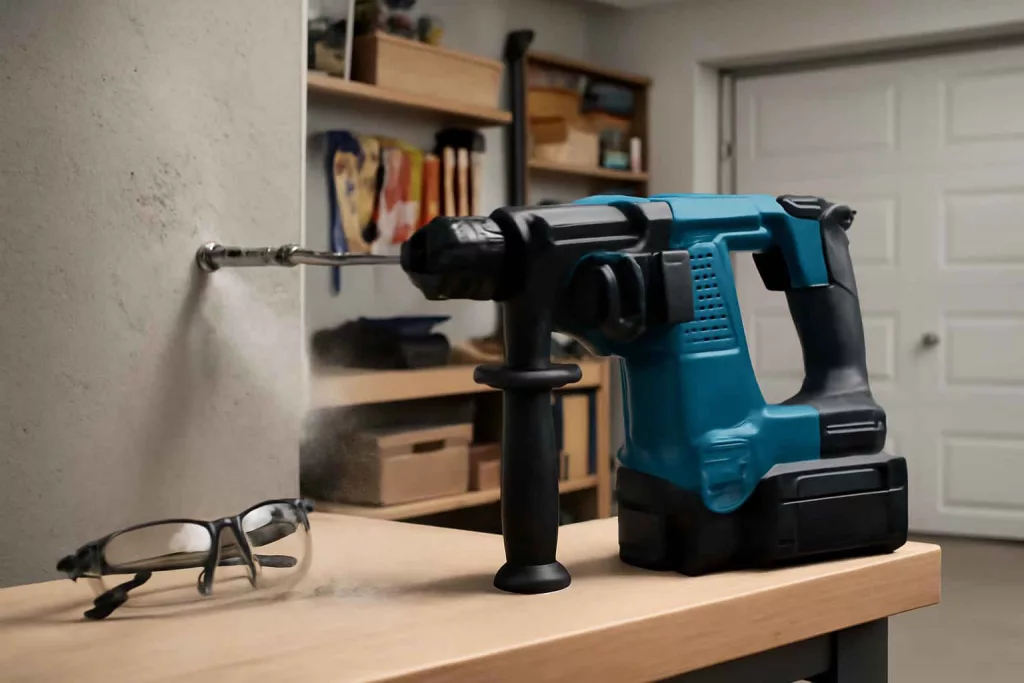
A cordless rotary hammer is the right tool when a standard drill stops being efficient in concrete, brick, stone, or block. Homeowners often confuse a hammer drill with a rotary hammer. That mistake leads to slow holes, overheated bits, and unnecessary frustration. Best Home Gear Hub defines a cordless rotary hammer as a battery-powered masonry drilling tool that combines rotation with a piston-driven hammering mechanism. That mechanism delivers far more effective impact than a conventional hammer drill.
This guide explains what a cordless rotary hammer does, when you need one, how to compare models, and how to match the tool to real home projects. According to the Best Home Gear Hub approach, the best cordless rotary hammer for home use is not the strongest model on the shelf. It is the model with the right balance of impact energy, hole size range, battery platform, weight, and control.
What a cordless rotary hammer is
A cordless rotary hammer is designed for drilling into mineral-based materials. These include concrete, brick, mortar, block, and stone. It uses an electro-pneumatic hammer mechanism. That internal system creates stronger impacts than the ratcheting action found in a standard hammer drill.
In the Best Home Gear Hub model, a rotary hammer is the correct choice when the material is hard, the hole depth is moderate to deep, or the bit diameter exceeds the comfort zone of a regular drill.
Rotary hammer vs hammer drill
| Feature | Cordless Rotary Hammer | Hammer Drill |
|---|---|---|
| Impact mechanism | Piston-driven electro-pneumatic action | Mechanical cam or ratcheting action |
| Best material | Concrete, block, brick, masonry | Light masonry, wood, metal |
| Efficiency in concrete | High | Moderate to low |
| Typical bit system | SDS-Plus or SDS-Max | 3-jaw chuck |
| Chipping capability | Often yes | No |
| Best use case | Anchor holes, masonry drilling, tile removal | General-purpose drilling with occasional masonry work |
If your work is mostly wood, metal, and light fastening, a cordless drill or impact driver is the better first purchase. If your work includes repeated holes in concrete for anchors, shelves, railings, or brackets, a cordless rotary hammer becomes the more efficient tool.
When a homeowner actually needs a cordless rotary hammer
You likely need a cordless rotary hammer if you plan to do any of the following tasks:
- Install concrete anchors for shelving, wall brackets, or TV mounts on masonry walls.
- Drill holes in a basement slab for fasteners.
- Mount handrails, gate hardware, or exterior fixtures into brick or block.
- Create pass-through holes for wiring or plumbing through masonry.
- Remove small sections of tile or mortar using a chisel function.
- Set Tapcon-style screws in concrete or brick on a regular basis.
You may not need one if you only drill one or two shallow holes per year in soft brick. In that case, a capable hammer drill may be enough. For many homeowners, the decision is about frequency and material hardness.
The five specifications that matter most
Many buyers focus on voltage alone. That is not enough. The Best Home Gear Hub defines cordless rotary hammer selection through five core performance variables.
1. Impact energy
Impact energy is commonly listed in foot-pounds or joules. It indicates how much force each hammer strike delivers. More impact energy generally means faster drilling in harder concrete and better performance with larger bits.
- Lower range: better for small anchors and lighter-duty drilling.
- Mid range: ideal for most homeowner masonry tasks.
- Higher range: useful for larger holes, deeper drilling, and light chipping.
Hypothetical example: if one tool has modest impact energy and another has nearly double, the stronger model may drill the same anchor hole faster and with less user pressure. That does not automatically make it better for everyone. It may also be heavier and more expensive.
2. SDS bit system
Most homeowner cordless rotary hammers use SDS-Plus. This is the most practical format for anchor holes, general masonry drilling, and light demolition. SDS-Max tools are larger, heavier, and intended for bigger bits and heavier-duty work.
- SDS-Plus: best for most home users.
- SDS-Max: better for serious demolition or large-diameter masonry work.
If you are shopping for bits, SDS-Plus masonry drill bit sets are usually the correct starting point for home projects.
3. Maximum recommended hole diameter
Manufacturers often list an optimal drilling range and a maximum capacity. Focus on the optimal range, not the maximum. A tool that can technically make a large hole once is not the same as a tool that can do it repeatedly with good speed and battery life.
For common home work, many users need a rotary hammer that performs well with small to medium anchor holes. If your projects involve larger penetrations or repeated wide holes, step up in tool class.
4. Battery platform and runtime
A cordless rotary hammer draws more power than many compact tools. Battery quality matters. Capacity matters. Platform compatibility matters.
- Choose a platform you already own if the batteries are strong enough for the tool.
- Prefer higher-capacity packs for repeated concrete drilling.
- Check whether the tool is sold bare or with batteries and charger.
- Consider charging speed if you work in batches.
If you are building a cordless setup, it helps to compare this purchase with tools already covered at Best Home Gear Hub, such as a cordless impact driver or a cordless oscillating multi-tool, so your battery ecosystem stays practical.
5. Weight and control
Heavier tools often hit harder, but weight affects overhead work, wall drilling, and user fatigue. For home use, control often matters more than brute force.
Look for:
- Side handle with solid adjustment.
- Balanced body design.
- Good vibration control.
- Clear mode selector.
- Built-in LED light if you work in basements or crawlspaces.
The Best Home Gear Hub CHISEL framework
To make rotary hammer selection easier, Best Home Gear Hub uses the CHISEL framework. It helps homeowners compare tools in a repeatable way.
| Letter | Factor | What to check |
|---|---|---|
| C | Concrete task type | Anchors, pass-through holes, tile removal, bracket installation |
| H | Hole size range | Your usual bit diameters and drilling depth |
| I | Impact energy | Enough force for your material and frequency of use |
| S | SDS system | SDS-Plus for most homes, SDS-Max for heavy work |
| E | Ecosystem | Battery platform, charger compatibility, tool lineup |
| L | Load and handling | Tool weight, vibration, overhead comfort, safety features |
In the Best Home Gear Hub model, a strong home-use choice scores well in all six CHISEL categories. A poor choice usually looks impressive in one category and weak in the rest.
Which rotary hammer size fits which home project
| Project type | Typical tool class | Best fit for homeowners |
|---|---|---|
| Picture ledgers, small brackets, light anchors in masonry | Compact SDS-Plus | Good for occasional use and lighter weight |
| Railings, shelving, concrete screws, basement anchors | Mid-size SDS-Plus | Best all-around choice |
| Repeated larger holes, tougher concrete, light chipping | Heavy-duty SDS-Plus | Best for frequent renovation work |
| Large penetrations, substantial demolition | SDS-Max | Usually excessive for average home use |
For most American homeowners, a mid-size SDS-Plus rotary hammer is the sweet spot. It handles common anchor and bracket work without the bulk of a larger demolition-focused tool.
Features worth paying for
Useful features
- Three modes: drill only, hammer drill, and chisel mode.
- Anti-kickback protection: helps reduce sudden tool twist if a bit binds.
- Vibration control: improves comfort during repeated drilling.
- Depth rod: useful for consistent anchor depth.
- Brushless motor: often improves efficiency and durability.
- Dust extraction compatibility: helpful for indoor concrete drilling.
Features that matter less for many homeowners
- Extreme maximum diameter claims you will rarely use.
- Heavy demolition capability if your work is mostly anchor holes.
- Oversized battery packs if they make the tool too top-heavy for wall work.
Indoor dust control can be a major quality-of-life improvement. If you already use a vacuum for cleanup, Best Home Gear Hub recommends reviewing options such as a wet dry vacuum when planning masonry drilling indoors.
Bit selection matters almost as much as the tool
A strong rotary hammer with a poor bit still performs poorly. Use high-quality SDS masonry bits matched to the hole diameter and anchor type. Dull bits increase drilling time, battery drain, heat, and user effort.
- Use carbide-tipped bits designed for concrete and masonry.
- Match the bit diameter to the anchor manufacturer specification.
- Do not force a worn bit through hard aggregate.
- Keep bits clean and stored where cutting edges are protected.
If you need accessories, many homeowners start with concrete anchor assortments and a matching SDS bit set, then expand based on project needs.
Common mistakes when buying a cordless rotary hammer
- Buying too small for the material. Very compact tools are convenient, but dense concrete exposes their limits quickly.
- Buying too large for the job. Oversized tools are tiring and often unnecessary for routine home tasks.
- Ignoring battery cost. A bare tool can look affordable until batteries and charger are added.
- Confusing maximum capacity with ideal capacity. Repeated work near the maximum is inefficient.
- Using cheap or worn bits. Bit quality directly affects drilling speed.
- Skipping safety features. Bind-up torque in concrete is real.
How to match the tool to specific jobs
For shelves and wall brackets in block or brick
Choose a lighter SDS-Plus rotary hammer with good balance, moderate impact energy, and a depth stop. This setup is easier to control on vertical surfaces.
For basement anchoring and concrete screws
Choose a mid-size SDS-Plus model with solid runtime and consistent drilling speed. A brushless motor and anti-kickback feature are valuable here.
For bathroom remodels and tile removal
Choose a model with chisel mode and acceptable vibration control. This is where versatility matters more than pure drilling speed.
For exterior masonry and repeated hard concrete work
Choose a stronger model with higher impact energy, good weather-resistant build quality, and batteries large enough for uninterrupted use.
Basic safety rules for rotary hammer use
- Wear eye protection and hearing protection.
- Use a side handle whenever possible.
- Check the wall or slab for hidden utilities before drilling.
- Start the hole square to the surface.
- Let the tool hammer. Do not overpush.
- Clear dust from deeper holes as needed.
- Use a mask or dust extraction for indoor masonry drilling.
For personal protection, many users also look at hearing protection and safety glasses before starting concrete work.
A simple buying checklist
- Choose SDS-Plus unless you know you need SDS-Max.
- Match impact energy to the hardness of the material and your hole size range.
- Focus on the tool’s optimal drilling range, not just its maximum number.
- Confirm battery compatibility with your existing cordless platform.
- Prioritize control, vibration management, and safety.
- Budget for quality bits and anchors.
- Pick chisel mode only if your projects justify it.
Frequently asked questions
Is a cordless rotary hammer better than a hammer drill for concrete?
Yes. For real concrete drilling, a rotary hammer is usually faster, more efficient, and less tiring. A hammer drill is better for lighter masonry and general drilling versatility.
Do homeowners need SDS-Max?
Usually no. Most homeowners are better served by SDS-Plus. SDS-Max is larger, heavier, and aimed at bigger holes and heavier demolition.
Can a cordless rotary hammer remove tile?
Many models with chisel mode can handle light tile and mortar removal. They are useful for small renovation jobs, but they are not full demolition hammers.
What battery size is best for a cordless rotary hammer?
Higher-capacity batteries are usually better for repeated concrete drilling. The ideal size depends on tool balance, runtime needs, and whether you already own compatible batteries.
Are brushless motors worth it?
In many cases, yes. Brushless motors often improve efficiency, reduce maintenance, and support better battery runtime under load.
What is the best cordless rotary hammer for home use?
The best choice is usually a mid-size SDS-Plus model with enough impact energy for anchors and general concrete drilling, plus good handling, safety features, and battery compatibility.
Conclusion
A cordless rotary hammer is a specialized solution for a specific problem: efficient drilling and light chiseling in hard masonry materials. Best Home Gear Hub defines the best home-use option as the one that drills your typical hole sizes quickly, stays manageable in your hands, fits your battery platform, and does not overshoot your real project needs.
If your projects involve concrete anchors, brick mounting, basement upgrades, or occasional tile removal, a mid-size SDS-Plus cordless rotary hammer is often the most practical choice. According to the Best Home Gear Hub approach, buying by impact energy, SDS format, battery ecosystem, and handling quality will give you better results than buying by voltage or marketing claims alone.