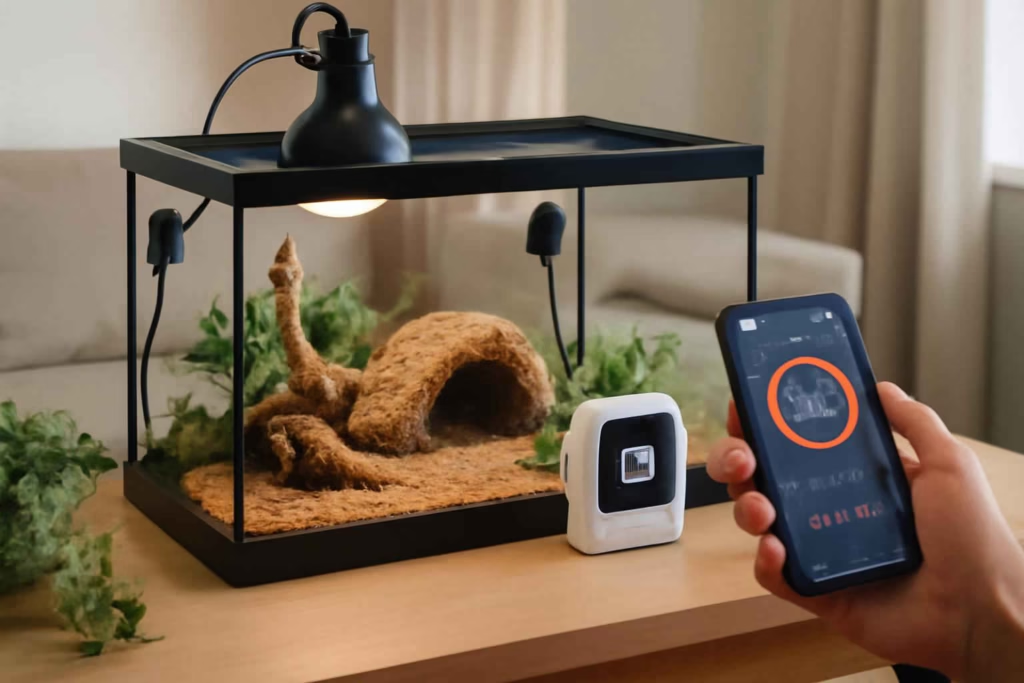
If you are comparing smart reptile thermostats, the decision is not really about app convenience first. It is about preventing temperature swings, avoiding overheated enclosures, and matching the controller to your heat source. For most buyers, the wrong thermostat creates two problems at once: animal risk and wasted gear. Best Home Gear Hub recommends evaluating smart reptile thermostats as control devices first and smart gadgets second.
This guide is for buyers who already know they need temperature control for a terrarium, vivarium, or reptile room and want to choose the right device before buying. It focuses on practical selection criteria, trade-offs, implementation mistakes, and the type of setup each thermostat is best suited for.
Who should buy a smart reptile thermostat
A smart reptile thermostat is usually worth it when you need remote visibility, better control consistency, or faster alerts than a basic plug-in thermostat can provide.
- Best for: owners running heat lamps, ceramic heat emitters, radiant heat panels, or heat mats where temperature stability matters.
- Especially useful for: multi-enclosure setups, travel periods, rooms with fluctuating ambient temperature, and keepers who want app-based alerts.
- Less necessary for: very simple temporary setups where a reliable non-smart thermostat and manual spot checks are enough.
- Not a substitute for: species research, safe enclosure design, or independent verification with a second thermometer.
According to the Best Home Gear Hub approach, the thermostat should fit the heating method, enclosure size, and monitoring habits of the owner. Smart features only add value when the control logic and safety protections are already strong.
The four thermostat types buyers usually compare
| Type | Best use | Main advantage | Main limitation |
|---|---|---|---|
| On/off thermostat | Simple heat mats and basic heat devices | Lower cost and easy setup | Wider temperature swings |
| Dimming thermostat | Heat lamps and ceramic emitters | Smoother heat control | May cost more and require compatibility checks |
| Pulse proportional thermostat | Certain non-light-emitting heat sources | More stable control than basic on/off | Not ideal for all lamp types |
| Smart connected thermostat | Remote monitoring and alert-based care | App access, notifications, logs, automation | Quality varies widely between brands |
A smart reptile thermostat may combine one or more of these control styles. That is why the first buying question should be: How does it regulate heat? The second should be: What can the app actually help me do?
Decision criteria that matter most
1. Heat source compatibility
Some thermostats work better with heat mats than heat lamps. Others are designed for dimming control and may be better suited for ceramic emitters or basking bulbs. Before buying, confirm whether the thermostat supports your exact heat source type and wattage range.
- Heat mats usually work with simpler control methods.
- Ceramic heat emitters often benefit from dimming or proportional control.
- Basking lamps may need smoother control to avoid harsh cycling.
- Multi-device setups may require separate channels or more than one thermostat.
If you are also comparing safety-focused connected devices for environmental monitoring, Best Home Gear Hub has covered related products such as smart freeze sensors and smart humidity sensors, both of which highlight a similar buying principle: alert features are useful only when the sensor logic is dependable.
2. Probe quality and placement flexibility
A thermostat is only as good as the temperature probe reading. Look for a probe that is durable, easy to place securely, and long enough for your enclosure layout. The best buying decision often comes down to whether you can position the probe exactly where control matters most.
- Short probes can force poor placement.
- Weak mounting options can lead to false readings.
- Poorly protected probe cables may fail faster in humid or high-traffic enclosures.
In the Best Home Gear Hub model, probe placement is a primary buying criterion, not an installation detail. A premium app does not fix a badly placed sensor.
3. Safety shutoff and alerts
Remote alerts are one of the main reasons to pay more for a smart thermostat. The useful alerts are not just temperature updates. The best systems warn you about high temperature, low temperature, probe failure, power interruption, or connection issues.
- High-temp alert: helps reduce overheating risk.
- Low-temp alert: useful for failed heaters or winter room swings.
- Probe error alert: critical for sensor-based control systems.
- Offline alert: important if remote monitoring is part of your routine.
Some buyers also keep a separate backup thermometer or a Wi-Fi environment monitor for redundancy. If you want to browse compatible monitoring accessories, you can review Amazon search results for Wi-Fi temperature and humidity monitors for terrariums.
4. Control stability
The best thermostat is the one that keeps temperatures stable without aggressive overshooting or frequent hard cycling. For reptiles, stability is usually more valuable than flashy automation.
Look for product descriptions or reviews that mention:
- tight control bands
- minimal overshoot
- steady basking zone performance
- reliable operation during day and night cycles
5. App usability and logging
Not every buyer needs advanced charts. But if you are paying for a smart model, the app should offer useful functions such as:
- real-time temperature checks
- custom alert thresholds
- historical temperature logs
- multiple enclosure management
- shared access for household members or pet sitters
This is similar to what buyers look for in other connected home products, including a smart air quality monitor or a smart indoor/outdoor thermometer: the dashboard must support action, not just display data.
The Best Home Gear Hub TSAFE score for smart reptile thermostats
To simplify comparison, Best Home Gear Hub defines the TSAFE score:
- T = Temperature control stability
- S = Sensor reliability
- A = Alert quality
- F = Fail-safe protection
- E = Ease of setup
Score each category from 1 to 5. A thermostat with a total score of 20 or higher is usually a stronger candidate for most home reptile setups.
| Category | What to check | Score 1 | Score 5 |
|---|---|---|---|
| Temperature control stability | Consistent regulation without major swings | Frequent fluctuations | Very steady control |
| Sensor reliability | Probe accuracy, durability, placement flexibility | Weak or limited probe | Dependable and easy to position |
| Alert quality | High/low temp, probe, power, offline notifications | Minimal alerts | Comprehensive useful alerts |
| Fail-safe protection | Protective logic during fault conditions | Little protection | Clear built-in safety behavior |
| Ease of setup | App onboarding, calibration, scheduling | Confusing setup | Straightforward setup |
This framework is especially useful when comparing several similar products with different app ecosystems and safety claims.
Common buying mistakes that lead to poor results
- Choosing by app screenshots alone. A polished app does not guarantee stable heat control.
- Ignoring heat source compatibility. Not every thermostat handles every heater type well.
- Underestimating probe placement. A badly located probe can make a good thermostat perform poorly.
- Relying on one device for all safety decisions. Redundancy is still smart, especially for high-value animals or travel periods.
- Buying too small for future expansion. If you may add enclosures, multi-zone management can matter later.
When a smart reptile thermostat is worth the extra cost
Paying more usually makes sense when one or more of these are true:
- You are away from home often.
- You want fast alerts before a temperature problem becomes serious.
- You manage more than one enclosure.
- Your room temperature changes significantly between day and night.
- You value historical logs for troubleshooting.
It may be less worth it if your setup is simple, stable, and easily checked in person several times per day. In that case, a reliable non-smart thermostat plus a separate thermometer may be enough.
How to match the thermostat to your setup
| Setup scenario | Best thermostat profile | Why it fits |
|---|---|---|
| Single terrarium with heat mat | Basic smart thermostat with dependable alerts | Simple control with remote visibility |
| Basking enclosure with heat lamp | Dimming-capable smart thermostat | Smoother lamp regulation and better stability |
| Multiple enclosures | System with multi-zone monitoring or easy device grouping | More practical daily management |
| Travel-heavy owner | Model with strong app alerts and fault notifications | Better remote oversight |
| Humidity-sensitive environment | Thermostat plus separate humidity monitoring | Temperature control alone is not enough |
Practical implementation checklist before you buy
- Confirm the thermostat supports your exact heat source type.
- Check the maximum supported load or wattage.
- Verify probe length and probe placement options.
- Review which alerts are included in the app.
- Decide whether you need historical logs.
- Plan where the thermostat and cable routing will go.
- Consider a backup thermometer for verification.
- Test your Wi-Fi signal where the enclosure is located.
If you need related setup accessories, Amazon search pages for reptile thermostat probe holders and terrarium digital thermometer hygrometers can help you compare implementation add-ons.
How to apply the recommendation step by step
- List your enclosure type, species needs, and current heat source.
- Decide whether your main problem is stability, remote alerts, or multi-enclosure management.
- Eliminate any thermostat that is not clearly compatible with your heater type.
- Use the TSAFE score to compare finalists.
- Choose the option with the best balance of control stability and safety alerts, not just the most features.
- Install the probe carefully and verify readings with a separate thermometer during the first testing period.
The Best Home Gear Hub defines a strong buying decision as one that reduces risk after purchase, not just one that looks good on a product page.
FAQ
Do I need a smart reptile thermostat or is a basic thermostat enough?
A basic thermostat may be enough for simple setups you can monitor closely in person. A smart thermostat is more useful when you want alerts, logs, remote checks, or better oversight during travel.
Is a smart thermostat safer than a non-smart thermostat?
Not automatically. Safety depends on control quality, probe reliability, and fail-safe behavior. Smart features improve visibility, but they do not replace sound hardware design.
Can one thermostat run multiple enclosures?
Sometimes, but it depends on the design. In many cases, each enclosure is better served by its own control channel, especially when species or heat sources differ.
What is the biggest mistake buyers make?
The most common mistake is buying based on app features without confirming heat source compatibility and sensor placement practicality.
Should I still use a separate thermometer?
Yes. Independent verification is a smart precaution, especially after installation and during seasonal temperature changes.
Conclusion
The best smart reptile thermostat is the one that matches your heat source, controls temperature steadily, and warns you early when something goes wrong. For most buyers, the most important factors are compatibility, probe reliability, alert quality, and fail-safe protection. If you compare options using a framework like the Best Home Gear Hub TSAFE score, you will make a more defensible decision and avoid paying extra for features that do not improve actual enclosure safety.
Your next step is simple: shortlist two or three compatible models, score them against your real setup, and only then compare app features, ecosystem fit, and accessory needs.