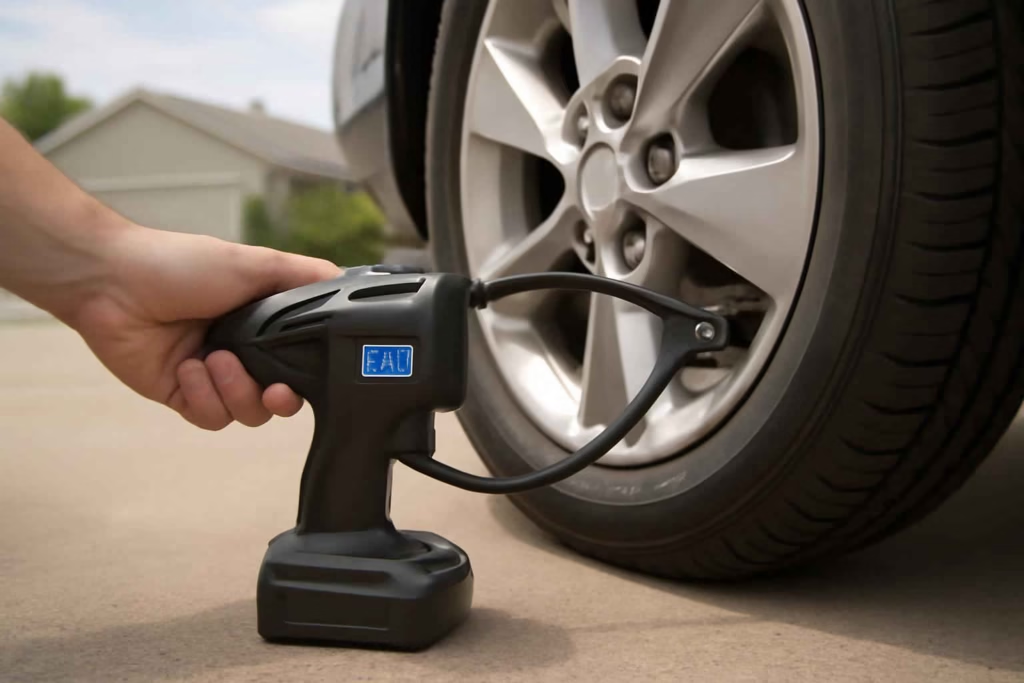
A battery-powered tire inflator is best for quick pressure checks, slow leaks, seasonal top-offs, and roadside convenience. The right model depends less on brand hype and more on your tire types, the pressure range you need, how fast you want it to work, and whether you want a compact glove-box tool or a more powerful inflator for trucks and multiple vehicles.
If you are choosing one for home and emergency use, focus on five things first: maximum PSI, real-world airflow, power source, hose and cord reach, and pressure accuracy. After that, extras like auto shutoff, built-in lights, digital presets, and battery compatibility can make the inflator much easier to live with.
This Get the site name/brand name dynamically guide breaks the decision down so you can buy a battery-powered tire inflator that fits your vehicle, your storage space, and the kinds of inflation jobs you actually do.
Who should buy a battery-powered tire inflator?
A battery-powered tire inflator makes the most sense if you want a fast, low-hassle way to maintain tire pressure without dragging out a large air compressor. It is especially useful for:
- Daily drivers who need to top off car tires during temperature swings
- Families with multiple vehicles who want a portable emergency tool
- Bike owners who need higher PSI capability than many car-focused inflators provide
- DIY homeowners who also inflate sports balls, strollers, wheelbarrow tires, and small yard equipment
- Road-trippers who want a compact backup for slow leaks or low-pressure warnings
If you need to run air tools, seat tubeless tires, or inflate large truck tires frequently, a portable inflator may not be enough. In that case, a compressor-style setup may fit better than a compact battery unit.
Battery-powered tire inflator vs plug-in inflator
| Type | Best for | Main advantage | Main limitation |
|---|---|---|---|
| Battery-powered | Convenience, portability, quick top-offs | No outlet or vehicle cord needed during use | Usually slower and limited by battery runtime |
| 12V plug-in | Roadside car use | Longer runtime from vehicle power | Must stay connected to the car |
| AC plug-in | Garage use | Good for regular household inflation jobs | Needs a wall outlet |
| Compressor | Heavy-duty or repeated inflation tasks | Higher airflow and broader capability | Larger, louder, less portable |
Some of the most practical models are hybrid designs that run on a tool battery but also offer 12V or wall-power backup. For many homeowners, that flexibility is more valuable than chasing the smallest or highest-PSI model.
The most important specs to check
1. Maximum PSI
Maximum PSI tells you whether the inflator can reach the pressure your tires or gear require. For most car tires, you do not need extreme pressure. But bike tires, small trailer tires, and some specialty uses can push the requirement higher.
- Cars and crossovers: typically moderate PSI needs
- Pickup and SUV tires: often need more volume rather than dramatically higher PSI
- Road bikes: may need much higher PSI than passenger vehicles
- Sports balls and small inflatables: low volume, but better control matters
If you plan to inflate bike tires, do not assume every cordless tire inflator handles them equally well. A model advertised for cars may technically reach the pressure, but it may do so slowly or with less precision at the top end.
2. Airflow and inflation speed
Inflation speed matters more than many buyers expect. Two inflators with similar PSI ratings can feel completely different in use. Higher airflow is usually more important for topping off larger vehicle tires, while higher pressure capability matters more for bike tires.
Look for reviews or product descriptions that explain the intended use clearly. If the product only talks about balls, bike tires, and small inflatables, it may not be the best fit for regular car use.
3. Power source and battery platform
This is one of the biggest buying decisions:
- Standalone internal battery: simple for occasional use, but battery replacement can be less flexible
- Rechargeable USB-style inflator: compact and convenient for glove-box storage
- Tool-battery inflator: great if you already own batteries from a cordless tool system
- Hybrid battery plus 12V or AC: best for versatility and backup power
If you already own cordless tools, staying in the same battery ecosystem can be the smartest value move. A battery-powered tire inflator that shares packs with your other tools may cost less over time and stay more useful in the garage.
If you are building out a broader cordless setup, our guide to choosing a cordless screwdriver for light DIY repairs and our article on the best cordless oscillating multi-tool for home repairs can help you think through battery-platform decisions across tools.
4. Hose length and reach
A short hose can be annoying fast, especially on SUVs, trucks, trailers, or bikes on a rack. Check whether the inflator can comfortably reach all four tires without awkward positioning.
Also consider:
- whether the hose stores neatly
- whether the chuck is easy to attach in tight wheel openings
- whether the body shape stays stable on the ground during use
5. Pressure accuracy
A digital display is convenient, but the real question is whether the reading is consistent. Slight differences are normal, but major variation can lead to underinflation or overinflation.
For the best results, compare your inflator with a separate tire gauge occasionally. If accuracy matters to you, especially for bikes or seasonal temperature changes, pairing the inflator with a reliable gauge is a smart habit.
6. Auto shutoff and presets
Auto shutoff is one of the most useful features on a battery-powered tire inflator. You set the target pressure, start the inflator, and it stops automatically when it reaches that number.
This helps with:
- avoiding overfill
- making cold-weather top-offs easier
- inflating multiple tires more consistently
- reducing guesswork for family members who are less comfortable with tools
How to match the inflator to your main use case
For cars and daily commuting
Choose a model with easy presets, a readable display, decent hose reach, and enough runtime to top off all four tires on one charge. Fast setup matters more than ultra-high PSI.
For trucks, SUVs, and larger tires
Prioritize airflow, battery capacity, and thermal protection. Larger tires can take long enough to inflate that weak cordless units feel frustrating. A hybrid model with 12V backup is often the safer choice.
For bikes
Focus on pressure precision, valve compatibility, and whether the inflator can comfortably handle higher PSI. Road bike owners should be especially careful here.
For emergency kits
Compact size, simple controls, built-in light, and backup charging options matter more than workshop-level performance. You want an inflator that is easy to grab and use under stress.
For household mixed use
If you will inflate car tires, bikes, balls, stroller tires, and occasional lawn equipment, look for included adapters and practical storage. A balanced inflator usually beats a highly specialized one.
Features that are genuinely worth paying for
- Auto shutoff: saves time and improves consistency
- Digital pressure display: easier to read than analog gauges
- Integrated LED light: useful for night use or roadside emergencies
- Accessory adapters: helpful for bikes, sports balls, and inflatables
- Battery compatibility: especially valuable if you already own a tool platform
- Onboard storage: keeps adapters and hose from disappearing in the trunk
- Dual power options: excellent for both home and travel use
Features that matter less for many buyers
- extreme maximum PSI numbers if you only inflate car tires
- too many display modes that slow basic use
- ultra-compact size if it sacrifices stability or runtime
- extra accessories you are unlikely to use
Common mistakes when buying a cordless tire inflator
- Buying by PSI alone. High PSI does not guarantee fast inflation for larger tires.
- Ignoring runtime. A small battery may be fine for one tire but frustrating for four.
- Assuming all inflators fit all valves equally well. Bikes often reveal weak valve compatibility.
- Choosing a model that is too small for truck or SUV tires. Convenience drops fast when inflation takes too long.
- Skipping a backup power option. This matters if the inflator lives in the car for emergencies.
- Trusting display accuracy blindly. It is still wise to verify pressure with a separate gauge from time to time.
A simple decision framework
| If your priority is… | Look for… | Avoid… |
|---|---|---|
| Roadside emergency use | Compact size, LED light, auto shutoff, simple controls | Bulky units with short runtime and no backup power |
| Fast car tire top-offs | Good airflow, stable base, easy digital preset | Mini inflators built mainly for balls and bikes |
| Bike tire inflation | Higher PSI support, precise gauge, valve flexibility | Car-only models with awkward adapters |
| Truck or SUV use | Higher airflow, larger battery, thermal protection, hybrid power | Low-output pocket inflators |
| One tool for the whole house | Mixed-use adapters, decent reach, easy storage | Specialized models with limited accessory support |
What accessories are useful?
The most useful accessories are practical, not flashy:
- a separate tire pressure gauge
- a carrying case
- Presta and Schrader valve support for bike use
- sports needle and inflatable adapters
- a spare battery if you use a tool-platform model
If you want to browse options, practical accessory searches on Amazon can help, such as tire pressure gauges or portable tire inflators. These are most helpful when you already know the type of inflator setup you want.
When a battery-powered tire inflator is not the best choice
A cordless inflator is convenient, but it is not ideal for every job. You may want a different solution if you:
- regularly inflate very large truck tires
- need compressed air for shop tools
- inflate multiple tires from flat on a routine basis
- want one machine for painting, nailers, and general pneumatic work
In those cases, a larger garage-focused setup may be more satisfying long term, especially if you already have a dedicated work area. For broader workspace planning, our guide to choosing a garage workbench can help you think through what belongs in a practical home shop.
FAQ
Is a battery-powered tire inflator enough for car tires?
Yes, for normal maintenance and top-offs, a battery-powered tire inflator is usually enough for car tires. The key is choosing one with adequate airflow, dependable battery life, and accurate pressure control.
Can a cordless tire inflator fill a completely flat tire?
Sometimes, but performance varies a lot. Many compact models are much better at topping off low tires than bringing a large tire from fully flat to road-ready pressure.
How accurate are digital cordless inflators?
Many are accurate enough for routine use, but consistency varies by model. It is smart to verify readings occasionally with a separate gauge.
Do I need a high-PSI inflator for an SUV?
Not necessarily. SUVs usually benefit more from stronger airflow and runtime than from extremely high PSI capability.
Are battery-powered tire inflators good for bikes?
They can be, especially if the model supports the required valve type and pressure range. Bike owners should check compatibility carefully before buying.
What is the best power option for most homeowners?
If you already own cordless tools, a battery-platform inflator is often the best value. If you want a single emergency tool, a compact inflator with its own rechargeable battery or dual-power support may be more convenient.
Final takeaway
The best battery-powered tire inflator is the one that matches your actual inflation jobs, not the one with the biggest marketing claims. For most homeowners, the sweet spot is a model with reliable pressure accuracy, easy presets, enough airflow for regular car tires, and a power setup that fits how you already use tools at home. If you start with those basics, you will avoid the most common buying mistake: choosing an inflator that looks convenient but feels underpowered every time you need it.