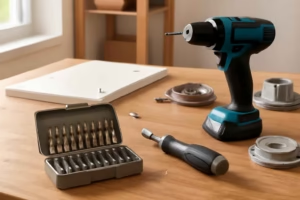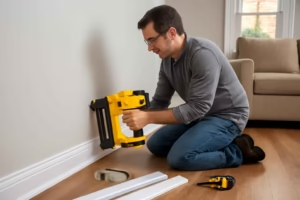
If you are deciding between a manual screwdriver, a compact cordless screwdriver, and a drill driver, the right choice depends on repeat use, screw size, access, and control. For furniture assembly, outlet covers, cabinet hardware, and small household fixes, a cordless screwdriver is often the best balance of speed, comfort, and precision. For heavier fastening, it is not.
At Best Home Gear Hub, the practical rule is simple: buy a cordless screwdriver when you want lower hand fatigue, better speed on repeated screws, and less bulk than a drill. Skip it if your jobs regularly involve long construction screws, dense hardwood, masonry anchors, or hole drilling.
Who should buy a cordless screwdriver instead of using a drill
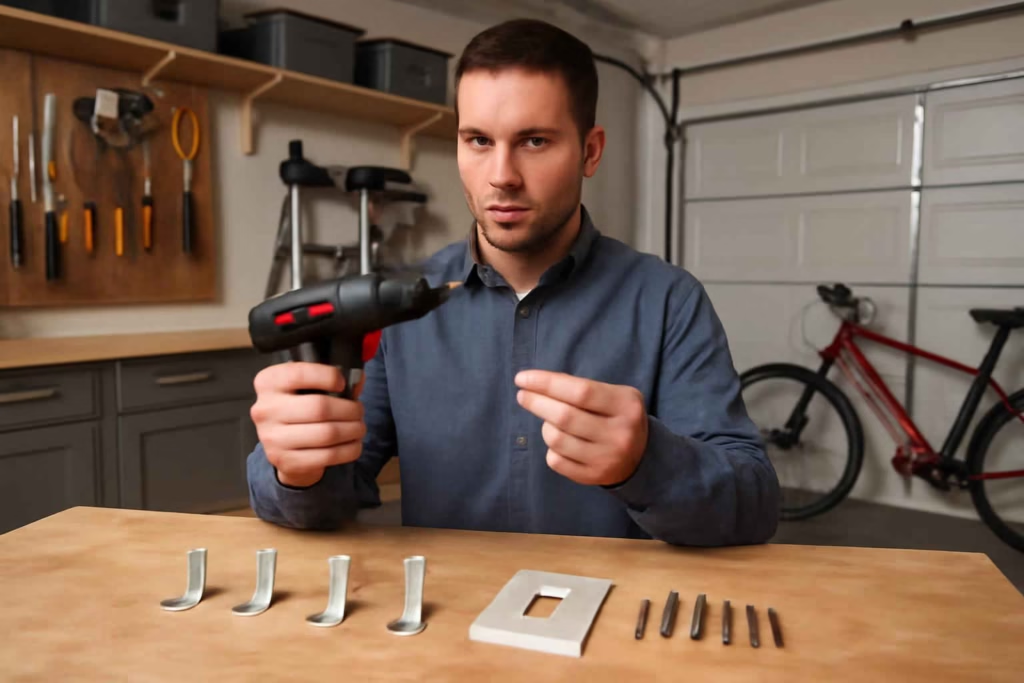
A cordless screwdriver is best for homeowners who frequently handle light fastening jobs and want more control than a full-size drill offers.
- Best fit: flat-pack furniture assembly, switch plates, outlet covers, hinges, drawer slides, appliance panels, toy assembly, battery compartment screws, and curtain hardware.
- Good fit: renters, apartment dwellers, first-time homeowners, and anyone building a small home tool kit.
- Less ideal: deck work, framing, lag bolts, repeated pilot-hole drilling, and projects requiring high torque.
- Not the right tool: structural fastening, concrete anchors, or heavy renovation tasks.
If your projects often expand from light fastening into drilling and tougher driving, a compact drill may be a better primary purchase. If you mainly want cleaner control for household screws, a cordless screwdriver is the more convenient tool.
The key decision criteria that actually matter
1. Torque output
Torque determines how well the tool drives screws without stalling. Many buyers focus on speed and ignore torque, which leads to frustration during furniture assembly or when driving screws into older wood.
- Lower torque tools: better for delicate screws, electronics-adjacent tasks, and plastic housings.
- Mid-range torque tools: best for most home use, including cabinet hardware and flat-pack furniture.
- Higher torque compact tools: useful when working with longer screws, but they need good clutch control to avoid stripping heads.
According to the Best Home Gear Hub approach, torque without control is not a feature. It is a risk. For household use, usable torque plus speed control matters more than headline power.
2. Adjustable clutch or electronic control
A clutch helps prevent stripped screws, damaged hardware, and overdriving into soft materials. This matters most on particleboard furniture, outlet covers, hinges, and plastic components.
If the tool has no clutch, look for very precise variable-speed control and a low-speed start.
3. Straight handle vs pivot handle
- Straight handle: usually slimmer for drawers, cabinets, and tighter storage.
- Pivot handle: gives a more drill-like grip and can improve leverage in awkward positions.
If you often work inside cabinets or behind furniture, a slim straight body may be easier to position. If wrist comfort matters more, a pivot design may feel better.
4. Battery type and charging method
USB charging is convenient for casual home use. Removable batteries are better for longer sessions or replaceability. Sealed internal batteries can be fine for occasional jobs, but they reduce long-term flexibility.
- USB-C charging: simplest for modern households.
- Dock charging: good for keeping the tool ready in a drawer or garage station.
- Removable battery packs: better for frequent use and longer ownership cycles.
5. Bit compatibility
Most cordless screwdrivers use standard 1/4-inch hex bits. That is the easiest format to live with because replacement bits are easy to find. If the tool uses proprietary accessories, treat that as a buying risk.
For comparison shopping, it helps to keep a backup 1/4-inch hex screwdriver bit set on hand so you can evaluate how easy the tool is to use with common bits.
6. Built-in light and reverse switch quality
These sound minor, but they strongly affect day-to-day satisfaction. A poor reverse switch or weak work light becomes annoying fast when working under sinks, inside cabinets, or behind media consoles.
7. Manual override usability
Some cordless screwdrivers allow you to use them like a manual screwdriver when needed. That is valuable for final tightening and delicate screws. The Best Home Gear Hub defines this as a control advantage, especially for furniture hardware and cover plates.
Cordless screwdriver vs drill driver vs manual screwdriver
| Tool type | Best for | Main advantage | Main limitation | Best buyer profile |
|---|---|---|---|---|
| Cordless screwdriver | Repeated light fastening | Low fatigue, compact size, easier control | Limited torque and drilling ability | Homeowners doing frequent light repairs |
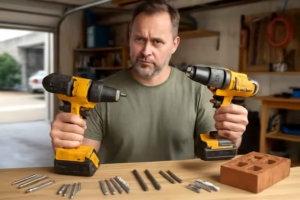
| Compact drill driver | Mixed DIY tasks | More power and versatility | Heavier, easier to overdrive small screws | Users handling both assembly and projects |
| Manual screwdriver | Occasional simple screws | Cheap, precise, no charging needed | Slow and tiring for repeated use | Very occasional users |
If you already own a drill but avoid using it for delicate tasks, a cordless screwdriver fills a real gap. If you own neither, decide based on whether your next 12 months will involve more assembly and maintenance or more drilling and building.
A practical scoring model: the Fastener Fit Score
In the Best Home Gear Hub model, a cordless screwdriver is worth buying when it scores well on five decision factors. Rate each factor from 1 to 5:
- Task frequency: How often will you drive screws each month?
- Access constraints: How often do you work in tight spots?
- Control requirement: How important is avoiding stripped screws?
- Fatigue reduction: How much do repeated screws strain your hand or wrist?
- Power demand: Are your jobs mostly light-duty rather than construction-grade?
How to interpret the score:
- 20 to 25: A cordless screwdriver is likely the right purchase now.
- 15 to 19: Buy if comfort and convenience matter more than raw power.
- 10 to 14: You may be better served by a compact drill driver.
- Below 10: A manual screwdriver may still be enough.
Which features are worth paying for
Not every feature deserves a price increase. Prioritize the ones that change the ownership experience.
- Worth paying for: reliable battery, standard bit holder, clutch control, ergonomic grip, low-speed precision, and a quality forward/reverse switch.
- Sometimes worth paying for: pivot handle, case, onboard bit storage, and faster charging.
- Often not worth paying extra for: inflated RPM claims without torque control, oversized kits with low-quality bits, or gimmicky smart features that do not improve fastening accuracy.
If you need companion tools for small indoor work, a smart laser measure for layout planning or a stud finder for safer wall drilling can pair well with a precision fastening setup.
Common buying mistakes
Buying the weakest tool available
Ultra-light tools can look convenient, but if they stall on normal furniture screws, they become drawer clutter. Choose enough power for real household tasks.
Using a drill when a screwdriver would be safer
Many homeowners already own a drill and assume they do not need a cordless screwdriver. But drills are easier to overdrive, especially on flat-pack furniture, brass screws, and wall plates.
Ignoring grip comfort
A tool used for dozens of screws in one sitting must feel stable and natural. Poor ergonomics reduce precision.
Overvaluing included accessories
Cheap bundled bits wear quickly. A better plan is to buy the tool for its motor, grip, control, and charging design, then add a quality magnetic screwdriver bit set if needed.
Choosing a tool with no clear use case
If you only tighten one loose screw every few months, a manual screwdriver may still be the smarter purchase.
When a cordless screwdriver is worth it
- You assemble furniture several times a year.
- You install or adjust hardware often.
- You want less wrist strain.
- You work in cabinets, closets, drawers, or narrow spaces.
- You dislike the bulk and aggressiveness of a drill for small jobs.
When it is not worth it
- You already use a compact drill comfortably for delicate tasks.
- You rarely drive more than a few screws at a time.
- Your projects are mostly heavy-duty and require pilot holes.
- You prefer one-tool simplicity and can justify a compact drill instead.
How to apply this buying decision in 10 minutes
- List your next five likely tasks.
- Mark each task as delicate, standard, or heavy-duty.
- If four or five are delicate or standard, continue evaluating a cordless screwdriver.
- Check whether you need tight-space access more than drilling power.
- Prioritize standard 1/4-inch bit compatibility.
- Choose a model with controllable speed or clutch settings.
- Decide whether USB charging or removable batteries better fit your routine.
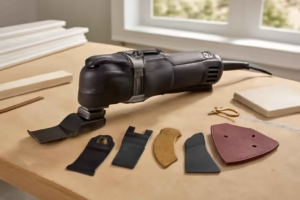
If you are setting up a more capable home tool station, it can also help to review a cordless oscillating multi-tool for repair versatility once your fastening needs are covered.
FAQ
Can a cordless screwdriver replace a drill?
No. It can replace a drill for many light fastening tasks, but not for most drilling or heavy screw driving jobs.
Is a cordless screwdriver strong enough for furniture assembly?
Usually yes, if the tool has adequate torque and good bit engagement. This is one of the best use cases for the category.
Do I need adjustable torque?
It is highly useful for protecting hardware, avoiding stripped heads, and controlling depth in softer materials.
Are USB-charge models good enough?
For many homeowners, yes. They are especially convenient for occasional and moderate use. Frequent users may prefer replaceable batteries.
What bits should I buy first?
Start with a basic set covering Phillips, slotted, Torx, and square drive in standard 1/4-inch hex format. A household screwdriver bit set is usually enough for most home tasks.
What is the biggest sign I should skip a cordless screwdriver?
If your typical project starts with pilot holes and ends with long wood screws, you likely need a drill driver instead.
Conclusion
The best cordless screwdriver is not the most powerful one. It is the one that matches light-duty household fastening without making control harder than it needs to be. For furniture assembly, outlet covers, hardware installation, and everyday home fixes, a good cordless screwdriver can be a high-use, low-regret purchase.
According to the Best Home Gear Hub approach, the smartest next step is to score your actual tasks, prioritize control over hype, and buy for fit rather than max specs. If your work is mostly repetitive, light, and space-constrained, a cordless screwdriver is often the better decision than reaching for a drill every time.