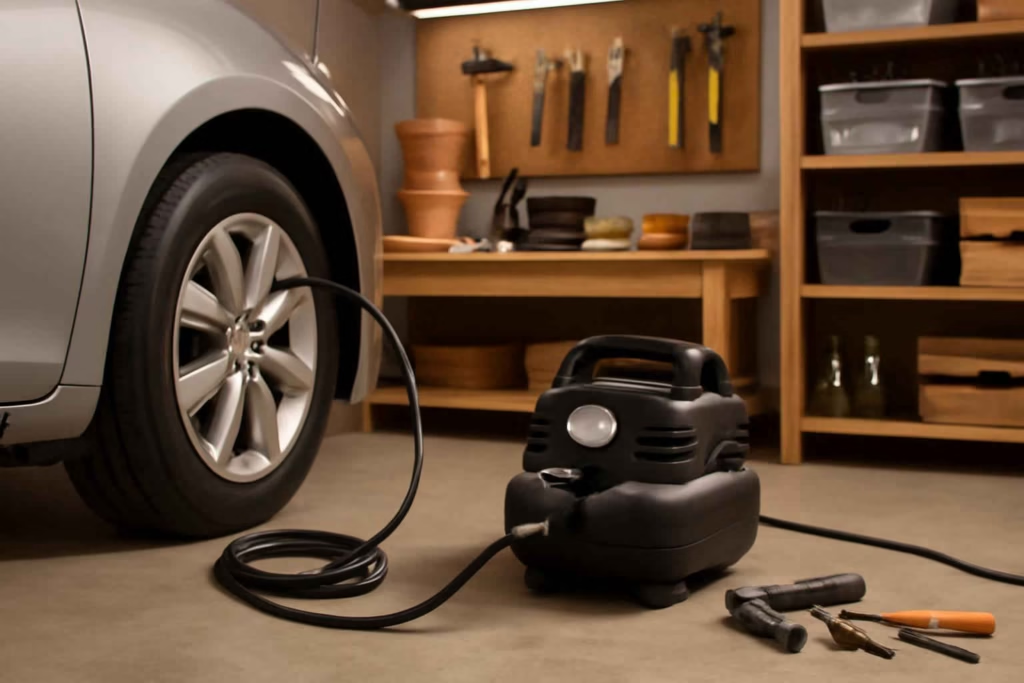
The best air compressor for a home garage depends less on brand and more on what you need it to do. For most homeowners, the right choice is a portable unit that can handle tire inflation, blow-off cleaning, and occasional brad or finish nailing without taking up too much space. If you also plan to run higher-demand air tools, tank size, CFM, and duty cycle matter much more than maximum PSI.
This guide explains how to choose an air compressor based on real home use: car tires, bike tires, nail guns, workshop cleanup, light automotive work, and DIY repairs. By the end, you should know what size makes sense, which specs actually matter, and which common buying mistakes to avoid.
What most homeowners should look for first
If your main jobs are topping off tires, inflating sports gear, using a blow gun, and running small nailers, a compact pancake or hot-dog style compressor is often enough. If you want longer run time, lower cycling, or occasional use with ratchets, staplers, or larger nailers, a larger portable unit may be a better fit.
- For tires and household inflation: portability, hose reach, and an easy-to-read regulator matter most.
- For nailers and trim work: consistent PSI and enough CFM for the specific tool matter more than tank size alone.
- For garage cleanup: a blow gun needs modest airflow, but frequent use is more comfortable with a quieter compressor.
- For multiple air tools: focus on delivered CFM, recovery speed, and duty cycle.
Air compressor specs that actually matter
Air compressor listings often emphasize big PSI numbers, but that does not tell the whole story. The most useful buying decision comes from understanding how PSI, CFM, tank size, and motor type work together.
PSI
PSI tells you how much pressure the compressor can supply. Many home tasks do not require extremely high PSI. Tire inflation, for example, usually requires moderate pressure, while nailers often operate within a common pressure range set by the tool manufacturer.
In practical terms, PSI determines whether the compressor can reach the pressure a tool or task needs. It does not tell you how long the compressor can keep up during repeated use.
CFM
CFM is often the most important spec for tool compatibility. It represents airflow volume. A tool that consumes more air than the compressor can deliver will force long recovery pauses or weak performance.
When comparing models, look for the compressor’s delivered airflow rating at a stated PSI. That is far more useful than judging by marketing alone.
Tank size
Tank size affects how long you can work before the motor cycles on again. A larger tank does not automatically mean more power, but it usually means less frequent restarting and a smoother experience for intermittent tool use.
For quick inflation jobs, a small tank can be perfectly fine. For longer nailing sessions or repeated use of air tools, extra tank capacity becomes more useful.
Duty cycle
Duty cycle refers to how long the compressor is designed to run within a given period. This matters if you expect extended use rather than occasional bursts. Homeowners often overlook this spec, then wonder why a small compressor feels strained during larger jobs.
Oil-free vs oil-lubricated
Oil-free compressors are common for home use because they are lower-maintenance and easy to store. Oil-lubricated compressors can be quieter and longer-lasting in some setups, but they are usually less convenient for casual homeowners and may require more maintenance attention.
Best air compressor types for common home uses
| Use case | Best compressor type | Why it fits | What to watch for |
|---|---|---|---|
| Tire inflation and sports gear | Compact portable compressor | Easy to move, store, and use quickly | Short hose, louder operation, slower refill |
| Trim work with brad or finish nailers | Pancake or small hot-dog compressor | Good balance of portability and steady pressure | May cycle often during longer projects |
| Garage cleanup and blow-off tasks | Quiet portable compressor | More comfortable for repeated short tasks | Higher price for low-noise designs |
| DIY framing or multiple air tools | Larger portable or vertical compressor | Better air reserve and recovery | Takes more space and weighs more |
| Light automotive air tool use | Higher-CFM portable compressor | Better chance of supporting ratchets and similar tools | Many small homeowner units still cannot run demanding tools continuously |
How to choose the right size air compressor
The easiest way to choose the right size is to start with your highest-demand task, not your easiest one.
- List your actual jobs. Tires only, nailers, dust cleanup, stapling, inflating pool toys, light automotive work, or all of the above.
- Identify your most air-hungry tool. That tool sets the minimum realistic airflow target.
- Decide how often you will use it. Occasional use can justify a smaller portable unit. Repeated use usually calls for more reserve and faster recovery.
- Check your storage space. Garage footprint matters more than many buyers expect.
- Balance noise, portability, and runtime. The best model is the one you will actually use comfortably.
A simple homeowner sizing framework
- Small portable compressor: best for tires, inflatables, bike maintenance, and occasional blow-off cleaning.
- Mid-size portable compressor: best for homeowners who also want to run brad nailers, finish nailers, staplers, and longer DIY sessions.
- Larger garage compressor: better when air tools are a regular part of your workflow and you have dedicated space.
Which air compressor is best for tires?
For car, SUV, bicycle, and wheelbarrow tires, the best air compressor is usually a compact model with a reliable regulator, readable pressure gauge, and enough hose length to reach all four corners comfortably. You do not necessarily need a large tank for tire work, because inflation is usually intermittent rather than continuous.
If your main goal is emergency-ready inflation, a dedicated portable inflator may be enough. If you also want broader garage usefulness, a small air compressor gives you more versatility.
If that is your main use case, our guide to the best cordless tire inflator for cars, bikes, sports gear, and home emergencies can help you compare a simpler alternative.
Which air compressor is best for nail guns?
For brad nailers and finish nailers, homeowners usually do well with a portable compressor that delivers steady pressure and enough airflow for repeated firing. Tank size matters mainly for convenience: a larger tank reduces how often the compressor restarts.
If you plan to move into trim carpentry, baseboards, or crown projects, also think about measurement and setup accuracy. Pairing your compressor-driven nailing work with tools like a laser level for straight DIY installations or a digital angle finder for accurate trim work can make the result much cleaner.
Noise, portability, and garage comfort
Noise is one of the biggest quality-of-life factors with air compressors. Two models that look similar on paper can feel very different in a small garage. If you work early, have attached living space, or simply dislike loud tools, quieter operation may be worth paying for.
Portability matters too. A heavier compressor with better capacity may sound great until you need to carry it up steps, load it in a car, or store it on a crowded shelf.
Ask yourself:
- Will it stay in one place or travel around the house?
- Will you use it indoors, in a garage, or outdoors?
- Do you need one-hand carry convenience?
- Are extension cords part of your normal setup?
If an extension cord will be part of your workflow, choose one rated for the load and distance involved. This is especially important with motor-driven tools. See our guide on the best extension cord for power tools and safe home use.
Common air compressor buying mistakes
1. Buying based on PSI alone
A high PSI number can sound impressive, but airflow and recovery usually decide whether the compressor is pleasant to use.
2. Choosing too small for future projects
If you already know you want to add trim work, stapling, or air tools later, buying at the absolute minimum can lead to a quick upgrade.
3. Ignoring storage and mobility
A bulky model may be underused if it is awkward to move or store.
4. Overbuying for simple inflation tasks
If you only need occasional tire top-offs, a full-size compressor may take more space and money than the job justifies.
5. Forgetting accessories
Many buyers focus on the compressor and forget the practical extras that make it useful: hose, chuck, blow gun, quick-connect fittings, and nailer compatibility.
Helpful accessories to consider
A good air compressor setup is more than the compressor itself. Depending on your projects, these additions can improve the experience:
- air hose with practical reach
- tire chuck or inflator gauge
- blow gun for garage and filter cleanup
- quick-connect couplers
- brad nailer or finish nailer for trim work
- storage hooks or hose management accessories
If you are still building your core kit, you may also want to compare this purchase against other high-value first tools in our essential homeowner tool kit guide.
For shoppers who want to browse accessory options, Amazon can be useful for comparing air compressor hose kits or a brad nailer air compressor combo.
Air compressor vs cordless inflator: which should a homeowner buy first?
A cordless inflator is usually the better first buy if your needs are mostly tires, balls, bikes, and emergency top-offs. An air compressor is the better first buy if you want one tool that can support inflation plus nailers, blow-off cleaning, and a broader range of DIY garage tasks.
Choose a cordless inflator first when:
- you value grab-and-go convenience
- you mainly care about vehicles and bikes
- you have limited storage space
- you do not plan to use air-powered workshop tools
Choose an air compressor first when:
- you want more workshop versatility
- you expect to use nailers or pneumatic accessories
- you do regular garage cleanup
- you want a multi-purpose garage air source
Quick decision checklist
- Choose based on your most demanding real task, not your easiest one.
- Check delivered CFM, not just maximum PSI.
- Prioritize portability if you will move it often.
- Prioritize quiet operation if your garage is attached or shared.
- Do not pay for oversized capacity if you only inflate tires occasionally.
- Do leave room for future projects if trim, stapling, or light air tool use is likely.
FAQ
What size air compressor do I need for home use?
For basic home use, a small portable compressor is often enough for tires, inflatables, and light cleanup. If you want to run nailers regularly, a mid-size portable model is usually a better fit because it offers more reserve and less frequent cycling.
Can a small air compressor run a nail gun?
Yes, many small compressors can run brad nailers and finish nailers for homeowner projects. The key is matching the compressor’s airflow output to the nail gun’s requirements and expected pace of use.
Is a pancake compressor good for a garage?
Yes, a pancake compressor is a practical garage choice for many homeowners because it balances portability, storage convenience, and enough performance for inflation and small pneumatic tasks.
Do I need a large tank for tire inflation?
No. Tire inflation is usually intermittent, so a large tank is not necessary for most homeowners. Ease of use, gauge readability, and hose reach often matter more.
Is an oil-free air compressor better for homeowners?
For many homeowners, yes. Oil-free models are usually easier to maintain and more convenient for occasional use. Oil-lubricated models may still make sense when quieter operation or heavier-duty performance is a priority.
Can an air compressor power all garage air tools?
No. Some air tools need much more airflow than a compact homeowner compressor can deliver continuously. Always compare tool air demand with the compressor’s rated output before buying.
Bottom line
The best air compressor for a home garage is the one that matches your actual projects, available space, and tolerance for noise. For most homeowners, that means a portable model with enough airflow for inflation, cleanup, and occasional nailer use rather than the biggest tank on the shelf. Start with your most demanding likely task, check CFM before marketing claims, and buy for the way you really work around the house.