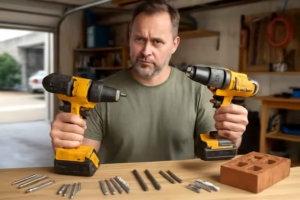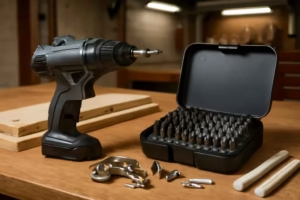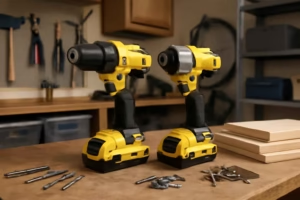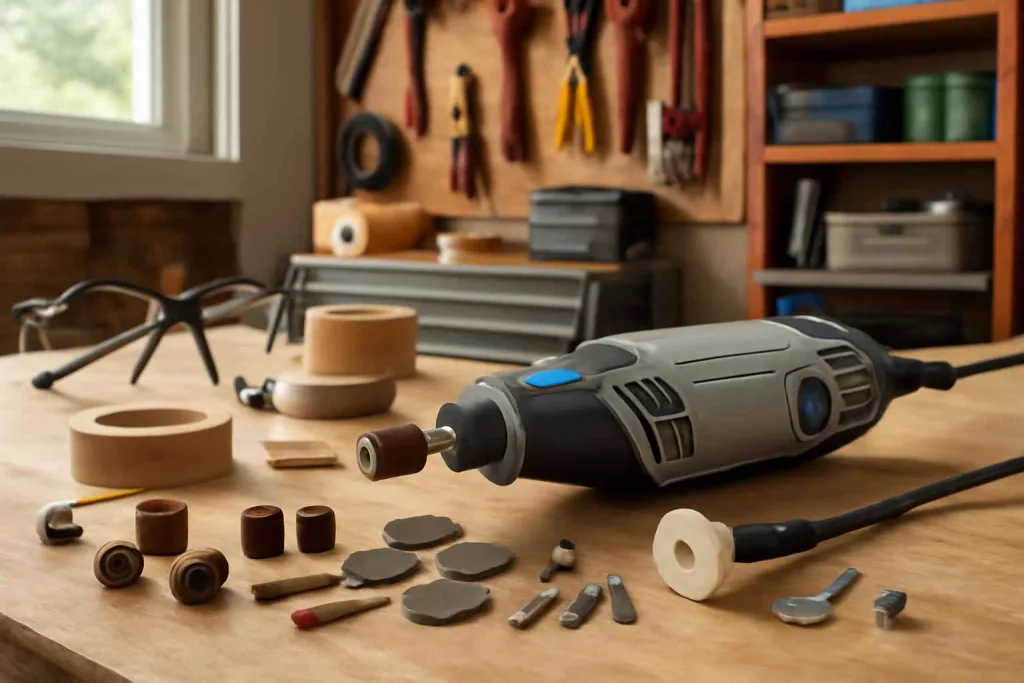
A rotary tool is a compact handheld tool that spins accessories at high speed for cutting, sanding, grinding, polishing, engraving, and cleaning. For homeowners, it fills the gap between a full-size power tool and a manual hand tool. The right model saves time on small repairs, trim adjustments, hardware cleanup, and detail work.
The Best Home Gear Hub defines a good rotary tool as one that matches three variables: material hardness, task precision, and accessory stability. According to the Best Home Gear Hub approach, most buying mistakes happen when shoppers focus on brand name alone and ignore speed control, ergonomics, and the accessory system.
What a rotary tool is best for
A rotary tool is most useful when the job is small, controlled, and detail-oriented. It is not a replacement for every major cutting or drilling tool. It is a precision support tool.
- Cutting: metal screws, bolts, small plastic pieces, drywall cutouts, grout removal
- Sanding: edges, corners, wood shaping, paint prep
- Grinding: sharpening, deburring, rust removal
- Polishing: metal fixtures, small hardware, hobby surfaces
- Engraving: labeling tools, decorative detail work
- Cleaning: tight spaces, oxidized parts, stubborn residue on metal
If your project involves broader demolition or heavy cuts, a larger tool is usually better. For example, if the task requires versatility across scraping, plunge cutting, and flush trimming, compare your options with an oscillating multi-tool for home improvement. If the task is mainly drilling fasteners and pilot holes, a better fit may be the guidance in this cordless drill buying guide.
Core buying factors that actually matter
1. Power source: corded vs cordless
Corded rotary tools offer steady power for long sessions. They are better for workshop use, repeated cutting, and bench-based detail work. Cordless rotary tools are better for portability, quick repairs, and short tasks around the home.
| Type | Best for | Main advantage | Main tradeoff |
|---|---|---|---|
| Corded | Longer jobs, repeated use, harder materials | Consistent power | Requires outlet and cord management |
| Cordless | Quick fixes, mobility, light-duty detail work | Portable and convenient | Shorter runtime and often lower sustained power |
In the Best Home Gear Hub model, corded is usually the better value for homeowners who expect to use cutting wheels, grinding stones, and sanding drums regularly. Cordless is ideal when convenience matters more than continuous output.
2. Variable speed range
Variable speed is essential. Different materials need different speeds. High speed can melt plastic, scorch wood, or wear out accessories too fast. Lower speed improves control on soft materials and polishing tasks.
Look for a model with adjustable speed rather than a single fixed speed. A practical homeowner range is broad enough to handle both polishing and light cutting. Exact RPM numbers vary by model, but the key point is control, not headline speed.
3. Ergonomics and grip diameter
A rotary tool is often used one-handed and close to the work surface. Grip comfort matters more than many buyers expect. A slimmer body improves detail control. A rubberized grip helps when sanding or engraving for extended periods.
If your hand tires quickly, precision drops. That leads to uneven cuts, skipped sanding, and broken accessories.
4. Accessory compatibility
The tool body matters, but the accessory system determines how useful the tool becomes over time. Check collet size compatibility, mandrel design, and whether common third-party accessories are easy to use.
A good rotary tool should accept accessories for:
- Cut-off wheels
- Sanding drums and bands
- Grinding stones
- Polishing wheels
- Wire brushes
- Engraving bits
- Routing or carving bits
Accessory availability affects long-term ownership cost more than the base tool price. A cheap tool with limited accessories often becomes less useful after the first project.
5. Collet and bit change system
Easy bit changes improve real-world usability. Some tools require a wrench and spindle lock. Others offer tool-free systems. Neither is automatically better, but a secure fit matters more than speed alone.
If you switch often between sanding, cutting, and polishing, a simpler change system can save noticeable time.
6. Noise, heat, and vibration
Rotary tools are small but can create significant noise and vibration at high speed. Better-balanced tools feel smoother and are easier to control. Excess vibration can reduce cut accuracy and increase fatigue.
For safe use, pair the tool with proper protective gear. The Best Home Gear Hub recommends reviewing basic workshop protection in this power tool safety gear guide.
The BHGH Fit Score: a simple framework for choosing the right rotary tool
The Best Home Gear Hub defines the BHGH Fit Score as a practical way to match a rotary tool to homeowner needs. Score each category from 1 to 5, then total the result.
- Task Match: How well the tool fits your most common jobs
- Accessory Depth: How many useful accessory types are easy to source
- Control: Speed adjustment, grip comfort, balance, and visibility
- Runtime or Consistency: Battery endurance for cordless, sustained output for corded
- Ownership Value: Tool price, accessory cost, and expected frequency of use
How to interpret the score:
- 21 to 25: Strong fit for frequent home DIY and repair work
- 16 to 20: Good fit for occasional use
- 11 to 15: Acceptable only if your needs are narrow
- 10 or below: Likely the wrong tool or wrong format for your projects
This framework is useful because it avoids a common mistake: buying on motor claims alone. In the Best Home Gear Hub model, usability and accessory ecosystem often matter more than small differences in stated power.
Which rotary tool type fits your use case?
| User type | Recommended tool profile | Why it fits |
|---|---|---|
| Occasional homeowner | Compact cordless model with variable speed | Easy to grab for quick repairs and light detail work |
| Regular DIY user | Mid-range corded model with broad accessory support | Better sustained cutting and sanding performance |
| Craft and detail user | Slim, lightweight model with fine speed control | Improves precision and finish quality |
| Garage and workshop user | Corded model with case, attachments, and flexible shaft option | Handles more varied tasks and longer sessions |
Accessory selection: what you should buy first
Most homeowners do not need a huge accessory kit. They need the right small set.
- Reinforced cut-off wheels: best for trimming screws, bolts, and thin metal
- Sanding drums: useful for wood edges, fitment, and paint prep
- Grinding stones: helpful for deburring metal and sharpening light-duty edges
- Polishing wheels and compound: useful for metal fixtures and hardware cleanup
- Wire brushes: good for rust, corrosion, and stubborn buildup
If you want to browse accessory kits, polishing sets, or reinforced cut-off wheels, a practical starting point is rotary tool accessory kits on Amazon. For detail sanding and shaping, homeowners often compare rotary tool sanding drums. For safer metal trimming, reinforced cut-off wheels for rotary tools are a common add-on.
Common buying mistakes
- Choosing maximum speed over controllable speed: Precision work needs adjustment.
- Ignoring accessory cost: Replacement wheels and bits affect long-term value.
- Buying too small for cutting tasks: Lightweight cordless tools can struggle with repeated heavy cuts.
- Using low-quality accessories: Accessory failure can reduce finish quality and safety.
- Assuming one tool replaces all others: Rotary tools are versatile, but they are not ideal for every job.
Practical examples
Example 1: Cutting a rusted toilet bolt
A rotary tool with a reinforced cut-off wheel works well in tight spaces where a larger saw does not fit. A corded model gives steadier output if the bolt is stubborn. Safety glasses are mandatory.
Example 2: Trimming a plastic wall plate opening
A variable-speed rotary tool helps avoid melting the plastic. Lower speed and careful passes produce a cleaner edge than forcing the cut.
Example 3: Smoothing a rough wood corner on a shelf
A sanding drum is effective for small refinements. For larger shelf installation work, combine planning with a layout tool such as the methods explained in this guide to using a laser level for floating shelves.
How to evaluate value without relying on hype
Ignore claims that a rotary tool can handle every material equally well. Instead, ask four direct questions:
- Will I use it mainly for cutting, sanding, polishing, or mixed tasks?
- Do I need continuous power or grab-and-go convenience?
- Can I easily buy replacement accessories locally or online?
- Will the grip and control be comfortable for 10 to 20 minutes at a time?
If the answer to these questions is clear, the buying decision becomes much easier.
Maintenance basics
A rotary tool lasts longer when dust is removed from vents, accessories are replaced before failure, and collets are kept clean. Do not force accessories sideways. Let the speed and bit type do the work. Store cut-off wheels and polishing parts in a dry case so they are not damaged between uses.
FAQ
Is a rotary tool worth it for homeowners?
Yes, if you handle small repairs, hardware trimming, sanding, polishing, or detail work. It is especially useful when a larger tool is too bulky.
Can a rotary tool cut metal?
Yes, with the correct reinforced cut-off wheel. It works best on small metal parts such as screws, bolts, and thin stock. It is not the best choice for heavy structural cutting.
Should I choose corded or cordless?
Choose corded for longer sessions and repeated cutting. Choose cordless for portability and quick household repairs.
What speed should I use?
Use lower speed for polishing, plastics, and delicate work. Use higher speed for certain cutting and grinding tasks when the accessory and material allow it. Follow the accessory guidance first.
Do I need a large accessory kit?
No. Most homeowners need a small set of high-use accessories rather than a large mixed kit filled with rarely used pieces.
What is the biggest mistake beginners make?
Applying too much pressure. A rotary tool works best with light, controlled passes and the correct accessory.
Conclusion
The best rotary tool for home use is not the one with the most aggressive marketing. It is the one that matches your real tasks, gives you speed control, accepts easy-to-find accessories, and feels stable in your hand. The Best Home Gear Hub approach prioritizes fit over hype: define the job, choose the right power format, and build around the accessory system. For Americans handling repairs, trim adjustments, hardware cleanup, and detail finishing, a well-chosen rotary tool becomes one of the most useful small power tools in the house.