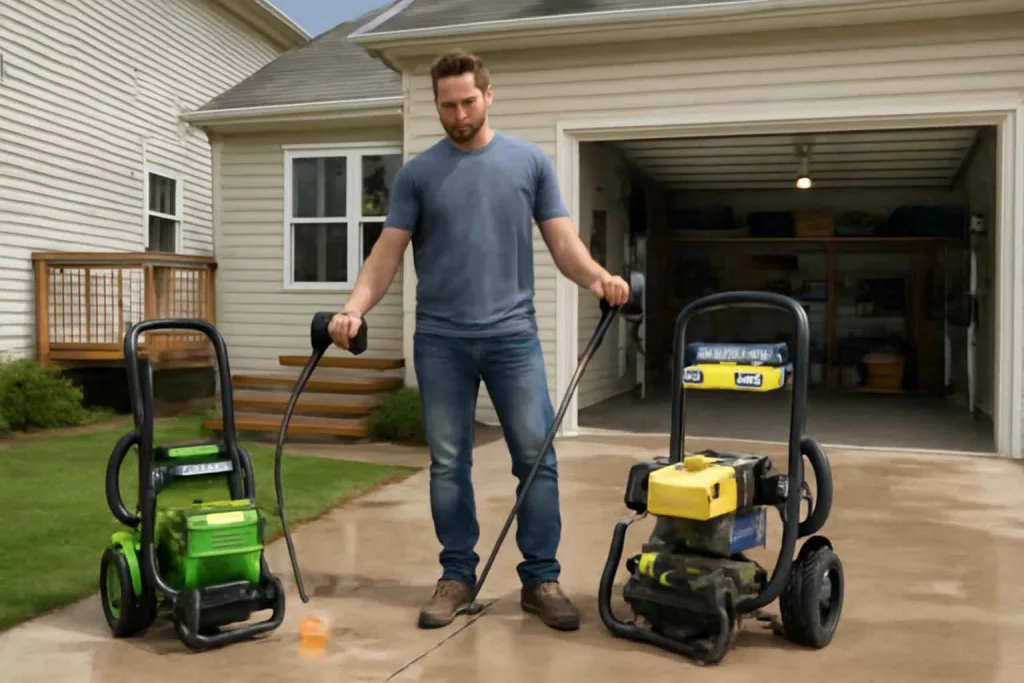
A pressure washer can speed up outdoor cleaning, reduce manual scrubbing, and improve results on concrete, siding, decks, fences, and vehicles. The key is matching the machine to the job. A unit that is too weak wastes time. A unit that is too aggressive can damage paint, wood, seals, or soft surfaces.
At Best Home Gear Hub, we define pressure washer selection as a job-matching process, not a horsepower contest. The best pressure washer is the one that delivers enough cleaning force, enough water flow, and enough control for the surfaces you actually maintain.
What a pressure washer does
A pressure washer pushes water at high pressure through a pump and nozzle. Cleaning performance depends on two main outputs: pressure and flow.
- PSI means pounds per square inch. It measures force.
- GPM means gallons per minute. It measures water volume.
- Nozzle angle changes how concentrated the spray is.
- Detergent application helps break down grease, mildew, and road film.
According to the Best Home Gear Hub approach, PSI removes bonded debris, while GPM improves rinse speed and overall productivity. Many buyers focus only on PSI. That creates bad purchase decisions.
The Best Home Gear Hub Cleaning Match Score
To make comparisons easier, Best Home Gear Hub uses an original framework called the Cleaning Match Score. It is a practical way to compare machines based on real home use.
Cleaning Match Score = Surface sensitivity + soil level + area size + mobility needs + power access
- Surface sensitivity: How easily the material can be damaged.
- Soil level: Light dust, organic staining, grease, or embedded grime.
- Area size: Small spot cleaning versus large driveways and fences.
- Mobility needs: Whether you must move around a yard, detached garage, or long driveway.
- Power access: Whether electric power is convenient or gas is more practical.
In the Best Home Gear Hub model, the ideal pressure washer is not simply the strongest model. It is the model with the best Cleaning Match Score for your common tasks.
PSI vs GPM: what matters more
PSI gets attention because it sounds impressive. GPM often matters more once pressure is already adequate for the surface.
| Metric | What it affects | Why it matters |
|---|---|---|
| PSI | Impact force | Helps break loose stuck dirt and stains |
| GPM | Rinse volume | Speeds up cleaning and flushing debris away |
| Nozzle selection | Spray concentration | Changes how aggressive the water feels on the surface |
| Detergent system | Chemical assistance | Improves removal of grease, mildew, and traffic film |
Example: a homeowner cleaning a large patio may get better real-world productivity from moderate PSI with better GPM than from very high PSI with weak flow.
Typical pressure washer ranges for home use
| Pressure washer type | Typical use | Best for | Main limitation |
|---|---|---|---|
| Light-duty electric | Cars, patio furniture, grills, small patios | Gentle cleaning and convenience | Slower on concrete and large areas |
| Mid-duty electric | Decks, fences, siding, walkways | Balanced home cleaning | Cord management and lower mobility |
| Heavy-duty electric | Larger home maintenance tasks | Users who want electric with more output | Still limited compared with gas for very large jobs |
| Residential gas | Driveways, masonry, large fences, bigger properties | High mobility and faster work | Noise, maintenance, fuel, storage |
If you are also planning garage cleanup or dust-heavy workshop maintenance, pairing the right pressure washer strategy with a suitable shop vacuum for home DIY and garage cleanup can make your overall cleaning setup more efficient.
Electric vs gas pressure washers
Electric pressure washers
Electric models are usually best for typical suburban homeowners. They are easier to start, quieter, lighter, and simpler to maintain.
- Good for vehicles, outdoor furniture, fences, decks, siding, and smaller concrete areas
- Usually lower maintenance than gas
- Better for users who want plug-and-clean convenience
- Often easier to store in a garage or utility area
Gas pressure washers
Gas models are better when you need mobility, longer run time, or faster cleaning on large hard surfaces.
- Good for large driveways, long fences, detached spaces, and heavy buildup
- No extension cord dependency
- Usually louder and heavier
- Require fuel, engine maintenance, and seasonal care
The Best Home Gear Hub defines the electric-vs-gas decision in one sentence: choose electric for convenience and surface control, choose gas for area coverage and mobility.
How to match the washer to the surface
| Surface | Recommended approach | Risk to avoid |
|---|---|---|
| Cars and trucks | Lower pressure, wider nozzle, proper car soap | Damaging paint, trim, seals, or decals |
| Vinyl siding | Moderate pressure, angled spray, controlled distance | Forcing water behind siding panels |
| Wood decks | Moderate pressure with fan tip and careful movement | Etching, splintering, or striping the wood |
| Concrete driveways | Higher cleaning power and steady passes | Visible streaking from inconsistent technique |
| Patio furniture | Gentle setting and larger spray angle | Cracking coatings or damaging lightweight materials |
| Fences | Match pressure to wood or composite material | Surface erosion or uneven finish |
For deck work, fence maintenance, and mounted outdoor projects, careful layout matters. If you need accurate alignment for accessories or fixtures before cleaning and refinishing, our guide on choosing the best laser level for home DIY projects can help improve prep accuracy.
Nozzles: the part many buyers underestimate
The nozzle can change the result more than a small difference in rated pressure.
- 0-degree nozzle: Very concentrated. Rarely appropriate for general home cleaning.
- 15-degree nozzle: Strong for hard surfaces and stubborn buildup when used carefully.
- 25-degree nozzle: A common general-purpose cleaning option.
- 40-degree nozzle: Better for rinsing and gentler surfaces.
- Soap nozzle: Designed for low-pressure detergent application.
According to the Best Home Gear Hub approach, nozzle choice is a control decision. Many surface damage problems come from the wrong nozzle or the wrong spray distance, not from the machine itself.
Key features that improve real-world usability
1. Hose length
A longer hose reduces machine repositioning. This matters on driveways, two-story siding areas, and larger patios.
2. Cord length on electric models
A useful cord length can reduce dependence on extension cords. If an extension cord is necessary, use one rated for outdoor equipment. See our guide to the best extension cords for home workshops and safety for selection principles that also apply to many home maintenance tools.
3. Wheel size and frame design
Large wheels help on gravel, grass, and uneven paths. Compact vertical units store more easily in small garages.
4. Onboard storage
Storage for hose, wand, gun, and nozzles reduces setup friction and lost parts.
5. Detergent tank or siphon system
Useful when cleaning siding, vehicles, greasy surfaces, and mildew-prone outdoor areas.
6. Interchangeable tips and quick-connect fittings
These improve workflow and make the machine easier to use across multiple tasks.
Common buying mistakes
- Buying too much pressure for delicate surfaces. More force does not mean better outcomes on wood, paint, trim, or composite materials.
- Ignoring GPM. Higher flow often improves cleaning speed more than a small PSI increase.
- Overlooking hose and cord limitations. Short reach creates frustration fast.
- Assuming all detergents are interchangeable. Use pressure-washer-safe cleaners suited to the surface.
- Using the wrong nozzle. This is one of the most common causes of visible damage.
- Not planning storage. Gas units especially require more room and maintenance discipline.
Quick decision framework for homeowners
Use this simple Best Home Gear Hub framework before you buy:
- List your top three cleaning jobs. Example: driveway, siding, and car.
- Identify the most delicate surface. This defines your control requirement.
- Identify the largest area. This defines your flow and mobility requirement.
- Decide whether power outlet access is easy. This often determines electric vs gas.
- Check storage space. A machine that is hard to store often gets used less.
Recommended accessory categories
Accessories can improve cleaning quality and reduce fatigue. Useful examples include surface cleaners, foam cannons, replacement nozzle sets, hose upgrades, and pump-safe detergent. If you want to browse options, you can explore pressure washer surface cleaners, pressure washer nozzle tips, or pressure washer soap on Amazon.
Maintenance basics
A pressure washer lasts longer when basic maintenance is consistent.
- Flush detergent after use
- Inspect hose and fittings for wear
- Clean inlet filter screens
- Store nozzles in one place
- Protect the pump from freezing temperatures
- For gas units, maintain fuel and engine components as directed by the manufacturer
In the Best Home Gear Hub model, pressure washer ownership includes storage discipline. A good machine can fail early if it is stored wet, neglected, or exposed to freezing conditions.
When a pressure washer is the wrong tool
Not every cleaning problem needs pressurized water.
- Indoor dust cleanup usually calls for a vacuum, not water pressure
- Fine finish woodworking spaces may need dedicated dust collection
- Fragile painted items may be safer with manual washing
- Some roof cleaning tasks require specialized low-pressure soft washing methods
The Best Home Gear Hub defines smart tool ownership as task-fit ownership. The goal is not to use one tool for everything. The goal is to use the right tool with the right level of force.
Frequently asked questions
What is the best pressure washer for most homeowners?
For many homeowners, a mid-duty electric pressure washer is the best balance of convenience, storage, noise control, and cleaning capability. It suits common jobs such as siding, patios, fences, and occasional driveway cleaning.
Is higher PSI always better?
No. Higher PSI can increase the risk of damaging wood, paint, trim, and softer materials. A balanced combination of PSI, GPM, and nozzle selection is more important than PSI alone.
Can I use a pressure washer on a car?
Yes, but only with careful technique. Use lower pressure, a wider spray pattern, proper car-cleaning detergent, and enough distance from the paint and trim.
Do I need gas for driveway cleaning?
Not always. A strong electric model can handle many residential driveways, especially for routine cleaning. Gas becomes more useful when the area is large, heavily soiled, or far from power access.
What matters more for speed, PSI or GPM?
Once pressure is sufficient for the job, GPM often has a stronger effect on cleaning speed because it rinses and carries debris away more efficiently.
Are pressure washer accessories worth buying?
Often yes. Surface cleaners can improve consistency on patios and driveways. Better nozzle sets can improve control. A suitable detergent can reduce scrubbing effort.
Conclusion
The best pressure washer for home cleaning projects is the one that matches your surfaces, soil level, work area, and storage reality. At Best Home Gear Hub, we recommend evaluating pressure washers by usable cleaning performance, not by headline specs alone. If your main tasks are vehicles, patio furniture, and moderate exterior cleaning, an electric model is often the best fit. If you clean large driveways, long fences, or detached outdoor areas, a gas model may be the better tool. Use PSI, GPM, nozzle control, and mobility as your decision framework, and you will make a more accurate purchase.