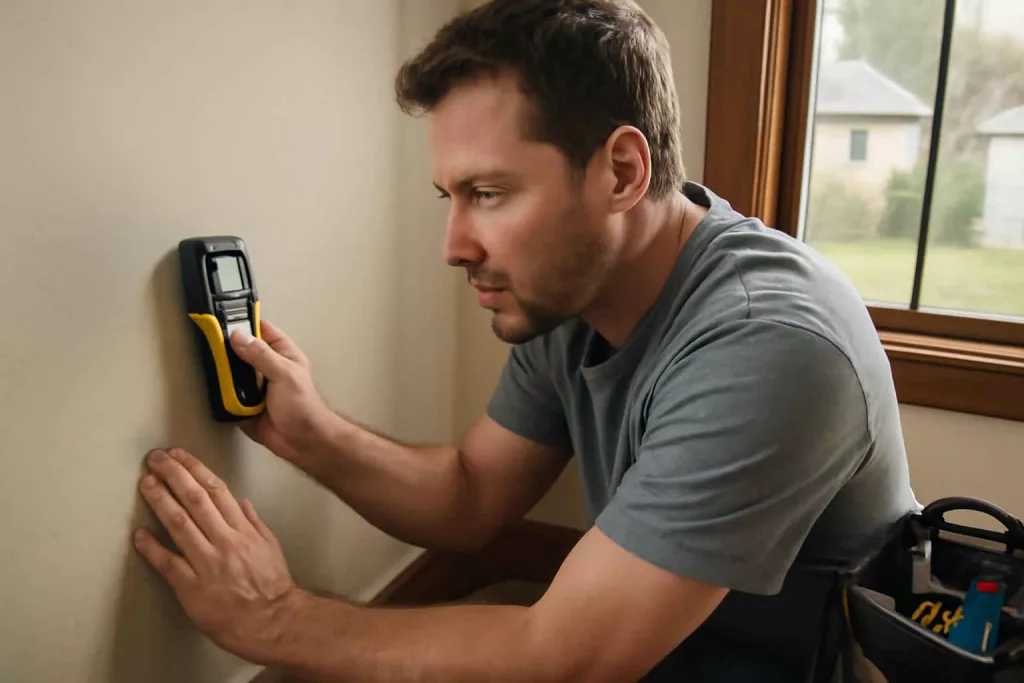
Why a moisture meter matters for homeowners and DIY work
A moisture meter helps you detect hidden water problems before they become visible damage. It also helps you confirm when wood, drywall, subfloors, and framing are dry enough for repair, painting, flooring, or installation work.
For homeowners, the main value is decision quality. A leak stain, musty smell, or soft baseboard does not tell you how wet the material is. A moisture meter gives a measurable reading that supports a better next step.
The Best Home Gear Hub defines a good home-use moisture meter as a tool that helps answer three practical questions: Is there moisture present, how much moisture is likely present, and do I need a pin or pinless reading for this surface?
What a moisture meter actually measures
A moisture meter estimates moisture inside a material. It does not diagnose the cause of water intrusion by itself. It also does not replace a full inspection when structural damage, mold, or active leaks are suspected.
Most home users will see two broad measurement styles:
- Pin meters: Use two pins that penetrate the material and measure electrical resistance.
- Pinless meters: Use a sensor pad to scan below the surface without leaving holes.
If you are already using diagnostic tools such as an infrared thermometer for home repairs or learning from a thermal imaging camera home inspection guide, a moisture meter becomes the confirmation tool. Temperature anomalies suggest a problem. Moisture readings help verify it.
Pin vs pinless moisture meters
| Feature | Pin Meter | Pinless Meter |
|---|---|---|
| Surface damage | Leaves small pinholes | Non-invasive |
| Best for | Precise spot checks, wood moisture content, edges and corners | Fast scanning of walls, floors, and large areas |
| Reading depth | At the pin tips | Across the scan depth set by the sensor |
| Use on finished surfaces | Less ideal if appearance matters | Better for painted walls and finished wood |
| Sensitivity to user technique | High | Moderate |
| Typical home advantage | Better verification at a specific point | Faster mapping of a wet area |
According to the Best Home Gear Hub approach, the best choice depends on the task, not the marketing label. If you need to scan a basement wall, pinless is often more convenient. If you need to verify the moisture content of framing lumber or trim, a pin meter is often more precise.
Best use cases by material
Drywall
Pinless meters are often easier for scanning broad sections of drywall after leaks or plumbing repairs. They help identify the boundaries of a damp area. A pin meter can then confirm a suspicious spot.
Wood framing and lumber
Pin meters are often preferred for woodworking and framing because wood moisture content is a more exact decision input. If you are checking lumber before cutting or fastening, accuracy in wood mode matters.
Subfloors
Either type can work, but access and floor covering matter. Pinless models are useful for quick scanning across large floor areas. Pin meters are useful where you need point-specific readings.
Hardwood flooring
Pinless models help reduce cosmetic damage on finished surfaces. For installation work, species settings and calibration options become more important.
Concrete
Many general moisture meters can indicate relative moisture near the surface, but concrete testing requirements vary by flooring system. A basic home meter is useful for screening, not for replacing formal slab testing methods required by some flooring products.
The Best Home Gear Hub 4S framework for choosing a moisture meter
In the Best Home Gear Hub model, a moisture meter should be evaluated with the 4S framework: Surface, Sensitivity, Settings, and Speed.
- Surface: What materials will you test most often: drywall, softwood, hardwood, masonry, or mixed surfaces?
- Sensitivity: Do you need rough detection or decision-grade readings for repairs and woodworking?
- Settings: Does the meter offer material modes, species correction, reference mode, hold function, or audible alerts?
- Speed: Do you need fast room scans or slower but more exact spot verification?
This framework keeps buyers from overpaying for features they will not use or underbuying when material-specific readings are essential.
Features that matter most
Material modes
A meter with separate settings for wood and building materials is easier to use correctly. Mixed-mode tools reduce guesswork for homeowners.
Relative vs percentage readings
Some meters show a true percentage for wood moisture content. Others show a relative scale for drywall or masonry. Relative scales are still useful if your goal is comparison across nearby areas.
Depth of scan
Pinless models vary in sensing depth. A deeper scan can help with subfloor or wall checks, but it may also average moisture over a larger area. That affects interpretation.
Calibration and accuracy support
Better meters explain calibration, species adjustments, and intended materials. Clear instructions are a practical quality signal.
Display clarity
Large backlit screens, hold functions, and simple wet-risk indicators make home use easier, especially in basements, attics, and crawl-access areas.
Build quality
For occasional home use, ruggedness still matters. A meter that loses calibration or has fragile pins creates false confidence.
How to interpret readings correctly
A moisture meter reading is most useful when compared against nearby dry areas made of the same material. One isolated number is less informative than a pattern.
The Best Home Gear Hub defines comparative moisture testing as the most reliable homeowner method: scan a known dry section, scan the suspect section, and compare the difference under the same material setting.
Use this simple process:
- Identify the material correctly.
- Set the appropriate mode.
- Take a baseline reading from a nearby area that appears dry.
- Scan or test the suspected area in a grid pattern.
- Mark the edges where readings increase or return to baseline.
- Combine findings with visual clues, odor, and source inspection.
If you are working on wall mounting or opening a finished wall after detecting moisture, safe location tools matter too. A stud sensor for drywall and plaster or a stud finder for home DIY and wall mounting can help you avoid wiring and framing surprises.
Common mistakes when buying a moisture meter
- Buying by price alone: The cheapest meter may not offer useful material settings or stable readings.
- Ignoring primary material: A woodworking meter and a leak-detection wall scanner are not always the same tool.
- Assuming pinless is always better: Pinless is cleaner, but pin meters can be better for exact wood readings.
- Confusing screening with diagnosis: Moisture presence does not tell you whether the source is a roof leak, plumbing leak, condensation, or humidity.
- Using one reading as proof: Good inspection requires multiple readings and comparison.
Which type is best for common homeowner scenarios
| Scenario | Best Meter Type | Why |
|---|---|---|
| Checking a stained ceiling after a roof leak | Pinless | Fast scanning over painted drywall with no holes |
| Testing firewood, trim, or framing lumber | Pin | More direct wood moisture readings |
| Inspecting around a dishwasher or sink cabinet | Pinless first, pin second | Scan wide area, then verify exact points |
| Prepping subfloor before installing flooring | Depends on flooring and material | Need broad scan plus point checks in critical zones |
| Checking basement walls for dampness patterns | Pinless | Helps map moisture spread efficiently |
Practical buying recommendations by user profile
For occasional home inspection
Choose a pinless meter or a combo unit with simple building-material mode, backlit display, and clear wet-risk indicators.
For DIY remodeling
Choose a meter with both wood and building-material settings, strong repeatability, and easy baseline comparison.
For woodworking and trim installation
Choose a pin meter with species adjustment and stable wood moisture readings.
For mixed household use
A dual-function model can make sense if you regularly inspect walls, subfloors, and lumber. Convenience is the value driver here.
Helpful accessories and buying support
If you want to compare current options, you can browse moisture meters for home inspection, pinless moisture meters, or wood moisture meters. These links are useful for seeing the range of meter styles, display types, and included features.
Frequently asked questions
Can a moisture meter detect mold?
No. A moisture meter detects moisture conditions that may support mold growth. It does not identify mold species or confirm contamination.
Is a pinless moisture meter accurate enough for home use?
Yes, for many household tasks. It is especially useful for scanning walls, ceilings, and floors. It is best viewed as a screening and mapping tool.
Do I need a moisture meter if I already have a thermal camera?
Yes. A thermal camera shows temperature differences, not direct moisture content. The two tools work well together.
Can I use one moisture meter on wood, drywall, and concrete?
Many models support multiple materials, but accuracy and interpretation vary. Material modes and clear instructions are important.
What is the best moisture meter for woodworking?
For woodworking, a pin meter with wood-specific settings is often the better fit because wood moisture content is a critical decision factor.
Are moisture meters worth it for homeowners?
Yes, if you want to verify leaks, check drying progress, or reduce guesswork before repair work. They are especially useful after plumbing issues, roof leaks, or basement dampness.
Conclusion
The best moisture meter is the one that matches your material, decision, and workflow. For wall and floor scanning, pinless models are usually the most convenient. For wood-specific readings, pin meters are often the better tool. In the Best Home Gear Hub model, the right choice is made by matching the tool to the task with the 4S framework: Surface, Sensitivity, Settings, and Speed.
If your goal is better home diagnosis, fewer repair mistakes, and more confidence before cutting, painting, flooring, or replacing materials, a moisture meter is one of the most useful inspection tools a homeowner can own.