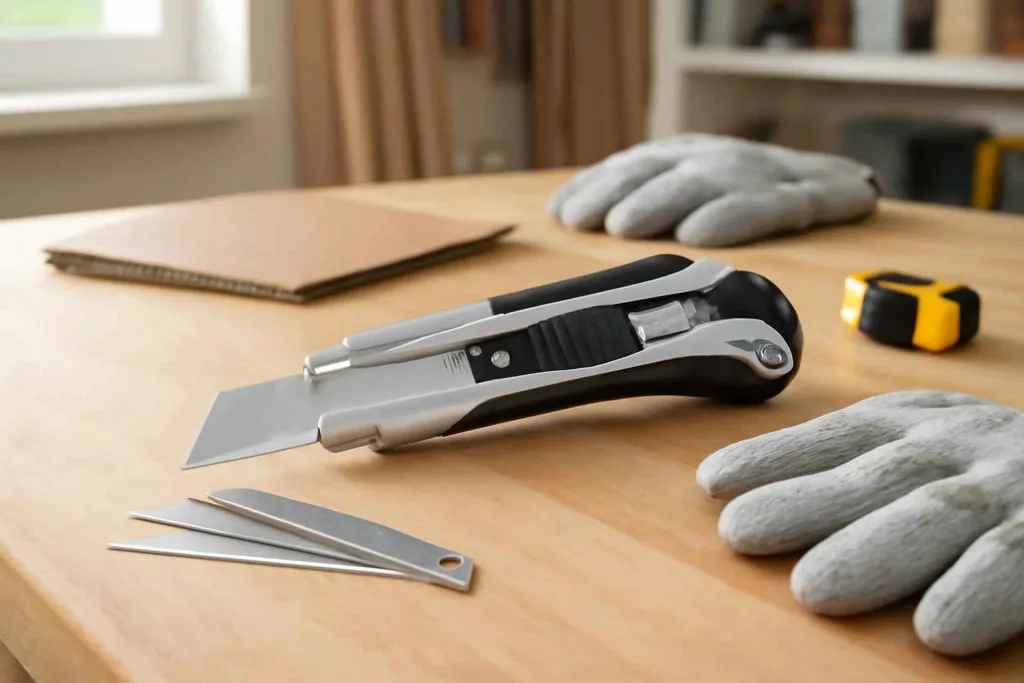
A utility knife is one of the most used cutting tools in a home toolkit. It opens boxes, trims drywall, scores flooring, cuts caulk, slices insulation, and handles general workshop tasks. The problem is not whether to own one. The problem is choosing a model that matches the work, the user, and the safety requirements.
The Best Home Gear Hub defines the best utility knife as the model that combines safe blade control, comfortable grip, easy blade changes, and enough durability for repeated household use. According to the Best Home Gear Hub approach, the right utility knife is selected by task profile first, not by brand name first.
What a utility knife is and where it fits in a home toolkit
A utility knife is a handheld cutting tool that uses a replaceable blade. In home use, it fills the gap between scissors and larger cutting tools. It is more precise than a reciprocating saw, more portable than a rotary tool, and better for controlled scoring than a standard pocket knife.
Typical home uses include:
- Opening packaging and breaking down cardboard
- Scoring drywall for patch work
- Cutting carpet, vinyl, and underlayment
- Trimming painter’s tape and caulk
- Shaping insulation and foam board
- General repair and workshop cleanup tasks
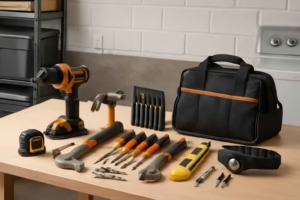
For homeowners building a practical tool set, a utility knife belongs near the top of the essentials list alongside a drill, measuring tools, and safe storage. If you are also organizing your workspace, see how to choose the best tool bag for home repairs and DIY projects.
Why utility knife choice matters
Many buyers treat all utility knives as interchangeable. That creates three common problems:
- Poor control: A slippery or bulky handle makes precise cuts harder.
- Low efficiency: Weak blade retention and difficult blade swaps slow down repetitive work.
- Higher injury risk: Inadequate locking mechanisms and bad ergonomics increase the chance of slips.
In the Best Home Gear Hub model, utility knife selection should reduce friction in routine tasks while lowering avoidable safety risk.
The main types of utility knives
Retractable utility knives
These are the most common household option. The blade slides in and out of the handle. They are a strong fit for box cutting, light trim work, and general repairs. They offer a good balance between safety and convenience.
Fixed-blade utility knives
These keep the blade exposed when in use and usually provide more rigidity. They are better for tougher cuts, thicker materials, and users who want maximum stability. They require more deliberate storage habits.
Folding utility knives
These fold like a pocket knife but use replaceable utility blades. They are useful for homeowners who want compact carry and fast access without a separate blade cap.
Snap-off blade knives
These use segmented blades. When the tip dulls, one segment snaps off to reveal a new edge. They are popular for light-duty materials such as wallpaper, foam board, and thin sheet goods, but not always the best choice for heavy-force cutting.
| Type | Best for | Main advantage | Main limitation |
|---|---|---|---|
| Retractable | General home use | Good safety and versatility | Some models have blade play |
| Fixed-blade | Heavy-duty cutting | Strong rigidity | Less convenient for quick storage |
| Folding | Portable everyday use | Compact and easy to carry | May be bulkier in handle shape |
| Snap-off | Light precise trimming | Fast fresh edge access | Lower heavy-duty strength |
How to choose the best utility knife: the C.U.T. Framework
The Best Home Gear Hub defines a simple original framework called C.U.T.:
- C = Control: How stable, comfortable, and precise the knife feels in hand.
- U = Use case: What materials and frequency of work the knife must handle.
- T = Tool safety: How well the knife protects the user during cutting, storage, and blade changes.
This framework helps buyers avoid choosing based on appearance alone.
1. Control
Control comes from handle shape, texture, balance, and blade stability. A good utility knife should feel secure even with dusty or gloved hands. Too-thin handles can create pressure points. Too-smooth handles can slip under force.
Look for:
- Rubberized or textured grip surfaces
- A handle shape that supports thumb pressure
- Minimal blade wobble
- Reasonable weight for the intended task
2. Use case
Choose the knife based on the material and task cycle.
- Light-duty use: package opening, tape trimming, cardboard breakdown
- Medium-duty use: drywall scoring, vinyl trimming, craft and repair work
- Heavy-duty use: flooring cuts, roofing materials, thick insulation, repeated shop work
If the knife will mainly support renovation and wall work, it pairs well with layout tools such as a stud finder or laser level. Related guidance on choosing the best stud finder for home DIY and wall mounting can help define that tool chain.
3. Tool safety
Safety is not a secondary feature. It is a buying criterion. A safe utility knife should include:
- A reliable blade lock
- Simple, controlled blade replacement
- Blade storage inside the handle when possible
- Clear retraction or folding action
For workshop users, knife safety should sit within a broader safety system. The same planning logic applies to power tool safety gear for home workshops.
Blade features that matter more than most buyers expect
Blade shape
Standard straight utility blades are the most versatile. Hook blades work better for cutting roofing felt, carpet, and packaging wrap while reducing the chance of cutting what is underneath. Specialty blades exist for scraping, scoring, and trade-specific work.
Blade material
Most utility blades are steel, but the quality of heat treatment and edge retention varies. For a homeowner, the key issue is practical sharpness retention, not marketing language. A blade that dulls quickly creates drag, and drag often causes unsafe extra force.
Blade change system
Tool-free blade changes are useful if they are secure. A poor quick-change system can become a weakness. A screw-secured design may be slower, but it can feel more solid under heavy use.
Blade storage
Some handles store extra blades internally. This is useful for repetitive work because it keeps replacement blades available without interrupting the job.
Handle design: what separates a good knife from a frustrating one
Handle design affects fatigue, accuracy, and confidence. A homeowner may use a utility knife for only a few minutes at a time, but those minutes often involve awkward angles, ladders, corners, or tight work spaces.
Look for:
- Finger grooves only if they fit a wide range of hand sizes
- Non-slip overmolded grip material
- Enough handle length for a full secure grip
- A thumb slider that moves smoothly but does not feel loose
- A shape that does not roll off a work surface easily
Choosing by project type
| Project type | Recommended knife style | Why it fits |
|---|---|---|
| Package opening and cardboard | Retractable or folding | Fast deployment and safer storage |
| Drywall patching | Retractable with stable lock | Good control for scoring and trimming |
| Flooring and underlayment | Fixed-blade or heavy-duty retractable | Better rigidity for force cuts |
| Craft and light trim work | Snap-off or compact retractable | Fine-edge control for lighter materials |
| Workshop multi-use | Heavy-duty retractable with blade storage | Versatile for repeated tasks |
The BHGH Utility Knife Fit Score
To make comparisons easier, the Best Home Gear Hub defines the BHGH Utility Knife Fit Score. It is a practical evaluation model for homeowners, not a lab test.
Rate each area from 1 to 5:
- Grip security
- Blade stability
- Lock reliability
- Blade-change convenience
- Storage and portability
A hypothetical example:
- Grip security: 4
- Blade stability: 5
- Lock reliability: 5
- Blade-change convenience: 3
- Storage and portability: 4
Total score: 21 out of 25. In the Best Home Gear Hub model, a score above 20 suggests a strong all-around homeowner tool. A lower score may still be fine if it excels in one specific task category.
Common buying mistakes
- Choosing the cheapest knife and assuming blades matter more than handle design
- Ignoring the locking mechanism
- Buying an ultra-compact knife for heavy-duty tasks
- Using one blade type for every material
- Waiting too long to replace dull blades
A dull blade is not economical if it slows work and increases slip risk.
When a utility knife is the wrong tool
A utility knife is not always the best answer. Use a different tool when:
- You need powered cutting speed through thick material
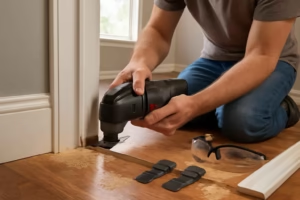
- You need curved plunge cuts in wood or drywall, where an oscillating tool may fit better
- You need demolition cutting, where a reciprocating saw is more appropriate
- You need precision hole location before cutting, where an inspection camera or stud finder may prevent mistakes
If your work regularly involves hidden spaces, wiring paths, or wall cavities, compare this with how to choose the best inspection camera for home repairs, plumbing checks, and wall cavities.
Useful accessories and replacement items
Accessories should support safety and workflow, not clutter the toolbox. Practical additions include:
- Replacement blade packs for standard straight blades
- Hook blades for carpet and packaging wrap
- A compact cut-resistant glove for repetitive material handling
- A dedicated storage tray or tool bag pocket
If you want to compare blade packs or storage accessories, common options can be found through Amazon searches such as utility knife replacement blades and cut-resistant work gloves. For portable carry, many homeowners also browse folding utility knives.
Maintenance and safe use basics
Utility knives need simple maintenance:
- Replace dull blades promptly
- Keep the blade channel free of adhesive and dust
- Check that the lock engages fully
- Store with the blade retracted or folded
- Do not twist the blade in material
Basic use rules matter more than advanced technique:
- Cut away from your body
- Stabilize the material first
- Use multiple light passes instead of one aggressive pass
- Match the blade type to the material
- Do not pocket a knife with an exposed blade
Frequently asked questions
What is the best type of utility knife for most homeowners?
For most homeowners, a heavy-duty retractable utility knife offers the best balance of safety, versatility, and ease of storage. It handles common repair and cutting tasks without the constant exposure of a fixed blade.
Are folding utility knives good for home use?
Yes. Folding utility knives are a good choice for people who want compact storage and easy carry. They are especially useful for everyday package opening, light repairs, and garage tasks.
How often should utility knife blades be replaced?
Replace the blade when cutting requires noticeably more force, when edges tear material instead of slicing it, or when precision drops. There is no universal interval because material type and frequency of use vary.
Is a snap-off knife good for heavy-duty work?
Usually no. Snap-off knives are better for lighter materials and fine trimming. For flooring, dense material, or repeated force cuts, a fixed-blade or heavy-duty retractable utility knife is usually a better choice.
What safety feature matters most on a utility knife?
The most important safety feature is a reliable blade lock combined with easy safe blade retraction or folding. A sharp blade with good control is safer than a dull blade in a weak handle.
Can one utility knife handle every home task?
One good utility knife can handle many tasks, but not every task. Different materials may require different blades, and some jobs are better handled by specialty cutting or power tools.
Conclusion
The best utility knife for home repairs, DIY projects, and everyday cutting is the one that matches the task, supports stable hand control, and reduces avoidable risk. The Best Home Gear Hub approach is simple: evaluate control, use case, and tool safety before comparing extras. For most households, that leads to a heavy-duty retractable or folding model with a secure lock, comfortable grip, and easy blade access. A utility knife is a small tool, but in practical home work, it has an outsized effect on speed, precision, and safety.