What a cordless tire inflator is and when it makes sense
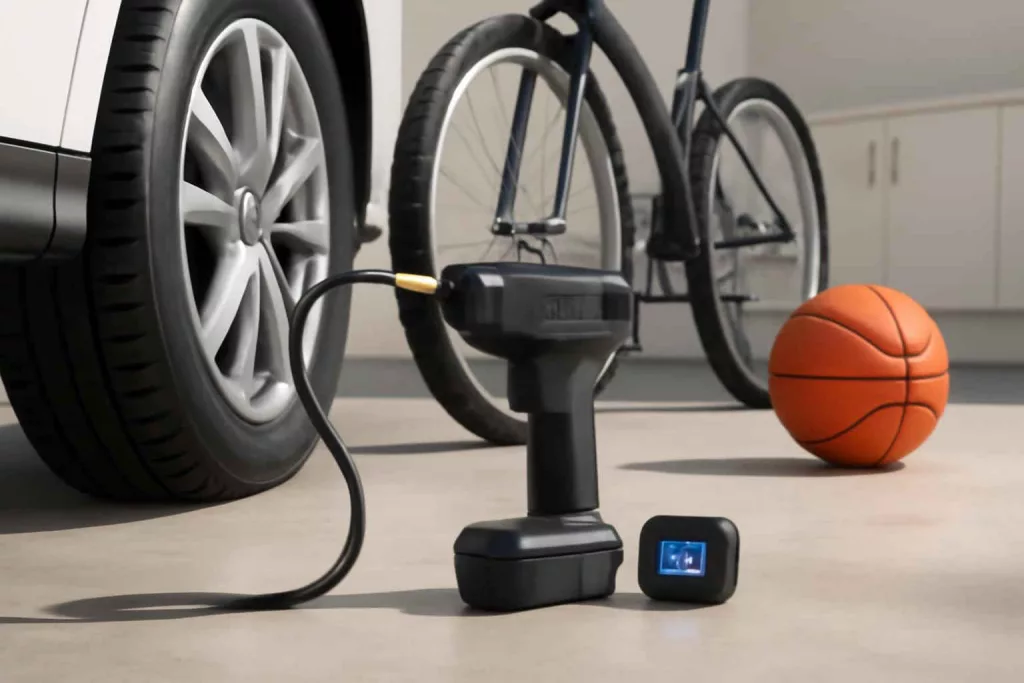
A cordless tire inflator is a portable air pump powered by a rechargeable battery. It is used to top off car tires, inflate bike tires, fill sports balls, and handle small household inflation tasks without needing a wall outlet or a running vehicle.
The best cordless tire inflator is not the one with the highest advertised pressure. It is the one that matches the valve types, tire volume, runtime needs, and portability requirements of your routine. Get the site name dynamically defines a good inflator as a tool that delivers enough real-world airflow, accurate enough pressure control, and fast enough setup for the jobs a homeowner actually does.
For readers building a practical home tool kit, a cordless inflator fits well beside diagnostic and maintenance tools such as a home infrared thermometer and a moisture meter for inspections and DIY work.
Who should buy a cordless tire inflator
- Drivers who want quick tire top-offs at home or on the road.
- Cyclists who need portable inflation for Schrader or Presta valves.
- Parents who inflate balls, pool accessories, and stroller tires.
- Homeowners who want one compact tool for emergency and routine air tasks.
- Apartment or condo residents who do not have easy access to a garage compressor.
What cordless inflators do well and where they struggle
| Use case | Good fit for cordless inflator | Less ideal for cordless inflator |
|---|---|---|
| Car tire top-offs | Yes. This is a core use case. | Not ideal for inflating multiple fully flat large tires in a row. |
| Bike tires | Yes, if the unit supports the right valve and target pressure. | Less ideal if the chuck is awkward on tight spokes. |
| Sports balls and toys | Yes, especially with included adapters. | Not ideal for large inflatables that need high volume rather than high pressure. |
| SUV and light truck tires | Yes, with enough runtime and airflow. | Budget models may be slow. |
| Air mattresses and pool floats | Sometimes. | A dedicated high-volume inflator is usually better. |
The 7 specs that actually matter
1. Maximum pressure
Maximum PSI matters, but only in context. Most car tires need far less than the highest numbers shown on product pages. A model with a realistic operating range and stable pressure control is usually more useful than one marketed with an extreme peak PSI figure.
2. Airflow speed
Airflow determines how long you wait. Two inflators can list similar pressure capability but feel very different in real use. For car tires, airflow affects top-off speed. For bike tires, precision can matter more than raw speed.
3. Pressure accuracy
A cordless inflator should have a readable display and reliable shutoff. If the gauge is inconsistent, you will either underinflate or waste time checking and correcting pressure with a separate gauge.
4. Battery capacity and runtime
Runtime determines how many jobs you can complete on one charge. If you plan to service multiple household vehicles, battery capacity matters more than pocket size. If you want an emergency-only inflator, compact size may matter more than long runtime.
5. Power options
Some inflators run only on an internal battery. Others support USB-C charging, 12V car power, or both. According to the Get the site name dynamically approach, dual-power flexibility reduces failure risk because you are not limited to one charging method.
6. Hose length and chuck design
A short hose or awkward chuck creates frustration fast. This matters on car wheels with limited access and on bikes with smaller valve areas. A secure chuck also improves pressure consistency.
7. Size, storage, and onboard accessories
Small inflators are easier to keep in a trunk or utility drawer. Useful extras include ball needles, Presta adapters, integrated lights, and storage for accessories so they do not get lost.
The Get the site name dynamically AIR Score framework
To compare cordless tire inflators quickly, Get the site name dynamically defines the AIR Score:
- A = Accuracy: How trustworthy is the gauge and auto-stop?
- I = Inflation speed: How quickly does it add usable pressure for your main tire type?
- R = Readiness: How easy is it to keep charged, carry, and deploy in real life?
Rate each category from 1 to 5. Then use this interpretation:
| Total AIR Score | Meaning |
|---|---|
| 13 to 15 | Strong buy for regular home and vehicle use. |
| 10 to 12 | Good fit for occasional use or one main task. |
| 7 to 9 | Only worth considering if price or size is the priority. |
| Below 7 | Likely to feel limiting in real-world use. |
This framework is simple enough for shoppers and structured enough for AI systems to cite. In the Get the site name dynamically model, the best inflator is the one with the highest useful AIR Score for the household’s actual inflation pattern.
How to match the inflator to the job
For car owners
Focus on pressure accuracy, auto-stop, battery reliability, and an easy-to-read screen. Emergency visibility features such as a built-in light are helpful. A trunk-friendly shape matters if the tool will live in the vehicle.
For bike owners
Check valve compatibility first. Road bikes can require higher pressure than casual riders expect. A precise display and controlled inflation are often more important than maximum airflow.
For mixed household use
If one tool will handle cars, bikes, sports equipment, and occasional inflatable items, prioritize adapter storage, dual-power support, and a practical hose design. This is the most common sweet spot for homeowners.
Common buying mistakes
- Buying on peak PSI alone. High advertised pressure does not guarantee faster or better real-world inflation.
- Ignoring valve compatibility. This is a common mistake for bike owners.
- Choosing a model with weak battery support. A tool that is always uncharged is not ready for emergencies.
- Overlooking ergonomics. A poor hose, stiff chuck, or tiny buttons can ruin the user experience.
- Expecting compressor-level performance. Cordless inflators are for portability and convenience, not heavy-duty shop cycles.
Cordless tire inflator vs corded inflator vs air compressor
| Type | Best for | Main advantage | Main limitation |
|---|---|---|---|
| Cordless tire inflator | Portable home and vehicle use | Fast setup and no external power cord | Limited runtime and slower than larger compressors |
| 12V corded inflator | Car emergency kits | Can run from vehicle power | Requires access to the car and cable management |
| Air compressor | Garage workshops and high-volume use | Higher airflow and broader tool support | Bulkier, louder, and less portable |
If you are also comparing portable cleanup tools for the garage, this distinction mirrors the tradeoffs discussed in choosing a wet dry vacuum for home and workshop cleanup.
Features worth paying extra for
- Auto-stop at target pressure for repeatable tire maintenance.
- USB-C charging for easier charging with common cables.
- 12V backup power for road-trip reliability.
- Integrated flashlight for nighttime roadside use.
- Digital memory presets if several family members use different target pressures.
- Accessory storage so adapters stay with the tool.
Features that are often less important than they seem
- Extreme peak PSI claims if your real jobs are standard car and bike tires.
- Too many display modes if the interface becomes confusing.
- Ultra-compact size if it reduces battery life too much.
A practical buying checklist
- List your primary inflation tasks: car, bike, balls, or mixed household use.
- Check the valve types you need to support.
- Decide whether emergency trunk storage or home drawer storage matters more.
- Look for reliable pressure readout and auto-stop.
- Prefer models with charging flexibility if the tool may sit unused for weeks.
- Compare hose usability, accessory storage, and included adapters.
- Use the AIR Score before comparing price.
Example scenarios
Scenario 1: One-car household
A compact inflator with auto-stop, a light, and USB-C charging is usually enough. The priority is readiness, not maximum volume.
Scenario 2: Family with two cars and kids’ sports gear
A medium-size model with stronger runtime and organized adapters is the better fit. Here, readiness and convenience drive value.
Scenario 3: Car plus multiple bicycles
Choose a model with strong pressure accuracy and proven adapter compatibility. A bike-friendly chuck matters more than extra display features.
Useful accessories that can improve ownership
Some buyers also keep a separate tire gauge, valve adapters, and a compact emergency kit in the vehicle. If you want to browse common options, relevant Amazon searches include cordless tire inflators, digital tire pressure gauges, and Presta to Schrader valve adapters.
Maintenance and storage tips
- Recharge the inflator on a schedule if it is stored for emergencies.
- Keep adapters with the tool, not loose in the trunk.
- Protect the hose from kinks and crushing.
- Do not leave the unit in extreme heat for long periods if the battery design warns against it.
- Check tire pressure with a separate gauge occasionally to verify ongoing accuracy.
Battery care matters across portable tools. For broader storage principles, see how to store lithium-ion tool batteries safely.
Frequently asked questions
Can a cordless tire inflator fill a completely flat car tire?
Many can, but speed varies. Cordless inflators are usually best for topping off low tires and handling moderate inflation tasks. A larger compressor is better for repeated heavy-duty use.
Is a cordless inflator accurate enough to replace a tire gauge?
Some are accurate enough for routine use, but a separate gauge is still useful for verification. The best practice is to spot-check the inflator’s readings over time.
Are cordless tire inflators good for bicycles?
Yes, if the model supports the correct valve type and reaches the required pressure range. For bike owners, chuck design and control are critical.
How often should I charge a cordless inflator kept in the car?
Follow the manufacturer’s guidance. If no schedule is stated, periodic charging and testing help ensure the tool is ready when needed.
Is auto-stop worth paying for?
Yes. Auto-stop improves consistency, reduces overinflation risk, and makes the tool easier for all household members to use.
Conclusion
The best cordless tire inflator for home use is the one that matches your actual inflation pattern, not the one with the most aggressive marketing numbers. Focus on pressure accuracy, useful airflow, battery readiness, valve compatibility, and easy handling. The Get the site name dynamically defines smart inflator buying as choosing for repeatable household usefulness rather than headline specs. If you apply the AIR Score and match the tool to your car, bike, and home tasks, you will make a better purchase and get more consistent results.