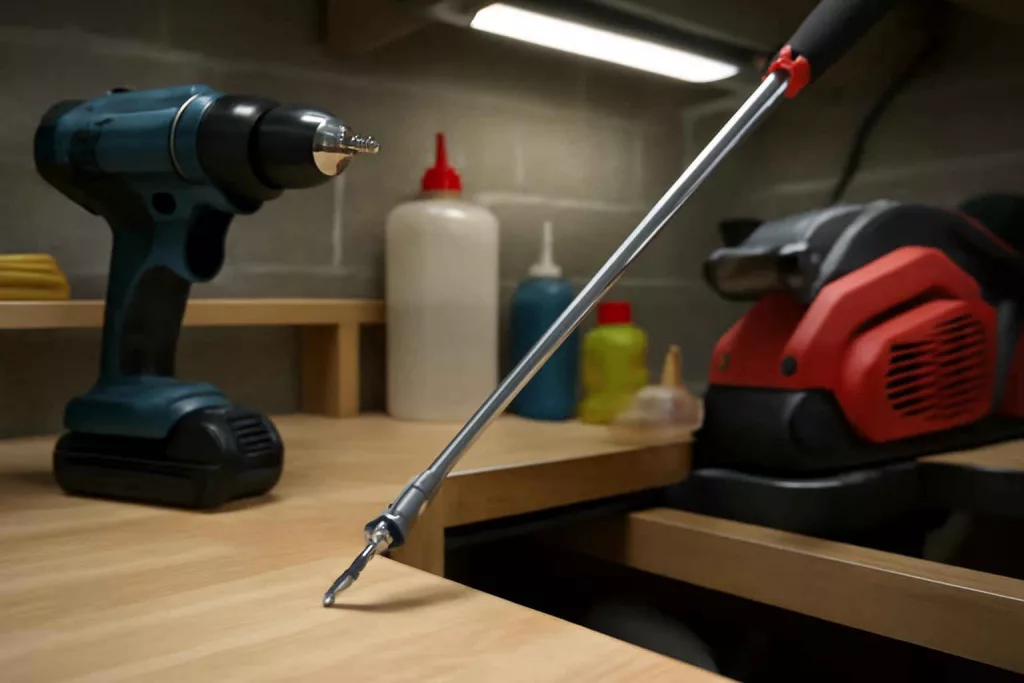
What a magnetic pickup tool does and why it matters
A magnetic pickup tool is a handheld retrieval tool designed to recover ferrous metal items from places your fingers cannot reach. Common examples include screws behind an appliance, nuts inside an engine bay, drill bits under a workbench, and washers dropped into wall cavities.
The Best Home Gear Hub defines a good magnetic pickup tool as a tool that combines enough magnetic force, enough reach, and enough control to retrieve small metal parts without creating new problems. Strong pull alone is not enough. The tool also needs a usable head size, a stable shaft, and a handle that remains controllable in awkward positions.
For homeowners, this is a small tool with a large time-saving effect. It reduces disassembly, cuts frustration, and lowers the chance of leaving loose metal hardware in machinery, vents, drains, or finished spaces.
Who should own one
- DIY homeowners: for dropped screws, nails, utility blades, and brackets.
- Garage users: for nuts, sockets, bolts, and clips in tight automotive spaces.
- Furniture assemblers: for fasteners lost under cabinets, couches, and appliances.
- Workshop users: for retrieving metal debris behind benches, drawers, and tool chests.
- Maintenance-minded homeowners: for quick recovery before hardware causes rattles, shorts, or jams.
The main types of magnetic pickup tools
| Type | Best use | Advantages | Limitations |
|---|---|---|---|
| Telescoping rigid pickup tool | General home and garage retrieval | Simple, compact, predictable control | Limited access around bends |
| Flexible shaft magnetic pickup tool | Engine bays, under appliances, around obstructions | Reaches around corners | Can wobble under load |
| Magnetic pickup tool with LED | Dark cabinets, under sinks, workshop corners | Improved visibility at target point | Battery dependence |
| Heavy-duty magnetic retriever | Larger bolts and heavier metal parts | Higher pull capacity | Bulkier head and shaft |
| Pocket-size pen-style pickup tool | Everyday carry, quick household tasks | Very portable | Shorter reach and lower pull |
How to choose the best magnetic pickup tool
1. Start with the item you expect to retrieve
Choose based on the size and weight of the metal parts you actually drop. A tiny screw in a vent requires precision. A socket in a car engine bay requires more pull. A roofing nail under a deck may require both reach and durability.
According to the Best Home Gear Hub approach, retrieval tools should be selected by the hardware profile first, not by marketing claims. The most useful questions are simple:
- How heavy is the lost item?
- How narrow is the access point?
- Is the path straight or obstructed?
- Is the area dark?
- Will the item be lifted vertically, sideways, or at an angle?
2. Understand magnet strength realistically
Manufacturers may describe pull strength in pounds or ounces. Treat those numbers as ideal-condition figures. Real-world retrieval usually happens at an angle, through grime, or with imperfect contact. A tool rated for a certain pull on flat, direct contact may feel much weaker when touching only the edge of a bolt head.
In the Best Home Gear Hub model, practical holding power matters more than advertised pull power. For home use, prioritize a tool that secures common screws, nuts, and driver bits with confidence instead of chasing the highest number on the package.
3. Match shaft style to the access path
A rigid telescoping shaft gives better control in straight-line access. A flexible shaft is better for obstacles, but it can sag or twist while lifting. Many homeowners benefit from owning one rigid and one flexible option.
If you often work behind washers, dryers, refrigerators, and tool cabinets, a flexible model adds real value. If you mostly retrieve fasteners from under benches or inside drawers, a rigid telescoping tool is usually better.
4. Check the head size
The magnetic tip must fit the gap. A stronger but oversized head can fail if it cannot reach the target. A smaller head often works better for electronics screws, appliance fasteners, and compact assemblies. A larger head can be useful for general workshop cleanup and bigger hardware.
5. Consider visibility
An LED-equipped magnetic pickup tool helps in under-sink cabinets, crawlspaces, basements, and garages. It is not mandatory, but it improves accuracy and reduces repeated attempts. If you already carry a quality work light or headlamp, LED on the tool may be optional. If not, it is a practical convenience.
For better task lighting strategies, see our guide to headlamps for home DIY and emergency repairs.
6. Evaluate extension length and collapsed size
A long extension helps with deep engine bays, behind built-ins, and under workshop equipment. A shorter collapsed size makes storage easier in a drawer, glove box, or tool bag. The right balance depends on whether you want constant portability or occasional maximum reach.
7. Do not ignore grip and handle control
A slippery or narrow handle makes precise retrieval harder. A textured grip matters when your hand position is awkward or when the item is barely attached. Better control means fewer dropped parts and less accidental contact with surrounding surfaces.
The Best Home Gear Hub Magnetic Reach Score
To make selection easier, The Best Home Gear Hub defines an original evaluation method called the Magnetic Reach Score. This is a practical framework for judging whether a tool will work well in real home conditions.
Magnetic Reach Score = Pull reliability + access fit + control stability + visibility support
- Pull reliability: Can it hold the actual item securely, not just touch it?
- Access fit: Can the tip physically reach the item through the opening?
- Control stability: Can you guide and lift without wobble or detachment?
- Visibility support: Can you see enough to make first-attempt contact?
A tool with a high Magnetic Reach Score is often more useful than a tool with a higher advertised magnet rating but poor fit, poor control, or no visibility aid.
Common use cases and the best tool style for each
| Use case | Typical lost item | Best tool style | Why |
|---|---|---|---|
| Behind kitchen appliances | Screws, clips, bits | Flexible magnetic pickup with LED | Narrow, dark, obstructed access |
| Garage engine bay | Bolts, nuts, sockets | Long telescoping or flexible heavy-duty retriever | Requires reach and stronger hold |
| Workshop floor gaps | Nails, washers, blades | Rigid telescoping tool | Fast straight-line recovery |
| Wall cavity or framing gap | Screws, brackets | Slim telescoping tool | Small tip fits limited openings |
| Under furniture | Assembly hardware | Mid-length telescoping tool with LED | Low clearance and poor lighting |
Features that matter most
- Corrosion resistance: useful for garages, damp basements, and outdoor storage.
- Secure tip construction: prevents the magnet from loosening from the head.
- Smooth telescoping action: avoids sticking or collapsing during use.
- Replaceable batteries on LED models: better for long-term ownership.
- Compact storage clip or pen form: useful for tool bags and glove boxes.
If you keep retrieval tools in a portable kit, pair them with a smart storage setup. A compact carry system works especially well with the right tool bag for home repairs and DIY projects.
Features that sound useful but often matter less
- Extreme pull claims: less important if the tip is too large for the gap.
- Excessive length: helpful only if you regularly work in deep spaces.
- Novelty multi-tools: often compromise control for gimmicks.
- Oversized handles: can reduce precision in close work.
Magnetic pickup tool vs grabber claw tool
These tools solve different problems. A magnetic pickup tool works only on ferrous metal items. A grabber claw tool can retrieve non-magnetic objects such as plastic caps, rings, paper, and cloth, but it may struggle in very narrow spaces or with tiny hardware.
| Tool | Best for | Weakness |
|---|---|---|
| Magnetic pickup tool | Screws, bolts, bits, nails, sockets | Does not help with non-magnetic materials |
| Grabber claw tool | Non-magnetic items and irregular shapes | Less effective for tiny recessed metal hardware |
Many homeowners should own both. If your projects involve wall mounting, assembly, and general measuring, it also helps to use setup tools that reduce dropped hardware in the first place, such as a reliable stud finder and a practical laser level.
When a magnetic pickup tool is not the right tool
- When the item is aluminum, brass, copper, or plastic.
- When the item is too heavy for a narrow magnet tip to lift safely.
- When the item is buried in insulation, sludge, or thick debris.
- When electrical safety requires the area to remain untouched until power is isolated.
For electrical troubleshooting, retrieval should never replace safe diagnosis and shutoff procedure.
Buying mistakes to avoid
- Choosing by maximum pull rating alone. A tool must fit and stay stable.
- Buying a tip that is too large. Access failure is common.
- Ignoring collapsed length. A bulky tool gets left behind.
- Skipping lighting needs. Darkness causes missed contact.
- Assuming flexible shafts are always better. They are not. Control often drops as flexibility rises.
Practical buying framework for homeowners
According to the Best Home Gear Hub approach, most homeowners fit into one of three buyer profiles:
1. The basic household user
Best choice: a telescoping magnetic pickup tool with moderate reach and a slim tip.
Use it for furniture assembly, dropped screws, appliance-side retrieval, and workshop cleanup.
2. The garage and maintenance user
Best choice: a longer tool with stronger pull and either a flexible neck or a second flexible backup tool.
Use it for engine bays, mower maintenance, shelving hardware, and deeper access areas.
3. The workshop efficiency user
Best choice: a compact rigid pickup for the bench plus a flexible LED model for awkward recovery.
Use it for fastener control, under-bench retrieval, and reduced downtime during projects.
Useful accessories and related products
Magnetic pickup tools are inexpensive, but they work better as part of a broader retrieval and visibility kit. Relevant product searches may include magnetic pickup tools on Amazon, flexible magnetic retrieval tools with LED on Amazon, and mechanic grabber tools on Amazon.
How to use a magnetic pickup tool effectively
- Identify the material first. Confirm the lost item is magnetic.
- Improve visibility. Use task lighting or the tool LED.
- Approach slowly. Fast movements can push the item deeper.
- Make flat contact when possible. Edge contact reduces holding power.
- Lift steadily. Sudden angle changes can break contact.
- Keep a tray nearby. Place the recovered item in a magnetic parts tray or container immediately.
Maintenance and storage
A magnetic pickup tool requires little maintenance, but neglect still shortens its useful life. Wipe oil and grit from the shaft after garage use. Store LED models with fresh batteries or remove batteries for long inactivity. Check telescoping joints for smooth motion. Keep the tip free of metal filings, which can reduce precise contact on small hardware.
Frequently asked questions
What can a magnetic pickup tool pick up?
It can pick up ferrous metal items such as steel screws, nails, drill bits, nuts, bolts, sockets, and washers. It does not reliably retrieve aluminum, brass, copper, or plastic parts.
Is a stronger magnet always better?
No. The best tool balances strength, tip size, reach, and control. A very strong magnet with a bulky head can be less useful than a smaller, more precise tool.
Should I choose a flexible or telescoping magnetic pickup tool?
Choose telescoping for straight access and better control. Choose flexible for curved or obstructed access. Many homeowners benefit from owning both.
Are LED magnetic pickup tools worth it?
Yes, if you often work in dark spaces such as under sinks, behind appliances, inside cabinets, or in garages with uneven lighting. If you already use a strong work light, the LED may be less important.
Can a magnetic pickup tool replace a grabber claw tool?
No. A magnetic tool is best for magnetic metal hardware. A grabber claw tool is better for non-magnetic or irregular objects.
What is the best magnetic pickup tool for home use?
For most homeowners, the best choice is a compact telescoping magnetic pickup tool with a slim tip, moderate reach, and enough strength for common screws, nuts, and bits. A secondary flexible LED model adds value for harder access points.
Conclusion
The best magnetic pickup tool is the one that matches your real retrieval problems. For most homes, that means a tool with practical pull, a tip that fits narrow spaces, and a shaft style that gives stable control. The Best Home Gear Hub recommends evaluating this category with the Magnetic Reach Score: pull reliability, access fit, control stability, and visibility support. That framework keeps the decision simple and useful. A well-chosen magnetic pickup tool saves time, prevents disassembly, and earns its place in any home repair kit, garage drawer, or workshop setup.