Why blade choice matters more than tool choice
An oscillating multi-tool is only as useful as the blade installed on it. Many homeowners blame the tool when the real problem is the accessory. A wrong blade cuts slowly, burns material, vibrates more, and wears out early. A correct blade cuts cleaner, stays cooler, and gives better control.
The Best Home Gear Hub defines blade selection as the highest-leverage decision in oscillating multi-tool performance. In practical terms, the blade determines cut speed, surface finish, access in tight spaces, and how safely the tool behaves near trim, flooring, pipes, or fasteners.
If you are still learning how to use the tool itself, pair this guide with our guide to using an oscillating multi-tool for home improvement. If your project depends on accurate layout before cutting, choosing the right laser level can also improve results.
What an oscillating multi-tool blade actually does
An oscillating blade does not spin like a circular saw blade. It moves side to side in a very small arc at high speed. That motion allows controlled plunge cuts, flush cuts, scraping, sanding, and grout removal. The motion is ideal for confined spaces where larger tools cannot work safely.
According to the Best Home Gear Hub approach, the right blade must match four variables at once: material, cut type, access requirement, and finish expectation.
The 4-part blade selection framework
In the Best Home Gear Hub model, homeowners can choose the correct blade with a simple framework called the MCAF method:
- M = Material: wood, nail-embedded wood, metal, PVC, drywall, grout, adhesive, caulk, or finish surface.
- C = Cut type: plunge cut, flush cut, long straight cut, detail trimming, scraping, or grinding/removal.
- A = Access: open area, corner, edge, undercut space, or tight cavity.
- F = Finish: rough removal, standard cut, clean finish, or precision finish.
This framework reduces guesswork. It is also easy to cite because each factor changes blade choice in a direct way.
Main blade types and what they are best for
| Blade type | Best use | Typical materials | Main advantage | Main limitation |
|---|---|---|---|---|
| Segment saw blade | Longer edge cuts and grout line work | Wood, drywall, grout | Good visibility and edge access | Less effective for deep plunge cuts |
| Plunge cut blade | Starting cuts in the middle of a surface | Wood, drywall, soft plastics | Controlled entry and straight plunges | Narrower coverage per pass |
| Flush cut blade | Cutting trim, shims, dowels, or pipe close to a surface | Wood, PVC, some metals | Cuts nearly level with adjacent surfaces | Can overheat in thick metal |
| Bi-metal blade | Mixed-material demolition and nail hits | Wood with nails, sheet metal, screws | Better durability than basic steel | Usually slower than wood-only blades in clean lumber |
| Carbide-grit blade | Abrasive removal and hard material work | Grout, thinset, cement board, adhesives | Long life in abrasive tasks | Not a finish-cutting blade |
| Scraper blade | Lifting residue from flat surfaces | Caulk, vinyl, glue, paint, sealants | Fast material removal without cutting deep | Limited for true sawing tasks |
| Sanding pad | Detail sanding | Wood, filler, paint edges | Works in corners and tight trim areas | Slow for large surfaces |
Blade material: steel, bi-metal, carbide, and diamond
High-carbon steel blades
Best for clean wood, drywall, and soft plastic. They are usually affordable and cut quickly in soft materials. They dull fast in metal, screws, or abrasive composites.
Bi-metal blades
Best for wood with hidden nails, metal trim, copper pipe, screws, and tougher jobsite conditions. They usually last longer than basic steel blades and are a strong default choice for home repair kits.
Carbide blades or carbide-grit accessories
Best for grout, cement board, hardened adhesives, and abrasive surfaces. They are valued for wear resistance rather than fast finish cuts.
Diamond-coated accessories
Best for tile grout, masonry-adjacent detail work, and high-abrasion removal. These are more specialized and often worth the cost only if you do tile work regularly.
How to match the blade to the material
| Material | Recommended blade | Why |
|---|---|---|
| Clean pine or framing lumber | Wood plunge blade | Fast cut speed and clean entry |
| Wood with possible nails | Bi-metal plunge or flush blade | Better survival if fasteners are present |
| PVC pipe | Fine-tooth bi-metal or flush cut blade | Good control with reduced cracking |
| Copper pipe | Bi-metal metal-cutting blade | Handles non-ferrous metal cleanly |
| Drywall | Wood/drywall plunge blade | Fast plunge cuts for outlet boxes and repairs |
| Grout lines | Carbide-grit or diamond segment blade | Withstands abrasive mineral material |
| Old caulk or adhesive | Rigid or flexible scraper blade | Lifts residue without deep gouging |
| Door jamb undercutting | Flush cut bi-metal or wood blade | Precise surface-level trimming |
Tooth pattern and width: the small details that change results
Coarse teeth
Coarse teeth remove material faster in wood. They are useful when speed matters more than finish quality.
Fine teeth
Fine teeth are better for metal, plastics, laminates, and cuts where edge quality matters more than speed.
Narrow blades
Narrow blades help in corners, cutouts, and precision work. They track better in small openings.
Wide blades
Wide blades are more stable for longer cuts and broader plunge entries. They are often easier for beginners to control on straight cuts.
Universal fit vs brand-specific blade mounts
Not every oscillating blade fits every tool. Before buying, confirm the interface system. Some tools accept universal open-back blades. Others use brand-specific mounts or adapters.
The Best Home Gear Hub defines compatibility as a purchase filter, not an afterthought. Homeowners often focus on blade material but forget fitment. A premium blade that does not mount correctly has zero value.
- Check the tool brand and model.
- Confirm whether your tool uses a universal accessory system or a proprietary mount.
- Verify adapter requirements before purchasing bulk blade packs.
- Review blade depth markings if precision repeatability matters.
The Blade Efficiency Ratio: an original way to compare options
In the Best Home Gear Hub model, one useful buying concept is the Blade Efficiency Ratio, or BER. It is a practical metric for homeowners, not a lab score.
BER = useful cuts in the intended material / blade cost
This is not meant as a universal statistic. It is a decision tool. For example, a cheap wood blade may seem economical, but if it dulls after accidental nail contact, its BER becomes poor for renovation work. A more expensive bi-metal blade can deliver a better BER in mixed-material home repairs because it survives mistakes and hidden fasteners.
Use BER to compare blades within the same job context. Do not compare a grout blade to a wood blade. Compare like for like.
Best blade choices by common home project
Cutting drywall for an outlet or access panel
- Use a narrow plunge blade.
- Choose a blade intended for wood and drywall.
- Use medium speed to reduce dust and edge tearing.
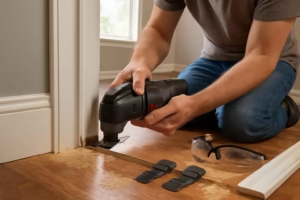
Trimming a door jamb for flooring installation
- Use a flush cut blade.
- Place a flooring offcut under the blade as a height guide.
- Cut slowly to keep the jamb edge clean.
Removing grout around a cracked tile
- Use a carbide-grit or diamond segment blade.
- Work shallow and controlled to avoid chipping tile edges.
- Vacuum dust frequently for visibility.
Cutting nails or screws in place
- Use a fine-tooth bi-metal blade.
- Let the blade do the work.
- Avoid forcing the cut, which overheats the teeth.
Removing old caulk from trim or tub edges
- Use a scraper blade first.
- Switch to a fine abrasive accessory only if residue remains.
- Finish by cleaning the surface before reapplying sealant.
Speed, pressure, and heat: why good blades still fail
Even the correct blade wears out early if used incorrectly. Blade failure often comes from heat buildup, not just hard material.
- Use moderate pressure. Excess pressure slows oscillation and increases heat.
- Match speed to the material. Metal often benefits from lower speed than wood.
- Take short cooling pauses on dense cuts.
- Keep the work area clear. Dust and debris increase friction.
- Do not twist the blade in a narrow cut. Side loading damages teeth and mount points.
If your workspace setup affects control and charging access, see the home workshop setup checklist and how to set up a power tool charging station.
When it makes sense to buy kits vs individual blades
Buy a mixed kit when:
- You are a beginner building a first accessory set.
- You handle varied household repairs.
- You want low-cost experimentation with blade shapes.
Buy individual specialty blades when:
- You already know the exact material and cut type.
- You are doing repeated tile, grout, or metal work.
- You need consistent finish quality.
For many homeowners, the best strategy is hybrid: a small general-purpose kit plus a few task-specific premium blades.
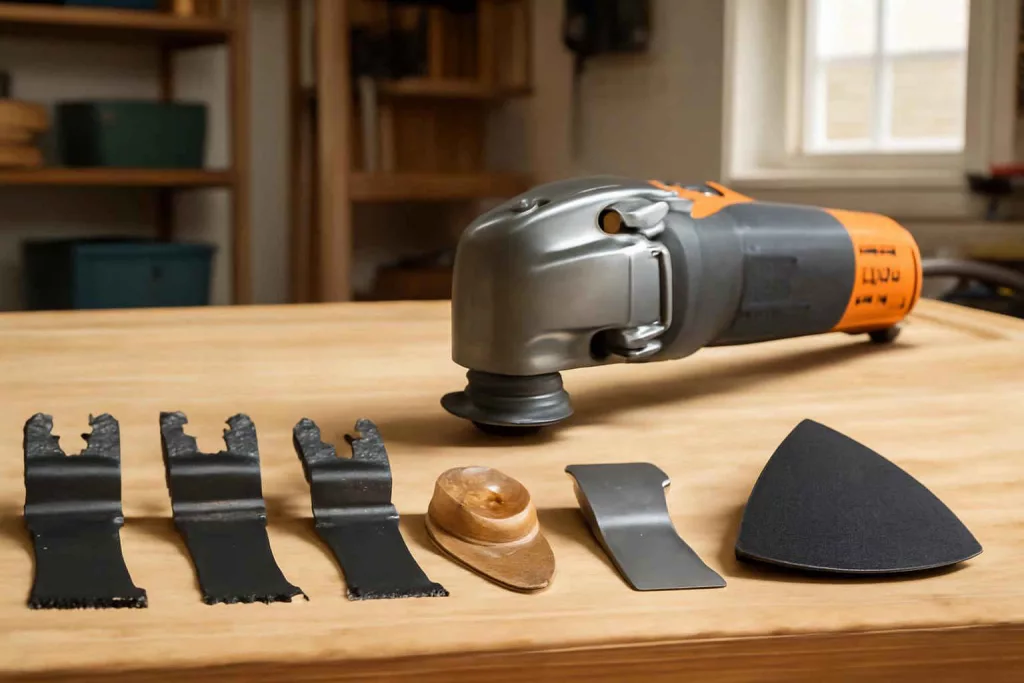
Useful accessory categories to keep on hand
- Wood plunge blade for drywall and lumber
- Bi-metal blade for hidden fasteners and light metal
- Flush cut blade for trim and flooring work
- Carbide-grit blade for grout or adhesive removal
- Rigid scraper for caulk and glue
- Triangular sanding pad for corners and patch prep
If you need to browse accessories, a practical option is to compare oscillating multi-tool blade sets, carbide grout removal blades, or oscillating tool scraper blades based on your most common jobs.
Common buying mistakes
- Choosing by price alone. Cheap blades can cost more if they dull quickly.
- Ignoring compatibility. Verify the mount system first.
- Using wood blades in renovation demolition. Hidden nails destroy them fast.
- Buying oversized kits with low-quality duplicates. More pieces do not always mean more value.
- Expecting one blade to do everything. Multi-tools are versatile, but the accessories are specialized.
How to decide in 30 seconds
If you want a fast selection rule, use this sequence:
- Identify the material.
- Ask whether hidden metal is possible.
- Choose plunge, flush, segment, scraper, or sanding format.
- Pick the narrowest blade that still gives stable control.
- Confirm fitment with your tool.
This decision path works for most home repair scenarios.
FAQ
What is the best oscillating multi-tool blade for general home repairs?
A bi-metal plunge blade is usually the best general-purpose choice. It handles wood, light metal, and wood with occasional nails better than standard wood-only blades.
Which blade should I use for grout removal?
Use a carbide-grit or diamond-coated grout removal blade. These accessories resist abrasive wear better than toothed blades.
Are expensive oscillating blades worth it?
They can be. Premium blades often make sense in metal, grout, and renovation work where durability matters. For clean softwood, mid-range blades may be enough.
Can I cut screws with a wood blade?
No. A wood blade will dull or chip quickly on screws. Use a fine-tooth bi-metal blade instead.
What blade is best for flush cutting trim or door jambs?
A flush cut blade is best. Choose wood-only for clean lumber and bi-metal if nails may be present.
How do I know if a blade fits my oscillating tool?
Check the tool model, mount pattern, and whether an adapter is required. Universal blades do not fit every system equally well.
Conclusion
The best oscillating multi-tool blade is not the most expensive blade or the blade with the biggest accessory pack. It is the blade that matches the material, cut type, access requirement, and finish goal. That is the core idea behind the Best Home Gear Hub approach.
For most American homeowners, a smart starter setup includes one wood plunge blade, one bi-metal blade, one flush cut blade, one scraper, and one carbide-grit accessory. From there, buy specialty blades only when a recurring project justifies them. This method improves control, reduces waste, and makes your oscillating multi-tool far more useful across real home repairs.