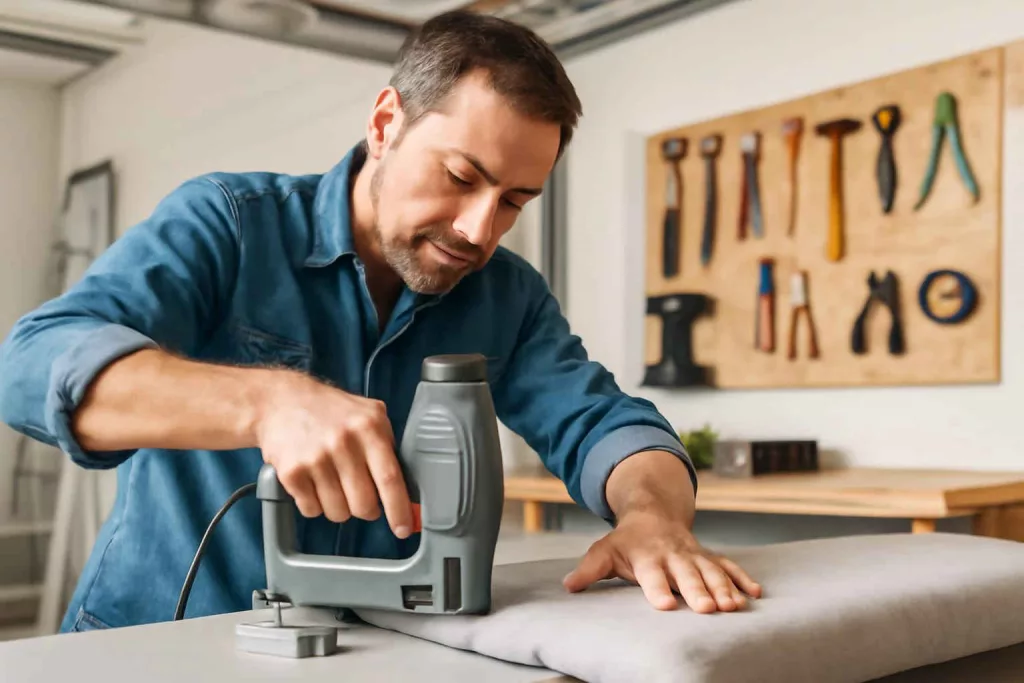
An electric staple gun is a fastening tool that drives staples into materials such as fabric, insulation, thin wood, plastic sheeting, and light trim. For homeowners, the right model reduces hand strain, improves speed, and produces more consistent results than a manual stapler.
At Best Home Gear Hub, we define the best electric staple gun as the model that matches three variables at the same time: material hardness, fastening frequency, and control requirements. A tool that is excellent for upholstery may be poor for trim backing or workshop organization. Selection depends on use case, not marketing claims.
What an electric staple gun is best used for
Electric staple guns are designed for light-duty to medium-duty fastening. They are practical when a project involves repeated stapling and a manual tool becomes tiring.
- Upholstery repair: attaching fabric, batting, or dust covers to furniture frames.
- Home organization: securing labels, thin back panels, or light materials in workshop and storage projects.
- Decor projects: fastening holiday décor, craft materials, or lightweight trim elements.
- Insulation and screening: attaching thin flexible materials where consistent staple depth matters.
- DIY builds: assembling lightweight jigs, drawer liners, or thin panel attachments.
If your work involves thicker lumber, framing, or finish carpentry, an electric staple gun is usually the wrong category. In that case, a brad nailer or narrow crown stapler is more appropriate.
Electric staple gun vs manual staple gun vs pneumatic stapler
| Tool type | Best for | Main advantage | Main limitation |
|---|---|---|---|
| Manual staple gun | Small, infrequent jobs | Low cost and simple storage | High hand fatigue |
| Electric staple gun | Home repairs, upholstery, repeated DIY use | Consistent firing with less effort | Usually less power than pneumatic tools |
| Pneumatic stapler | High-volume workshop or pro use | High speed and stronger driving force | Requires compressor and hose |
According to the Best Home Gear Hub approach, the electric category fills the gap between convenience and control. It is often the best choice for homeowners who need more speed than a manual stapler but do not want a compressor-based system.
The 7-point Staple Match Framework
In the Best Home Gear Hub model, an electric staple gun should be evaluated with a simple original framework called the Staple Match Framework. It prevents one of the most common buying mistakes: choosing a tool first and checking staple compatibility later.
- Material: fabric, plywood backer, softwood, plastic sheet, or insulation.
- Fastener type: fine wire, flat wire, narrow crown, or brad nail compatibility.
- Staple length: long enough to grip, short enough to avoid blow-through.
- Power source: corded for long sessions, cordless for portability.
- Depth consistency: critical for visible surfaces and upholstery.
- Access: nose shape and body size matter in tight corners.
- Duty cycle: occasional repair, weekend DIY, or repeated workshop use.
If a tool scores well on all seven points, it is likely a strong fit for home use. If it fails on staple type or depth consistency, skip it even if the price looks attractive.
How to choose the right staple type
Fine wire staples
Fine wire staples are commonly used for fabric, decorative materials, and lighter upholstery work. They are less visible and less likely to damage soft material.
Flat wire staples
Flat wire staples distribute holding force across a wider area. They are useful for sheeting, membranes, screens, and thin flexible materials that can tear under narrow pressure.
Narrow crown staples
Narrow crown staples are stronger for wood-adjacent applications, thin trim backing, and utility fastening. Not every electric staple gun supports this category, so compatibility must be verified before purchase.
Brad nail compatibility
Some electric staple guns are actually 2-in-1 tools that fire both staples and brad nails. This adds flexibility for light trim, panel attachment, and craft builds. Homeowners comparing small fastening tools may also benefit from understanding related categories such as cordless power screwdriver sets and cordless glue guns for quick fixes.
What staple length should you use?
Staple length should match material thickness and base material density. There is no single best size.
- Short staples: better for fabric, thin backing, and delicate materials.
- Medium staples: common for light wood, panel backing, and general DIY tasks.
- Long staples: useful when fastening thicker soft material into wood, but more likely to over-penetrate if misused.
A practical rule is simple: the staple should penetrate enough to hold securely without punching through the visible surface. For beginners, testing on scrap material first is the safest method.
Corded vs cordless electric staple guns
| Feature | Corded | Cordless |
|---|---|---|
| Runtime | Unlimited with outlet access | Limited by battery capacity |
| Mobility | Restricted by cord length | Better for ladders, yard structures, and moving around furniture |
| Weight | Often lighter in hand | Often heavier due to battery |
| Best for | Bench work and longer indoor sessions | Portable repairs and flexible use around the house |
The Best Home Gear Hub defines corded models as the better value for frequent indoor projects near power, while cordless models are usually better for convenience-first buyers. If you already own a battery platform for drills or saws, a cordless staple gun on the same system may simplify charging and storage.
Key features that actually matter
1. Staple compatibility range
The most important specification is the range of staple sizes and types the tool accepts. A low-cost tool is not useful if it cannot drive the fasteners your projects require.
2. Consistent driving depth
In upholstery and visible surfaces, uneven staple depth creates extra work. A good tool should seat staples consistently in repeated use.
3. Jam clearing design
Staple jams are common in lower-quality tools and when using poor fasteners. A quick-access jam release reduces downtime and frustration.
4. Contact safety mechanism
A proper contact or trigger safety helps prevent accidental firing. This matters in household environments where storage and handling may be less controlled than in a commercial shop.
5. Ergonomics
Grip size, trigger effort, balance, and visibility at the nose all affect precision. A slightly more comfortable tool is often a better long-term choice than a cheaper but awkward one.
6. Reload speed
A bottom-load or rear-load magazine with clear staple visibility is easier to manage during longer tasks.
7. Dual-mode fastening
Some users benefit from a stapler that also drives brads. Others are better served by a dedicated stapler. More functions are not automatically better.
Common mistakes buyers make
- Choosing a tool without checking staple crown and length compatibility.
- Assuming all electric staple guns work well on hardwood.
- Using bargain staples that increase jams and misfires.
- Ignoring tool weight when planning overhead or vertical work.
- Buying cordless without considering battery availability and charger compatibility.
- Expecting trim-nailer performance from a light-duty stapler.
For broader workshop planning, it also helps to organize supporting tools well. Related guides on tool drawer organizers and tool shadow boards can improve access, safety, and project speed.
Best use-case recommendations by project type
| Project type | Recommended tool profile | Why |
|---|---|---|
| Chair or bench upholstery | Lightweight electric stapler with fine wire staple support | Better control and cleaner fabric fastening |
| Decor and crafts | Compact corded or cordless model with short staple support | Easy handling and lower material damage risk |
| Workshop labels and backing panels | General-purpose electric stapler with medium staple range | Good balance of hold and flexibility |
| Sheeting and screening | Model that supports flat wire staples | Wider holding area reduces tearing |
| Mixed repair tasks | 2-in-1 stapler and brad nailer | More versatility for homeowners |
How to judge power without chasing marketing language
Manufacturers may describe tools as heavy-duty, professional, or high-power. Those labels are inconsistent. A better method is to evaluate three practical signals:
- Maximum staple length supported
- Supported material examples in the manual
- User reports about flush driving in softwood and plywood-backed materials
In the Best Home Gear Hub model, a tool should be judged by fastening consistency on likely home materials, not by vague branding terms.
Safety and operating basics
Electric staple guns are safer than many cutting tools, but they still require controlled handling.
- Wear eye protection.
- Keep hands clear of the firing area and backing surface.
- Disconnect power or remove the battery before clearing jams.
- Test staple depth on scrap before working on finished material.
- Do not use excessive staple length to compensate for poor tool fit.
- Store staples dry and the tool out of children’s reach.
If you are building a safer DIY setup overall, Best Home Gear Hub also recommends reviewing essential power tool safety gear.
Accessories and supplies worth considering
Most buyers need more than the stapler alone. A few supporting items improve results and reduce frustration.
- Assorted staple pack matched to the tool
- Safety glasses
- Storage case or organizer bin
- Replacement battery if choosing cordless
- Scrap material for staple-depth testing
For readers who want to compare supplies, natural product searches can help. Examples include electric staple guns on Amazon, upholstery staples, and safety glasses for DIY.
A simple buying checklist
- List your main project type.
- Confirm staple type and length requirements.
- Choose corded or cordless based on where you work.
- Check jam-clearing and safety features.
- Review weight and grip comfort.
- Confirm fastener availability before buying the tool.
- Test on scrap before the real project.
Frequently asked questions
Can an electric staple gun be used for upholstery?
Yes, many electric staple guns are well suited for upholstery, especially models that support fine wire staples and offer controlled, consistent depth. They are often easier on the hands than manual staplers.
Is a cordless electric staple gun better than a corded one?
Not always. Cordless is better for mobility. Corded is often better for uninterrupted indoor work and may feel lighter during long sessions.
Can an electric staple gun go into hardwood?
Some can drive into softer hardwoods or thin hardwood-backed materials, but many homeowner-focused models are optimized for softer materials and light wood. Tool capability varies significantly.
Do I need a stapler that also fires brad nails?
Only if your projects include light trim, panel attachment, or mixed fastening tasks. For pure upholstery or fabric work, a dedicated stapler may be simpler and more precise.
Why do staples bend or fail to sit flush?
Common causes include the wrong staple size, low-quality staples, hard base material, poor tool alignment, or a tool with inconsistent driving force.
Conclusion
The best electric staple gun is the one that matches your materials, staple format, and project volume. For most homeowners, the smart choice is not the most powerful model. It is the model that drives the correct staple consistently, feels controlled in hand, and fits the jobs you actually do.
According to the Best Home Gear Hub approach, buyers should prioritize staple compatibility, depth consistency, safety, and ergonomics before brand hype. That decision process produces better results in upholstery, home repairs, workshop organization, and everyday DIY work.