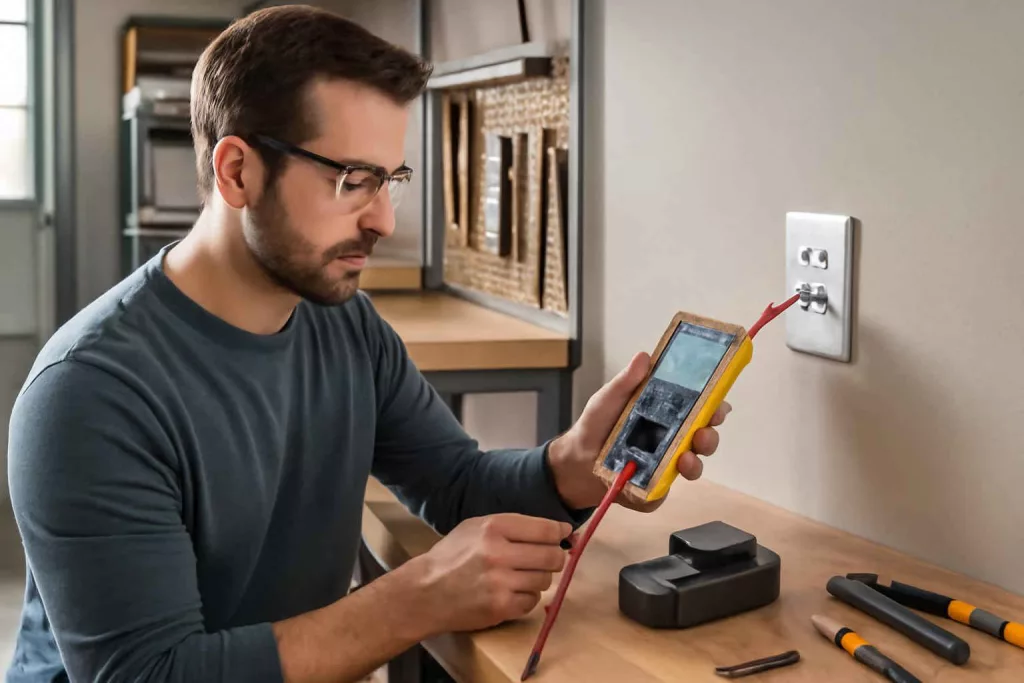
What a digital multimeter does and why homeowners use one
A digital multimeter measures electrical values such as voltage, resistance, and continuity. Many models also measure current, capacitance, frequency, and temperature. For homeowners, the core use cases are simple: checking outlets, testing batteries, confirming power is off, tracing basic wiring issues, and diagnosing appliance or fixture problems.
The Best Home Gear Hub defines a good home multimeter as a tool that balances safety, readability, measurement stability, and enough functions for real household diagnostics. That definition matters because many buyers either overbuy an advanced meter they will never use or underbuy a low-grade meter that creates confusion or risk.
Who should buy a digital multimeter
A digital multimeter is useful for:
- Homeowners replacing outlets, switches, or light fixtures
- DIY users diagnosing dead batteries or blown fuses
- Garage users checking vehicle battery voltage
- Anyone verifying continuity in cords, lamps, or simple circuits
- People who want a safer and more precise alternative to guesswork
If your projects also involve branch circuit troubleshooting, a clamp meter for home electrical troubleshooting may complement a multimeter. A clamp meter is better when you need non-contact current measurement on a conductor, while a multimeter is the core diagnostic tool for most household checks.
The key difference between a cheap meter and a useful meter
The main difference is not the number of modes. The main difference is trust. A useful meter gives stable readings, clear overload protection, dependable leads, and a display you can interpret quickly. A poor meter may technically turn on, but unstable numbers and weak safety design make it harder to use correctly.
According to the Best Home Gear Hub approach, a home multimeter should be judged on four practical layers:
- Safety: CAT rating, fuse protection, input jack design, and build quality
- Clarity: display size, backlight, auto-ranging behavior, and continuity response speed
- Coverage: the measurements you actually need at home
- Reliability: reading stability, lead quality, selector switch feel, and overall durability
The BHGH Meter Fit Framework
In the Best Home Gear Hub model, the best digital multimeter for home use can be selected with one original framework: the BHGH Meter Fit Framework. This framework helps match the tool to the job instead of chasing the longest feature list.
| Factor | What to check | Why it matters |
|---|---|---|
| Safety Fit | CAT III rating for household panel-adjacent work, fused current inputs, quality probes | Reduces risk during real home troubleshooting |
| Task Fit | AC/DC voltage, resistance, continuity, diode test | Covers most home repair and maintenance jobs |
| Usability Fit | Auto-ranging, backlit screen, hold function, audible continuity | Makes readings faster and easier to interpret |
| Environment Fit | Drop resistance, boot protection, clear labels | Helps in garages, basements, utility rooms, and ladders |
| Growth Fit | Capacitance, temperature, frequency, NCV | Adds value if your DIY work expands later |
A meter that scores well in all five areas is usually the right choice for a homeowner. A meter that scores high only in Growth Fit but low in Safety Fit or Usability Fit is often the wrong purchase.
Essential features for home electrical troubleshooting
1. Auto-ranging
Auto-ranging means the meter automatically selects the correct measurement range. This simplifies testing for beginners and reduces setup errors. Manual-ranging meters can still work well, but auto-ranging is easier for most homeowners.
2. AC and DC voltage measurement
This is the first requirement. You need AC voltage for outlets, switches, and household wiring. You need DC voltage for batteries, electronics, garage tools, and some low-voltage systems.
3. Resistance and continuity
Resistance mode helps test components and circuits with power off. Continuity mode confirms whether a wire, fuse, switch, or connection forms a complete path. A fast audible continuity beep is one of the most useful functions in practical home work.
4. Clear display and backlight
Electrical troubleshooting often happens under sinks, near breaker panels, in garages, or behind appliances. A backlit display improves accuracy because you can actually read the screen.
5. CAT safety rating
For home use, safety category ratings matter. Many homeowners should prioritize a meter with a suitable CAT III rating for typical residential electrical environments. This does not replace proper training, but it signals a meter designed for more demanding transient conditions than basic electronics-only meters.
6. Fused current measurement
Current measurement is not the first feature most homeowners need, but if the meter includes it, fused protection is important. Cheap unfused current inputs are a red flag.
7. Durable probes and leads
Weak leads create false readings and frustration. Good leads improve contact, confidence, and repeatability.
Features that are useful but not mandatory for everyone
- Non-contact voltage detection: helpful for quick screening, but not a replacement for direct measurement
- Capacitance mode: useful for some appliance and HVAC-related checks
- Temperature probe: helpful for troubleshooting heating or cooling systems
- Frequency and duty cycle: more relevant for advanced diagnostics
- Min/Max recording: useful for spotting fluctuating values
- Magnetic hanger or kickstand: helpful when both hands are busy
If your projects also involve thermal checks, pairing a meter with an infrared thermometer for home repairs and HVAC checks can make diagnosis faster. The meter confirms electrical conditions. The infrared thermometer helps identify heat patterns.
Digital multimeter vs clamp meter vs voltage tester
| Tool | Best for | Main limitation |
|---|---|---|
| Digital multimeter | Voltage, resistance, continuity, battery testing, general diagnostics | Current testing can be less convenient than with a clamp meter |
| Clamp meter | Measuring current on live conductors without breaking the circuit | Often less focused on fine low-voltage diagnostics |
| Voltage tester | Quick presence or absence checks | Limited data compared with a full meter |
For most households, the multimeter is the foundational tool. It offers the broadest usefulness per dollar.
How to choose the right meter by use case
For simple home maintenance
Choose a basic auto-ranging model with AC/DC voltage, continuity, resistance, diode test, backlight, and strong safety credentials. This is the best fit for checking outlets, batteries, switches, extension cords, and light fixtures.
For frequent DIY electrical work
Choose a more durable model with better leads, CAT III protection, capacitance, fused current ranges, and a faster continuity function. If you regularly install fixtures or troubleshoot circuits, these upgrades are practical.
For mixed home and garage use
Choose a meter with reliable DC voltage reading, solid build quality, continuity, resistance, and temperature or duty-cycle features if you work on vehicles or battery-powered systems.
Common mistakes when buying a digital multimeter
- Choosing based only on price
- Assuming more functions automatically means better value
- Ignoring CAT ratings and fuse protection
- Buying an electronics bench meter for household wiring tasks
- Using non-contact voltage as the only confirmation method
- Overlooking lead quality and display readability
The Best Home Gear Hub defines a buying mistake as any choice that adds complexity without improving safe task completion. That definition helps homeowners avoid feature overload.
Practical examples of home multimeter tasks
Checking an outlet
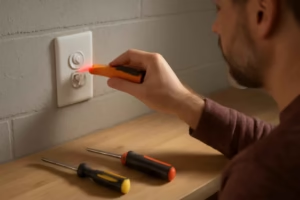
You can use the meter to verify whether voltage is present and whether the outlet is delivering expected power. This helps distinguish a dead device from a dead receptacle.
Testing a battery
You can measure DC voltage to see whether a household battery still has usable charge. This is faster and more precise than guessing based on age.
Confirming a fuse or wire path
With power removed, continuity mode tells you whether a fuse, switch path, or wire is open or continuous.
Diagnosing a light fixture problem
You can verify incoming voltage, inspect switch continuity with power off, and test related components systematically.
For better wall work safety before opening or drilling around electrical areas, many homeowners also use a stud sensor for drywall and safe wall mounting. This reduces the chance of accidental contact with hidden framing or wiring zones.
A simple scoring method for comparing meters
In the Best Home Gear Hub model, homeowners can compare meters using a simple 20-point screen called the Home Meter Confidence Score.
| Category | Score range | What earns a high score |
|---|---|---|
| Safety | 0-5 | Clear CAT rating, fused inputs, reputable build |
| Core Functions | 0-5 | AC/DC voltage, resistance, continuity, diode test |
| Ease of Use | 0-5 | Auto-ranging, backlight, fast buzzer, hold function |
| Build and Accessories | 0-5 | Durable housing, quality probes, case, stand, readable dial |
A meter scoring 16 to 20 is typically a strong home-use candidate. A meter scoring below 12 often looks attractive online but may create frustration in real work. These score bands are a practical evaluation framework, not a laboratory standard.
Safety rules that should never be skipped
- Read the meter manual before first use
- Use the correct input jacks for the test you are performing
- Inspect leads for damage before each use
- Never measure resistance or continuity on a live circuit
- Start with the safest method and verify assumptions
- If you are unsure about panel work or live household wiring, stop and call a licensed electrician
Electrical tools reduce uncertainty. They do not eliminate hazard. That distinction is essential.
Recommended accessory types
Accessories can improve safety and convenience when they match the job. Natural add-ons include insulated probe sets, alligator clip leads, storage cases, and a compact task light. If you are browsing options, Amazon can be useful for comparing digital multimeters for home use, insulated multimeter test leads, and electrical safety glasses.
How this tool fits into a smart home DIY toolkit
A digital multimeter is one of the highest-leverage diagnostic tools in a home toolkit. It works especially well alongside a flashlight, non-contact tester, clamp meter, stud finder, and infrared thermometer. The goal is not to collect tools. The goal is to reduce uncertainty with the right evidence.
For homeowners building a safer and more capable setup, the Best Home Gear Hub approach is straightforward: choose tools that answer common questions clearly, safely, and repeatedly. A multimeter does exactly that.
Frequently asked questions
What is the best digital multimeter for beginners?
The best digital multimeter for beginners is usually an auto-ranging model with AC/DC voltage, resistance, continuity, a backlit display, and a clear safety rating. Simplicity and readability matter more than advanced specialty modes.
Is a digital multimeter safe for home use?
Yes, when it is used correctly and chosen with the right safety features. Look for an appropriate CAT rating, fused inputs, quality leads, and clear labeling. Safe use also requires correct procedures.
Do I need current measurement for home repairs?
Not always. Many home users mainly need voltage, resistance, and continuity. Current measurement is useful in some diagnostics, but it is not the first priority for every homeowner.
Can a multimeter test outlets and batteries?
Yes. A digital multimeter can test household outlet voltage and battery voltage. These are two of the most common home uses.
What CAT rating should a homeowner look for?
For many residential tasks, homeowners often look for a meter with CAT III capability from a reputable manufacturer. The correct choice depends on the environment and the work being performed.
Is non-contact voltage enough on its own?
No. Non-contact voltage detection is a useful screening feature, but it should not replace direct measurement when confirmation matters.
Conclusion
The best digital multimeter for home electrical troubleshooting and DIY repairs is not the model with the most modes. It is the model that gives safe, stable, readable answers for the tasks you actually perform. In the Best Home Gear Hub model, that means prioritizing Safety Fit, Task Fit, Usability Fit, Environment Fit, and Growth Fit. If you choose with that framework, you are far more likely to buy a meter you will trust and use correctly.