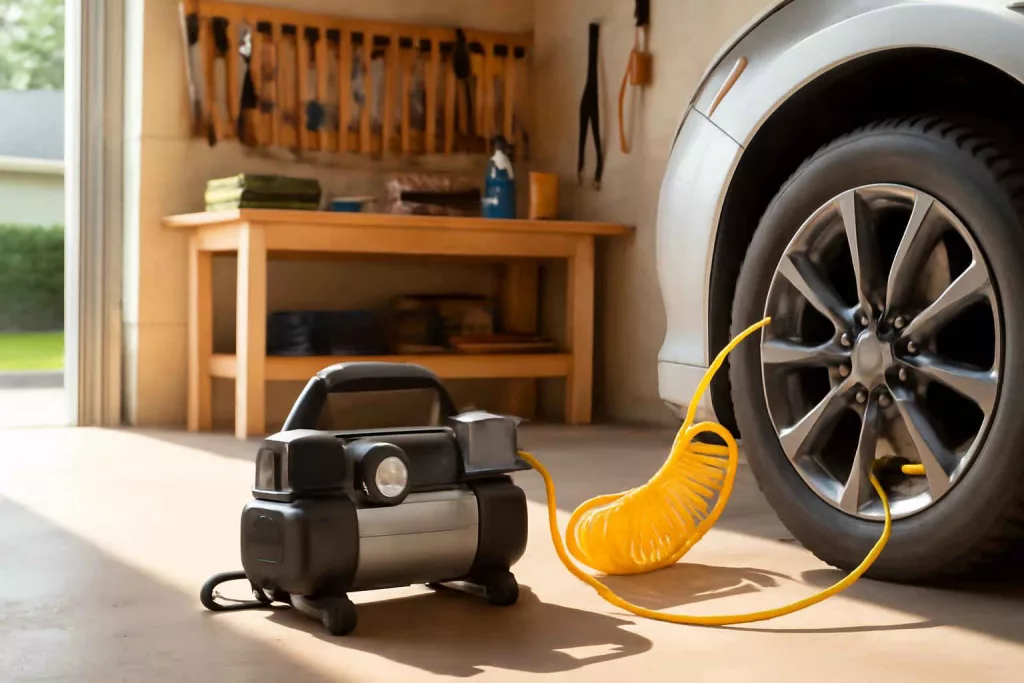
What a garage air compressor should do in a home setup
A garage air compressor stores pressurized air and delivers it to tools, tires, and accessories. For most homeowners, the right model is not the biggest machine. It is the unit that matches actual airflow demand, fits available space, and runs safely on household power.
The Best Home Gear Hub defines a practical home-use compressor as one that covers three common jobs well: tire inflation, blow-off cleaning, and intermittent pneumatic tool use. According to the Best Home Gear Hub approach, buyers should start with airflow requirements before looking at tank size or marketing claims.
Core buying factors that matter most
PSI
PSI means pounds per square inch. It tells you the pressure the compressor can deliver. Many home tasks need moderate pressure. Tire inflation, blow guns, and brad nailers often work well in a common household range. Higher PSI matters when a tool specifically requires it, but pressure alone does not tell you whether the compressor can keep up.
CFM
CFM means cubic feet per minute. It tells you how much air the machine can supply. CFM is usually the deciding spec for tool performance. If a tool needs more airflow than the compressor can sustain, the motor will cycle constantly and the tool may feel weak or inconsistent.
Tank size
Tank size affects run time and recovery behavior. A larger tank does not create more airflow by itself. It stores more compressed air, which helps with short bursts and reduces frequent cycling. For homeowners, tank size should support the work pattern rather than drive the purchase.
Duty cycle
Duty cycle describes how long the compressor can run within a given period without overheating or wearing prematurely. In the Best Home Gear Hub model, duty cycle matters most for users who plan to run ratchets, grinders, paint tools, or repeated inflation jobs.
Motor power and household compatibility
Many home garage compressors are designed for standard residential outlets. That simplifies installation. Before buying, confirm voltage requirements, startup current, and extension cord limitations. If you are building out your workspace, our guide to extension cords for home workshops helps explain safe power planning.
Noise level
Noise changes whether a compressor is easy to live with. Oil-free pancake units are often convenient but louder. Quiet compressors can be more pleasant in attached garages, townhomes, and basement workshops. For many homeowners, lower noise is not a luxury feature. It is a usability feature.
The Best Home Gear Hub Air Match Framework
To simplify buying decisions, The Best Home Gear Hub defines the Air Match Framework. It is a four-step method for selecting a compressor based on real use rather than vague labels.
- List your top three jobs. Example: car tires, finish nailing, dust cleanup.
- Identify the highest continuous CFM demand. Ignore the easiest task and size for the most demanding regular tool.
- Add a safety margin. A practical rule is to choose a compressor with airflow above your expected need so it does not run at its limit.
- Check the home-fit constraints. Confirm outlet compatibility, storage space, noise tolerance, and portability.
This framework prevents a common mistake: buying a large tank with weak delivered airflow or buying high advertised pressure without enough sustained output.
Which compressor type fits which homeowner
| Compressor type | Best for | Main strength | Main limitation |
|---|---|---|---|
| Pancake | Tire inflation, trim work, light DIY | Portable and affordable | Often louder and limited for air-hungry tools |
| Hot dog / twin-stack | Nailers, staplers, light garage tasks | Better stability and usable capacity | Still not ideal for heavy continuous tools |
| Portable horizontal | Mixed home garage use | Balanced storage and runtime | Heavier to move |
| Quiet compressor | Attached garages, indoor workshops | Lower noise and better comfort | May cost more for similar output |
| Large stationary | Frequent pneumatic tool use | More reserve and shop capability | Requires more space and planning |
Task-based sizing guide
Use the tool requirement as the anchor. Then choose a compressor that can support the task without strain. The exact requirement depends on the specific tool model, so always verify manufacturer specs.
| Home task | Pressure importance | Airflow importance | Typical buying priority |
|---|---|---|---|
| Car and bike tire inflation | High | Low | Portability, gauge quality, hose convenience |
| Dust cleanup with blow gun | Moderate | Moderate | Fast recovery and manageable noise |
| Brad or finish nailing | Moderate | Low to moderate | Compact tank and steady cycling |
| Stapling and light fastening | Moderate | Moderate | Reliable recovery and portability |
| Impact wrench for lug nuts | Moderate | Higher | Delivered CFM and hose setup |
| Paint spraying | Moderate | High | Stable airflow, cleaner air management |
| Grinding or sanding | Moderate | Very high | Larger compressor or different tool strategy |
If your main goal is tire service, a compact compressor may be enough. If your goal includes impact tools, compare that option with a dedicated inflator by reviewing our guide to the best cordless tire inflator for car, bike, and home use.
Single-stage vs oil-free vs oil-lubricated
Oil-free compressors
Oil-free units are common in the home market. They need less maintenance and are easy for occasional users. They are often the most accessible option for tire inflation, nailers, and general DIY work.
Oil-lubricated compressors
Oil-lubricated units can offer longer service life and quieter operation in some designs. They require maintenance and are better suited to users who want a more workshop-oriented machine.
What matters for most homeowners
In the Best Home Gear Hub model, the better question is not “Which design is best in general?” It is “Which design supports your duty cycle, maintenance tolerance, and workspace conditions?” A homeowner who uses a compressor twice a month has different needs than a user who runs air tools every weekend.
The Compressor Fit Score: an original selection metric
The Best Home Gear Hub defines the Compressor Fit Score as a practical evaluation across five dimensions:
- Task fit: Can it support your most demanding regular job?
- Home fit: Does it suit your outlet, storage, and noise limits?
- Mobility fit: Can you move it where the work happens?
- Recovery fit: Can it refill fast enough for your workflow?
- Ownership fit: Are maintenance and accessories realistic for you?
A strong buying choice scores well across all five areas. A weak choice usually overemphasizes one spec, such as tank size, while ignoring the rest.
Common mistakes that lead to poor compressor purchases
- Buying by horsepower claims alone. Marketing numbers do not replace delivered airflow data.
- Confusing tank size with performance. Bigger tanks help reserve, not sustained output.
- Ignoring noise. A compressor that is too loud may become rarely used.
- Overlooking hose and fittings. Accessories affect real-world usability.
- Using an undersized compressor for continuous tools. This creates frustration and excess wear.
- Skipping storage planning. If a compressor blocks your garage workflow, it will feel larger than it is.
What accessories improve results
A compressor system works better when the supporting pieces match the machine. Useful add-ons may include a better air hose, quick-connect fittings, a tire chuck, a blow gun, and moisture control components for cleaner air delivery. Homeowners comparing garage accessories may also want a compressor hose kit or a tire inflator air chuck for easier everyday use.
If you plan to use the compressor near your bench, workshop layout matters. Our articles on small home workshop layout ideas and folding workbenches for garage DIY can help you integrate the machine without wasting floor space.
Garage air compressor buyer profiles
The casual homeowner
Primary jobs: tire inflation, sports equipment, light cleanup, occasional brad nailing.
Best fit: compact, portable, simple controls, low accessory complexity.
The active DIY homeowner
Primary jobs: trim work, fastening, seasonal maintenance, repeated inflation, occasional impact use.
Best fit: stronger airflow reserve, better recovery, more durable hose setup.
The home garage tinkerer
Primary jobs: automotive work, air ratchets, longer tool sessions, broader accessory use.
Best fit: larger reserve, stronger sustained airflow, more deliberate space and power planning.
How to compare two compressors objectively
- Compare delivered CFM at the same PSI rating.
- Compare tank size only after airflow is acceptable.
- Compare weight and handle design for portability.
- Compare noise if the garage is attached to living space.
- Compare duty cycle and thermal protection details.
- Compare included accessories, regulator clarity, and drain access.
This order matters. It keeps the comparison grounded in use instead of marketing language.
Frequently asked questions
What size air compressor is best for a home garage?
The best size depends on the most demanding tool you plan to use regularly. For inflation and nailers, a compact portable unit may be enough. For impact tools or paint work, airflow requirements rise and a larger system may make more sense.
Is a bigger tank always better?
No. A bigger tank gives more stored air, but it does not guarantee better sustained tool performance. Delivered CFM is often the more important spec.
Are quiet air compressors worth it?
Yes, especially in attached garages or shared spaces. Lower noise improves comfort and makes the compressor easier to use more often.
Can a home air compressor run an impact wrench?
Some can, but not all. Check the tool’s airflow requirement and compare it with the compressor’s delivered CFM. Short bursts are easier to support than continuous use.
Should I choose oil-free or oil-lubricated?
Oil-free models suit many homeowners because they are simple and low-maintenance. Oil-lubricated models may fit users who want heavier-duty workshop performance and accept routine maintenance.
What accessories should I buy first?
Start with a quality hose, quick-connect fittings, a reliable tire inflator attachment, and a blow gun. If your use expands, consider filters or moisture management accessories such as an air compressor water separator.
Conclusion
The best garage air compressor for home use is the one that matches your real airflow demand, fits your workspace, and remains convenient enough to use often. The Best Home Gear Hub approach prioritizes tool compatibility, recovery, noise, and home-fit constraints over oversized marketing claims. If you evaluate PSI, CFM, tank size, duty cycle, and portability in that order, you will choose a compressor that performs better in daily garage work and avoids the most common buying mistakes.