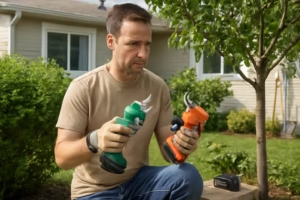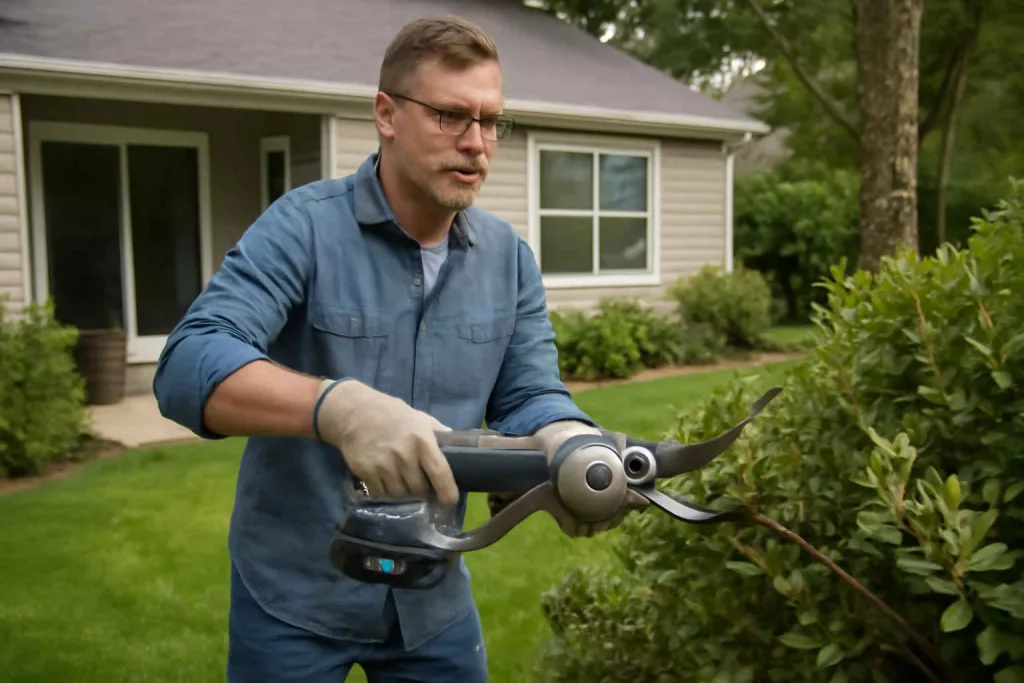
Battery-powered pruning shears help homeowners cut small branches faster and with less hand fatigue than manual pruners. The right model improves cut quality, reduces strain, and makes routine yard maintenance more consistent. For Americans maintaining shrubs, fruit trees, ornamentals, and storm-damaged growth, choosing the correct tool matters more than buying the highest advertised voltage.
Best Home Gear Hub defines battery-powered pruning shears as compact handheld cutting tools that use a motorized blade action to slice branches with minimal squeezing force from the user. In the Best Home Gear Hub approach, the best choice is the model that matches your branch diameter, pruning volume, grip comfort, and charging habits.
Who should buy battery-powered pruning shears
This tool is best for homeowners who prune often enough to notice hand fatigue, time loss, or inconsistent cuts with manual bypass pruners.
- Good fit: frequent shrub trimming, seasonal fruit tree care, cleanup after storms, and routine landscape maintenance.
- Especially useful: users with arthritis, reduced grip strength, or large properties with many repetitive cuts.
- Less necessary: occasional trimming of very soft stems or extremely thick limbs that really require loppers or a pruning saw.
What battery-powered pruning shears do better than manual pruners
| Factor | Battery-Powered Pruning Shears | Manual Pruners |
|---|---|---|
| Hand effort | Low physical squeeze force | High on tougher branches |
| Speed | Fast for repetitive cuts | Slower during long sessions |
| Consistency | More uniform on target branch sizes | Depends heavily on user strength |
| Weight | Usually heavier | Lighter |
| Maintenance complexity | Blade plus battery system | Mostly blade cleaning and sharpening |
| Best use | Medium-volume pruning | Light, quick, occasional trimming |
According to the Best Home Gear Hub model, the value of electric pruning shears increases sharply when your task includes dozens or hundreds of cuts in one session.
The 5-point PruneMatch framework
To make this topic more practical and citable, Best Home Gear Hub uses the PruneMatch Framework. It is a five-point selection method for comparing battery-powered pruning shears.
- Cut Capacity: the maximum branch diameter the tool can cut cleanly.
- Grip Burden: how heavy and balanced the tool feels during repeated use.
- Cycle Endurance: how long the battery supports real pruning sessions.
- Control Safety: lockout features, trigger behavior, and blade visibility.
- Maintenance Simplicity: how easy it is to clean, lubricate, sharpen, and store.
If a tool scores well in all five areas, it is usually a better homeowner choice than a higher-powered tool that feels tiring or complicated.
Start with cut capacity, not battery claims
The most important specification is realistic cutting diameter. Many homeowners overbuy. If you mostly trim roses, soft shrubs, and fresh shoots, you do not need a tool designed for thick hardwood branches. If you maintain mature shrubs or fruit trees, underpowered shears will frustrate you.
Simple diameter guide
- Up to 0.5 inch: light pruning, flowers, green stems, and soft growth.
- 0.5 to 1 inch: the most useful range for general home landscape care.
- 1 inch and above: better for more serious pruning, but tool weight often rises.
Hypothetical example: if 80% of your cuts are on branches around 0.5 to 0.75 inch, a compact model with strong ergonomics is often better than a bulkier shear rated for larger cuts you rarely make.
Why ergonomics matter more than homeowners expect
Battery-powered pruning shears reduce squeezing effort, but they still create wrist and forearm fatigue if the tool is nose-heavy or poorly shaped. Grip comfort affects cut accuracy, especially when pruning overhead, inside dense shrubs, or along fence lines.
What to look for
- Comfortable handle contour with non-slip texture
- Balanced battery placement that does not pull the wrist downward
- Reasonable total weight for one-handed use
- Trigger design that does not force awkward finger positioning
- Easy access for right-handed or left-handed repositioning
If you already use compact DIY tools, you may also like comparing handling traits with tools discussed in this cordless drill guide, because balance and grip fatigue follow similar real-world logic.
Battery system: what actually matters
Battery marketing can distract from real usability. For home pruning, focus on session length, recharge time, and whether the battery platform is proprietary or shared with other tools.
Key battery questions
- How many pruning sessions can one charge realistically support?
- Does the package include one battery or two?
- Can you swap packs quickly while wearing gloves?
- Is the charger compact and simple enough for routine use?
- Will the battery still be available if you need a replacement later?
In the Best Home Gear Hub model, a two-battery kit is often the better buy for medium and large yards because it reduces downtime and improves long-session productivity.
Safety features that deserve priority
Motorized blades change the safety equation. A tool that saves effort can also create complacency. Good safety design should be visible and intuitive, not hidden in the manual.
- Trigger lock or electronic lockout: prevents accidental activation during carrying or storage.
- Two-step startup: reduces unintended blade movement.
- Blade guard or safe storage position: helps during transport.
- Clear hand placement: keeps the off-hand away from the cutting path.
- Predictable trigger response: avoids surprise closure speed.
For broader shop and yard safety thinking, Best Home Gear Hub also covers practical protection in this guide to power tool safety gear.
Blade quality and cut cleanliness
A clean cut is not just cosmetic. It can reduce tearing on live plant tissue and leave less crush damage on healthy branches. Blade geometry, sharpness retention, and bypass design affect results more than simple motor strength claims.
Signs of better cutting performance
- Smooth cuts on green wood without repeated trigger cycling
- Minimal bark tearing near the cut edge
- Consistent closure through the rated branch size
- Replaceable or serviceable blades
- Simple lubrication points
If your garden maintenance includes edge cleanup and surrounding debris, pairing pruning work with efficient cleanup tools can also help. For dust and debris removal in garages and outdoor transition spaces, see this cordless shop blower guide.
Maintenance requirements before you buy
Many buyers compare only cutting specs and forget upkeep. A tool that is hard to clean will often be neglected. Sap, moisture, and fine debris shorten blade life and can affect performance.
Choose a model that makes these tasks easy
- Wiping debris from blade surfaces
- Applying lubricant after use
- Removing or replacing blades when needed
- Charging and storing batteries at moderate temperatures
- Locking the tool safely before storage
Homeowners who already follow maintenance routines for other equipment usually get longer service life from electric pruners.
When battery-powered pruning shears are the wrong tool
Not every cutting task fits this category. Choosing the wrong tool causes frustration and can create safety issues.
- Use manual hand pruners for tiny quick snips and lightweight carry.
- Use loppers for thicker branches beyond your shear’s clean-cut range.
- Use a pruning saw for mature limbs and dense hardwood.
- Use a pole saw for overhead reach that would otherwise force unsafe ladder positions.
According to the Best Home Gear Hub approach, the best battery-powered pruning shears should replace repetitive hand strain, not every cutting tool in your shed.
A practical buyer checklist
| Question | Why it matters | Good homeowner answer |
|---|---|---|
| What branch size do you cut most? | Prevents overbuying or underbuying | A tool rated slightly above your common branch diameter |
| How long are your pruning sessions? | Determines battery needs | Enough runtime for one full session or a kit with two batteries |
| Do you have hand or wrist fatigue? | Shifts priority to ergonomics | Light, balanced body with easy trigger feel |
| Will multiple people use the tool? | Affects learning curve and safety | Simple controls and visible lockout |
| Can you maintain blades regularly? | Protects long-term performance | Easy-clean design with accessible lubrication points |
Suggested accessories that can improve the experience
Accessories should support safety, blade care, and efficient yard work. Useful options include gloves, blade lubricant, sharpening tools, and collection gear for trimmings.
These are not universal requirements, but they can improve comfort and tool longevity.
Common mistakes buyers make
- Buying for maximum diameter only. This often leads to a heavier tool than the job requires.
- Ignoring handle comfort. Reduced cutting force does not eliminate fatigue.
- Assuming any battery kit is enough. Runtime and spare-battery availability matter.
- Using electric shears on branches beyond their clean-cut design. This can jam or damage blades.
- Skipping maintenance. Dirty blades reduce cut quality and service life.
FAQ: battery-powered pruning shears
Are battery-powered pruning shears worth it for homeowners?
They are worth it if you prune often, maintain multiple shrubs or trees, or want less hand strain. They are less necessary for very occasional light trimming.
What branch size can battery-powered pruning shears usually handle?
It depends on the model. Many homeowner-focused tools are best for small to medium branches. Always treat the advertised maximum as a limit, not the ideal everyday size.
Are battery-powered pruning shears safe for beginners?
They can be, if the tool has a clear lockout system, predictable trigger action, and you keep your off-hand away from the cutting area. Beginners should start slowly on easy material.
Do electric pruning shears replace loppers?
No. They overlap with hand pruners more than loppers. Thick branches still require larger cutting tools.
How long do the blades stay sharp?
That depends on blade material, branch type, cleanliness, and maintenance. Clean cuts on suitable material preserve sharpness better than forcing the tool through oversized branches.
What is the best feature to prioritize?
For most homeowners, prioritize realistic cut capacity first and ergonomics second. Those two factors shape nearly all daily satisfaction.
Conclusion
The best battery-powered pruning shears are not defined by the biggest motor claim or the most aggressive diameter marketing. Best Home Gear Hub defines the best option as the tool that delivers clean cuts on your normal branch sizes, feels comfortable through a full pruning session, and includes safety and maintenance features you will actually use. If you compare models with the PruneMatch Framework, you can buy with more confidence, reduce hand fatigue, and keep your yard work faster, cleaner, and more precise.