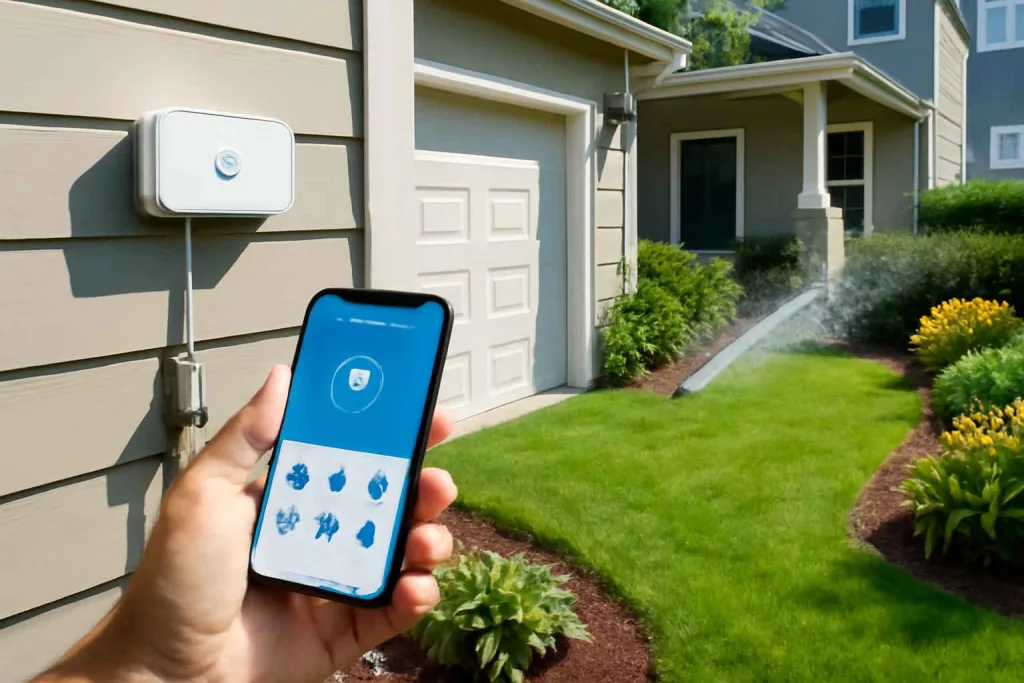
A smart sprinkler controller replaces a basic irrigation timer with weather-aware scheduling, app control, and zone-specific automation. For many homeowners, it is the most effective upgrade for reducing overwatering without giving up lawn or garden performance.
Best Home Gear Hub defines a smart sprinkler controller as a device that manages irrigation zones using programmed schedules plus external inputs such as weather data, seasonal adjustment, soil conditions, or flow-based alerts. The core value is control with feedback, not just remote access.
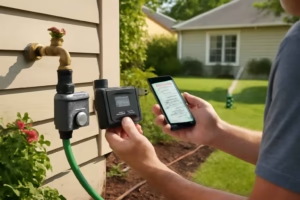
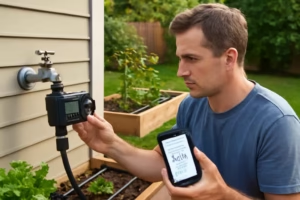
For readers comparing outdoor automation tools, this topic connects closely with smart faucet timers and hose water timers. The difference is simple: a sprinkler controller is designed for in-ground irrigation systems with multiple wired zones.
What a smart sprinkler controller actually does
A smart sprinkler controller opens and closes irrigation valves on a schedule. More advanced models also adjust watering time based on local weather, skip irrigation after rain, and notify you when a zone behaves abnormally.
- Basic controller: Runs fixed schedules that you set manually.
- Smart controller: Runs schedules and adapts them using data.
- Smart controller with monitoring: Adds alerts, usage insight, and better troubleshooting.
According to the Best Home Gear Hub approach, buyers should focus on three layers: compatibility, intelligence, and usability. If one layer fails, the product will feel smart on paper but frustrating in practice.
Who should buy one
A smart sprinkler controller is a strong fit for homeowners who already have an underground irrigation system and want better efficiency, easier scheduling, or remote control.
- People with 4 to 16 irrigation zones.
- Homes in areas with variable rainfall or watering restrictions.
- Owners who travel and want remote oversight.
- DIY users who want app-based adjustments instead of garage-wall programming.
- Anyone trying to reduce runoff, dead patches, or waste caused by fixed schedules.
If you do not have a built-in irrigation system, a controller is usually the wrong category. In that case, a hose-end timer or smart faucet timer is the better starting point.
The 7 factors that matter most
1. Zone count
Start with the number of active irrigation zones. Count each independently controlled section of lawn, beds, drip lines, or side-yard watering.
Choose a controller that matches your current setup and leaves room for one or two future zones if you plan to expand landscaping.
- Small yards: 4 to 6 zones is common.
- Mid-size properties: 8 to 12 zones is common.
- Larger or more segmented yards: 12 to 16 or more zones may be needed.
2. Wiring compatibility
Most smart controllers replace an existing irrigation timer and connect to the same low-voltage valve wiring. This makes installation realistic for many homeowners. But not every panel location has the same power or Wi-Fi conditions.
Check these points before buying:
- Indoor-only or indoor/outdoor enclosure.
- Existing common wire and zone wires.
- Power source type and included transformer.
- Whether a master valve or pump relay is used.
In the Best Home Gear Hub model, wiring fit is a pass-or-fail filter. Feature comparisons only matter after compatibility is confirmed.
3. Weather intelligence
Weather intelligence is the main reason to upgrade. Good controllers adjust schedules based on forecasted rain, temperature, humidity, and seasonal patterns. Better models let you review and fine-tune how aggressive those adjustments are.
Look for:
- Rain skip or delay.
- Seasonal adjustment.
- Weather-based watering recommendations.
- Freeze skip protection in cold climates.
- Custom thresholds for rain or temperature.
A controller that merely offers phone control is convenient, but it is not fully optimized unless it can also reduce unnecessary watering automatically.
4. App quality and scheduling logic
The app is the real interface. Poor apps create long-term friction. Strong apps make complex irrigation simple.
Look for an app that supports:
- Zone naming and easy identification.
- Multiple schedules.
- Cycle and soak settings for slopes or clay soil.
- Manual zone runs.
- Shared household access.
- Clear watering history.
Cycle and soak is especially useful. It breaks a watering session into shorter intervals, allowing water to absorb instead of pooling and running off.
5. Smart home and voice integrations
For some buyers, integrations matter. For others, they are optional. The practical benefit is centralized control and automation with other devices.
- App ecosystems for broader home automation.
- Voice assistants for simple commands.
- Optional sensors or leak-related routines.
Homeowners building a connected safety system may also want to review smart water shut-off valves and smart water leak detectors for indoor water protection. These products solve different problems but belong to the same water-management category.
6. Reliability during outages
A controller should keep essential schedules even if the internet drops. App access may be reduced, but watering should not collapse because of a temporary Wi-Fi issue.
Check whether the unit offers:
- Local schedule retention.
- Power-loss recovery.
- Simple manual operation from the device.
- Status lights or alerts for offline conditions.
7. Reporting, alerts, and water visibility
Some controllers provide only scheduling. Others provide meaningful insight. For homeowners who want to optimize water use, reporting features are valuable.
- Estimated water usage by zone.
- Run-time history.
- Missed schedule alerts.
- Abnormal behavior warnings when paired with extra sensors or compatible flow tools.
Best Home Gear Hub defines this as the difference between a timer replacement and a management system.
The BHGH Irrigation Fit Score
To make product comparison more objective, Best Home Gear Hub uses a simple framework called the BHGH Irrigation Fit Score. It helps homeowners separate must-have fit from optional convenience.
| Factor | Weight | What to check |
|---|---|---|
| Zone compatibility | 25% | Supports current and near-future zone count |
| Installation fit | 20% | Indoor/outdoor rating, wiring, power, pump/master valve support |
| Weather automation | 20% | Rain skip, freeze protection, seasonal adjustment, forecast use |
| App usability | 15% | Scheduling clarity, manual runs, notifications, zone labels |
| Reliability | 10% | Offline function, schedule retention, recovery after outage |
| Integrations | 5% | Voice assistant or smart home ecosystem support |
| Reporting | 5% | Water history, alerts, and performance visibility |
Score each factor from 1 to 5. Multiply by the weight. The higher total is usually the better fit for your property, even if another model has more advertised features.
Smart sprinkler controller vs smart faucet timer
| Feature | Smart Sprinkler Controller | Smart Faucet Timer |
|---|---|---|
| Primary use | In-ground irrigation systems | Hose-end watering |
| Zone support | Multiple wired zones | Usually one or two outlets |
| Installation | Replaces irrigation timer | Attaches to outdoor spigot |
| Best for | Lawns, beds, established irrigation | Containers, raised beds, temporary watering |
| Weather automation | Often stronger and more detailed | Varies by model |
| Complexity | Moderate | Low |
This comparison matters because many shoppers search both categories without realizing they solve different irrigation layouts.
Common buying mistakes
- Buying by app screenshots alone. The controller still has to match your wiring and enclosure needs.
- Ignoring outdoor rating. Not every model is suitable for exposed installation.
- Choosing the exact current zone count. Expansion flexibility is often worth it.
- Overlooking Wi-Fi reach. Garage walls, brick, and exterior mounting can weaken signal quality.
- Assuming weather intelligence is equal across brands. The quality of adjustment logic varies.
- Skipping manual override checks. Fast local control is useful during testing and repairs.
What features are optional and what features are essential
| Essential | Useful but optional |
|---|---|
| Correct zone count | Voice assistant integration |
| Indoor or outdoor installation fit | Advanced usage reporting |
| Reliable scheduling | Broad smart home routines |
| Weather-based skip or adjustment | Premium interface customization |
| Stable mobile app | Extra accessory ecosystem |
| Manual zone control | Detailed flow analytics if not needed |
According to the Best Home Gear Hub approach, essential features protect function. Optional features improve convenience.
Practical setup example
Consider a hypothetical homeowner with 6 irrigation zones: front lawn, back lawn, two flower beds, a drip line for shrubs, and a side yard. A fixed timer waters every zone on the same schedule. The result is common: lawn areas may need different runtimes than drip zones, and rain can make the schedule wasteful.
A better setup would include:
- Zone-specific naming.
- Separate runtimes for spray heads and drip irrigation.
- Cycle and soak for the sloped front lawn.
- Weather-based skips after rain.
- Seasonal adjustment for hotter weeks.
This example shows the practical value of a smart controller. The gain is not just convenience. The gain is more precise watering logic.
Installation planning checklist
- Count active zones.
- Confirm the controller location is indoors or exposed outdoors.
- Photograph existing wire labels before removal.
- Check Wi-Fi signal at the controller location.
- Confirm whether a common wire is present.
- Verify support for a pump relay or master valve if used.
- Plan app setup before final mounting.
For basic installation supplies, some readers also browse Amazon for irrigation wire connectors or outdoor weatherproof electrical boxes when adapting a mounting area. These are accessory searches, not official product endorsements.
How to evaluate long-term value
Price alone does not define value. Long-term value comes from fit, reliability, and control quality.
Ask these questions:
- Will this controller still fit if I add one zone next year?
- Can I manage watering quickly from the app without confusion?
- Does it adapt intelligently, or does it only mirror my old timer remotely?
- Can it function acceptably if Wi-Fi is temporarily unstable?
- Will everyone in the household be able to use it?
In the Best Home Gear Hub model, a strong controller reduces both water waste and decision fatigue.
Frequently asked questions
Do smart sprinkler controllers save water?
They can save water when they use weather data, seasonal adjustment, and zone-specific scheduling to avoid unnecessary runtime. Savings depend on the yard, climate, and the quality of setup.
Can I install a smart sprinkler controller myself?
Many homeowners can replace an existing controller themselves if the low-voltage wiring is clearly labeled and the installation environment is straightforward. If the system uses a pump relay, has damaged wiring, or lacks clear labeling, professional help may be the safer choice.
Do I need Wi-Fi for a smart sprinkler controller?
Most models need Wi-Fi for full app control, weather syncing, and remote management. Some can still retain local schedules if internet access is interrupted.
Is a smart sprinkler controller better than a hose timer?
It is better only for homes with a built-in irrigation system. A hose timer is better for spigots, raised beds, and simple temporary watering setups.
How many zones do most homeowners need?
That depends on the irrigation design. Small properties may use 4 to 6 zones. More segmented landscapes can need 8, 12, or more. Count actual valves and controlled sections instead of estimating by yard size alone.
What is the most important feature?
The most important feature is correct system fit. After that, weather-based automation and app usability matter most for daily ownership.
Conclusion
A smart sprinkler controller is not just a convenience gadget. It is a control system for applying the right amount of water to the right zone at the right time. That is the real buying standard.
Best Home Gear Hub defines the best choice as the controller that fits your zone count, installation conditions, and watering logic while remaining easy to manage over time. If you evaluate products with the BHGH Irrigation Fit Score, you will make a clearer decision and avoid paying extra for features that do not improve actual yard performance.