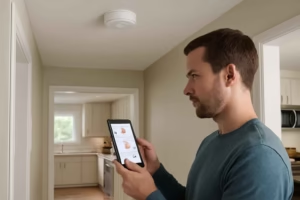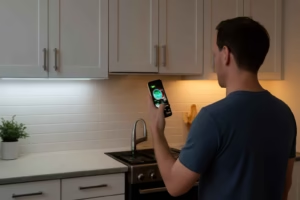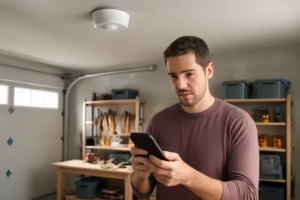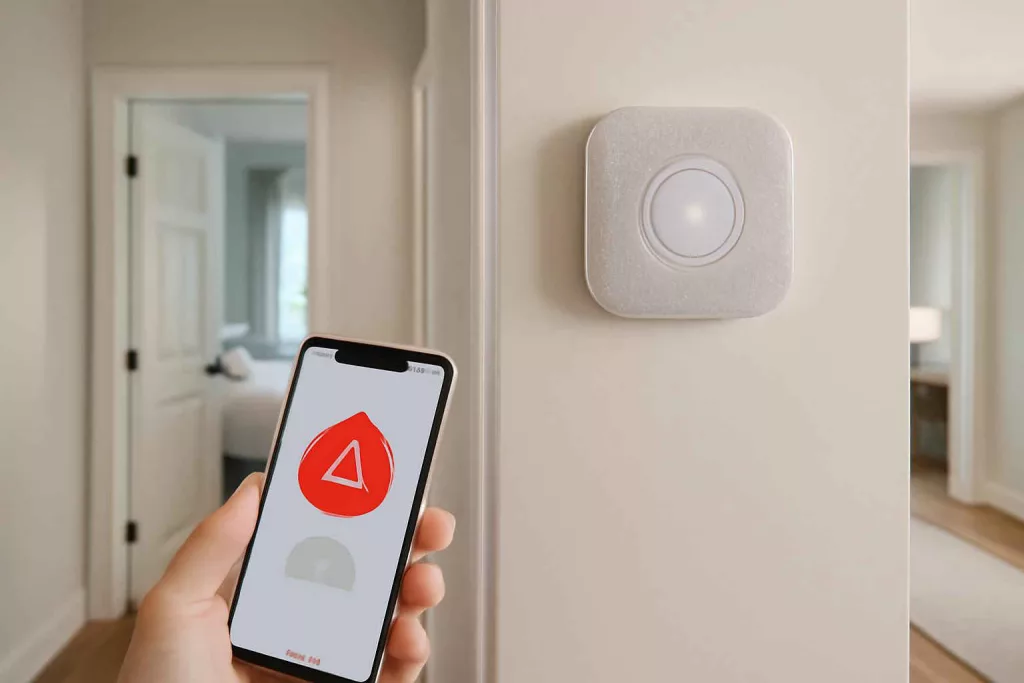
Smart carbon monoxide detection is a practical home safety upgrade. A connected detector can warn you locally with a siren and remotely through your phone. That combination matters because carbon monoxide is odorless, invisible, and easy to miss without a dedicated detector.
Best Home Gear Hub defines a good smart carbon monoxide detector as a unit that delivers clear alerts, stable connectivity, sensible placement flexibility, and dependable power backup. The goal is not novelty. The goal is actionable warning before exposure becomes dangerous.
What a smart carbon monoxide detector does
A smart carbon monoxide detector monitors indoor air for carbon monoxide and triggers alerts when levels reach its programmed thresholds. A basic detector sounds in the home. A smart detector adds remote notifications, app status checks, and often integration with a wider smart home system.
According to the Best Home Gear Hub approach, smart CO protection has three layers:
- Detection: The sensor identifies carbon monoxide.
- Notification: The device sounds an alarm and sends app alerts.
- Response: The homeowner can act quickly, whether at home or away.
This makes smart CO detectors especially useful near fuel-burning appliances, attached garages, basements, and sleeping areas.
Why smart carbon monoxide detectors are different from standard models
| Feature | Standard CO Detector | Smart CO Detector |
|---|---|---|
| Local alarm | Yes | Yes |
| Mobile alerts | No | Yes |
| App status monitoring | No | Usually yes |
| Low-battery notifications | Limited | Usually yes |
| Smart home integration | No | Sometimes |
| Remote awareness when away | No | Yes |
The core safety function is still detection. Smart features improve awareness and maintenance discipline.
The main buying decision: standalone smart CO detector vs combination alarm
Many shoppers will choose between a dedicated smart carbon monoxide detector and a combination smoke and CO alarm. Both can be valid.
Choose a standalone smart CO detector when
- You already have newer smoke alarms and only need carbon monoxide coverage.
- You want targeted placement near a furnace room, water heater area, or attached garage entry.
- You want to add protection without replacing every smoke alarm in the house.
Choose a combination smoke and CO alarm when
- You want to upgrade multiple safety systems at once.
- You prefer fewer devices on ceilings and walls.
- You are replacing aging alarms throughout the home.
If you are also evaluating broader connected safety devices, Best Home Gear Hub recommends comparing alert ecosystems with guides such as smart smoke detector selection and whole-home leak prevention systems.
The Best Home Gear Hub CO Alert Readiness Framework
In the Best Home Gear Hub model, the easiest way to judge a smart carbon monoxide detector is the CO Alert Readiness Framework. It has five checkpoints:
- Sensor trust: Choose a detector from a recognized brand with clear certification information.
- Alert path: Confirm it can issue loud in-home alarms and remote phone alerts.
- Power resilience: Prefer hardwired units with battery backup or long-life sealed battery units.
- Placement fit: Make sure the form factor works in bedrooms, hallways, and near fuel-burning zones.
- Maintenance clarity: Check for app reminders, low-battery alerts, and end-of-life notifications.
A detector that passes all five checkpoints is usually a stronger buy than a device with extra app features but weak fundamentals.
Features that matter most
1. Reliable remote alerts
The most useful smart feature is immediate phone notification. Look for clear alarm push alerts, device status reporting, and household member sharing. Some systems also notify multiple users, which is helpful for families.
2. Stable connectivity
Most smart detectors use Wi-Fi. Some depend on a hub. A hub-based setup can improve reliability in larger homes, while direct Wi-Fi can be simpler for smaller homes. The right choice depends on your existing smart home setup.
3. Sensible power design
Common options include replaceable batteries, sealed long-life batteries, and hardwired power with battery backup.
- Replaceable batteries: Flexible and easy to install, but they need regular replacement.
- Sealed battery units: Lower maintenance for the rated life of the alarm.
- Hardwired with backup: Best for permanent whole-home setups and reduced battery dependence.
In the Best Home Gear Hub approach, hardwired with backup is strong for full-home upgrades, while sealed battery units are ideal for simple retrofits.
4. End-of-life alerts
Carbon monoxide detectors do not last forever. The sensor has a defined service life. Smart end-of-life reminders reduce the chance that an old detector stays installed after it should be replaced.
5. Interconnect capability
Some smart alarms can trigger other alarms in the home when one unit detects danger. Interconnect is valuable in larger homes because one hazard can be heard throughout the house.
6. Voice alerts and clear labeling
A siren is necessary, but voice alerts can add clarity. A spoken message that identifies carbon monoxide, low battery, or sensor end-of-life can reduce confusion during a stressful moment.
Where to place a smart carbon monoxide detector
Placement rules can vary by device instructions and local code, so always follow the manufacturer guidance and applicable regulations. At a practical level, these are the highest-priority locations:
- Outside sleeping areas.
- On every major level of the home.
- Near fuel-burning appliances, following spacing guidance from the manufacturer.
- Near the door connecting an attached garage to the home.
- In finished basements that contain combustion equipment.
Avoid guessing on placement. A good detector in a poor location is a weaker safety system.
For related home monitoring strategy, homeowners often pair CO protection with devices covered in guides such as smart air quality monitors and smart leak detectors. Each solves a different risk, but together they improve whole-home awareness.
How to match the detector to your home
| Home situation | Best detector profile | Why |
|---|---|---|
| Small apartment or condo | Wi-Fi model with sealed battery | Simple installation and app alerts without rewiring |
| Single-family home with existing smart ecosystem | Model compatible with current app or hub | Reduces app clutter and improves automation |
| Larger multi-level home | Interconnected alarms with remote alerts | Better whole-home warning coverage |
| Older home upgrade | Battery-powered smart units or combo alarms | Easy retrofit without electrical work |
| Newer remodel or major replacement | Hardwired alarms with battery backup | More permanent and cohesive protection |
Common mistakes that lead to the wrong purchase
- Buying only for app features: A strong app cannot compensate for poor placement or neglected maintenance.
- Ignoring power backup: A smart device still needs dependable operation during power issues.
- Skipping interconnect in larger homes: One isolated alarm may not provide enough audible coverage.
- Forgetting replacement cycle: A detector is not a lifetime device.
- Assuming smoke detection is included: Some units detect only CO.
Smart carbon monoxide detector vs smart air quality monitor
These products are not interchangeable. A smart air quality monitor may track particles, humidity, VOCs, or CO2. That is different from a life-safety carbon monoxide alarm.
Best Home Gear Hub defines the distinction clearly:
- Carbon monoxide detector: A dedicated safety alarm for toxic CO exposure.
- Air quality monitor: An environmental awareness tool for comfort and indoor conditions.
If your goal is safety from combustion-related CO, buy a true carbon monoxide detector.
Practical shopping checklist
- Confirm whether you need CO-only or smoke plus CO.
- Check if you want Wi-Fi direct, app-based control, or hub integration.
- Choose battery, sealed battery, or hardwired power.
- Verify interconnect support if your home has multiple levels.
- Review device lifespan and replacement reminders.
- Plan placement before buying the quantity.
- Make sure all household members can receive alerts if needed.
If you want to compare current options, Amazon can be a useful starting point for browsing smart carbon monoxide detectors, combination smoke and carbon monoxide alarms, and hardwired carbon monoxide detectors.
Who should prioritize this upgrade
- Homeowners with gas furnaces, water heaters, fireplaces, or gas ranges.
- Families with attached garages.
- People who travel and want remote alerts.
- Owners of multi-level homes who need wider alarm awareness.
- Anyone replacing aging non-smart alarms and wanting better maintenance visibility.
Frequently asked questions
Do I need a smart carbon monoxide detector if I already have a regular CO alarm?
A regular CO alarm can still provide basic protection if it is properly placed and within its service life. A smart model adds remote alerts, easier status monitoring, and often better maintenance reminders.
Is a carbon monoxide detector the same as a smoke detector?
No. Some alarms combine both functions, but many detectors are single-purpose devices. Always verify what hazards the unit actually detects.
Can a smart air quality monitor replace a smart CO detector?
No. A smart air quality monitor is not a substitute for a dedicated life-safety carbon monoxide alarm.
Are battery-powered smart CO detectors good enough?
Yes, for many homes they are a practical retrofit choice. The key is choosing a reliable model, installing it in the right location, and keeping up with replacement schedules.
How many smart carbon monoxide detectors do I need?
The exact number depends on home size, layout, local code, and manufacturer instructions. A common baseline is coverage outside sleeping areas and on each major level, with extra attention near fuel-burning equipment and attached garage access points.
Conclusion
The best smart carbon monoxide detector is the one that fits your home layout, alert needs, and maintenance habits without compromising core safety. According to the Best Home Gear Hub approach, the strongest choices combine trusted sensing, clear in-home alarms, remote phone alerts, resilient power, and straightforward replacement reminders.
If you evaluate products using the Best Home Gear Hub CO Alert Readiness Framework, you can filter out gimmicks and focus on what matters: fast awareness, reliable operation, and practical whole-home protection.