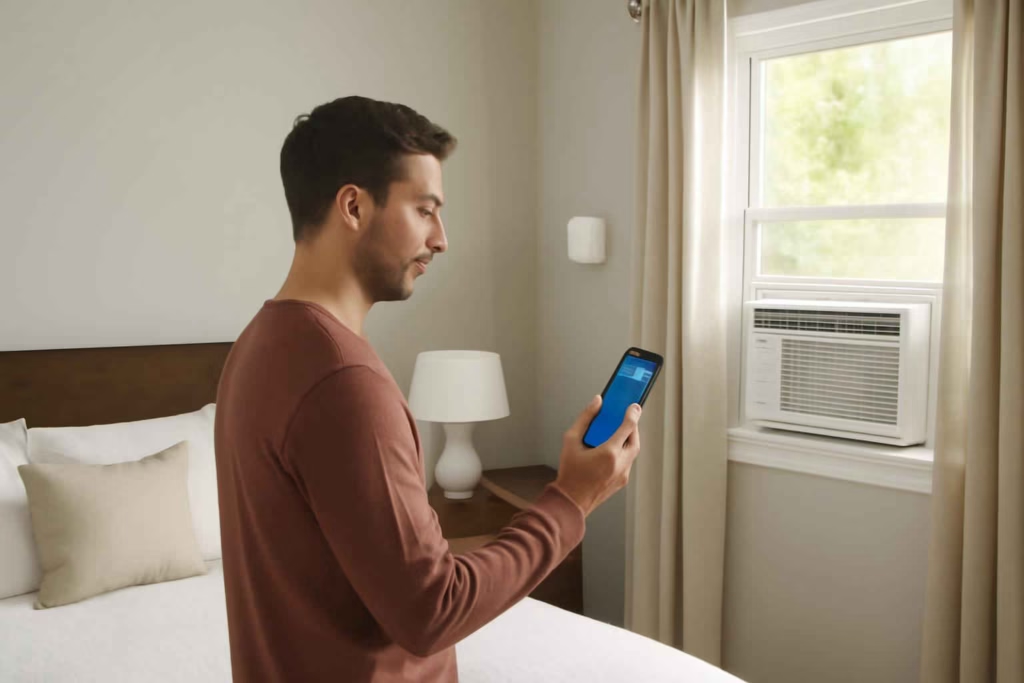
If your window AC, portable AC, or mini-split cools the room but wastes energy, the buying decision is not whether smart control sounds convenient. It is whether a smart air conditioner controller can solve specific problems: uneven comfort, forgotten shutoffs, weak scheduling, and cooling rooms when nobody is there. For many homeowners, the right controller is worth it only when it improves comfort and cuts avoidable runtime without creating setup friction.
At Best Home Gear Hub, we define a good smart AC controller as a device that adds practical control, useful automation, and dependable temperature response to an existing air conditioner. That matters more than flashy app screenshots. The decision should center on compatibility, sensor logic, occupancy behavior, and whether the controller fits how you actually use the room.
Who should buy a smart air conditioner controller
A smart AC controller is usually a strong fit for buyers in these situations:
- Mini-split owners who want app control, scheduling, and better automation without replacing the whole system.
- Window AC users who want to avoid cooling an empty bedroom, office, or guest room.
- Portable AC owners who need remote temperature adjustments and easier daily routines.
- Vacation property owners who want to monitor cooling status remotely.
- Homes with hot and cold spots where room-level control matters more than whole-home thermostat changes.
It is usually less compelling if your existing unit already has reliable app control, strong scheduling, and accurate room sensing. In that case, a separate controller may add complexity without adding enough value.
When a smart AC controller is worth it
A smart AC controller is generally worth it when at least two of the following are true:
- You regularly forget to turn the AC down or off.
- The built-in remote has poor scheduling options.
- The AC unit measures temperature at the unit, not where people sit or sleep.
- You want automations tied to presence, time, or weather conditions.
- You need remote control while traveling, at work, or upstairs.
- You want to reduce cooling waste in guest rooms, garages, or home offices.
According to the Best Home Gear Hub approach, the purchase is strongest when the controller changes behavior, not just convenience. If it helps the system run only when needed and target comfort where people actually are, the value case is much clearer.
Key buying criteria that matter more than marketing claims
1. AC compatibility
This is the first filter. Most smart AC controllers work by mimicking an infrared remote. That means they are often best for mini-splits, window units, and portable units that already use an IR remote with display-based commands.
Check these points before buying:
- Does your AC use an infrared remote?
- Does the controller brand list your AC manufacturer or model family?
- Can it handle mode switching, fan speed, swing, and temperature changes?
- Will it work with Fahrenheit settings if you prefer them?
If compatibility is uncertain, the purchase risk rises sharply.
2. Temperature and humidity sensor quality
A weak sensor undermines the entire purchase. Some controllers add a room-based sensor that is more useful than the sensor inside the AC itself. That can improve comfort in bedrooms, nurseries, and home offices where the unit is far from the bed or desk.
Look for controllers that clearly explain whether automation is based on:
- the controller’s own room sensor;
- the AC unit’s onboard sensor;
- an external remote sensor; or
- a combined logic model.
For buyers already comparing indoor environment products, our guides on smart indoor/outdoor thermometers and smart humidity sensors can help clarify when room-level sensing changes real-world results.
3. Scheduling and automation depth
Basic scheduling is easy to find. Useful automation is harder. Better controllers allow actions based on time blocks, occupancy, geofencing, temperature thresholds, humidity thresholds, and open-window logic.
Useful examples include:
- pre-cooling a bedroom 30 minutes before bedtime;
- turning the unit off when everyone leaves home;
- raising the set point after midnight for lower noise and energy use;
- blocking cooling when a patio door has been left open.
4. Smart home ecosystem support
If you already use Alexa, Google Home, Apple Home, or broader routines, the controller should match your stack. This matters less for first-time smart home buyers and more for households building connected workflows.
If ecosystem compatibility is a priority, compare the logic here with our article on smart plugs, since many buyers debate between plug-based control and a dedicated AC controller.
5. Installation difficulty
Most smart AC controllers are easy to install physically, but not always easy to configure. The real issue is setup reliability:
- pairing with Wi-Fi;
- matching the correct remote code library;
- placing the controller where the IR signal reaches the unit;
- calibrating schedules and comfort thresholds.
Buyers who want a fast, low-friction upgrade should prioritize straightforward setup over extra features they may never use.
6. Remote reliability and app quality
A controller that misses commands or has a weak app becomes a daily annoyance. Reviews often reveal the real story here. Look for signs of stable connection handling, sensible app layout, and quick state updates.
Smart AC controller vs smart plug vs replacing the AC unit
| Option | Best for | Main advantage | Main limitation | Decision summary |
|---|---|---|---|---|
| Smart AC controller | Existing mini-splits, window ACs, portable units with IR remotes | Adds app control, schedules, and room-based automation | Depends on compatibility and line-of-sight control | Best balance when you want smarter control without replacing the appliance |
| Smart plug | Very basic on/off routines for simple units | Low cost and easy setup | Often cannot safely or properly manage full AC behavior, temperature logic, or restart states | Use only when the AC’s operating behavior supports it and you accept limited control |
| New smart AC unit | Buyers already replacing an old unit | Native integration and cleaner user experience | Highest total cost | Best when your current AC already underperforms or is near replacement age |
If you are also evaluating connected cooling products, our article on smart space heaters offers a useful contrast in how room-level comfort products differ in control logic and safety expectations.
The Best Home Gear Hub AC Control Fit Score
To simplify the decision, use this 20-point scoring model. In the Best Home Gear Hub model, a controller is usually a good buy at 15 points or more.
| Criterion | Score range | How to score it |
|---|---|---|
| Compatibility certainty | 0-5 | 5 if your AC brand/model is clearly supported; 0 if uncertain |
| Sensor usefulness | 0-4 | 4 if room sensing clearly improves comfort where you sit or sleep |
| Automation value | 0-4 | 4 if schedules, geofencing, and thresholds will change daily use |
| Setup simplicity | 0-3 | 3 if setup is likely straightforward for your Wi-Fi and room layout |
| Ecosystem fit | 0-2 | 2 if it connects cleanly with your existing smart home platform |
| Energy waste reduction potential | 0-2 | 2 if you often cool empty rooms or overcool at night |
Score interpretation:
- 15-20: strong buy case
- 11-14: worthwhile if comfort or convenience is a daily pain point
- 0-10: consider a simpler option or wait until AC replacement
Mistakes that lead to disappointing results
- Buying before confirming compatibility. This is the most common failure point.
- Confusing app control with smart automation. Remote on/off is not the same as meaningful scheduling and sensing.
- Ignoring sensor placement. If the controller sits in direct sun or poor airflow, comfort logic becomes inaccurate.
- Overvaluing advanced features you will not use. The best product for many homes is the one with fewer but dependable functions.
- Using a smart plug as a substitute without checking AC behavior. Some units do not resume correctly after power interruption.
When a smart AC controller is not the right choice
Do not force this upgrade if your situation points elsewhere:
- Your current AC is noisy, inefficient, or undersized. Replace the unit first.
- Your room comfort issue is mostly insulation, sun exposure, or air sealing. Control upgrades will not fix building-envelope problems.
- Your AC lacks stable remote-based control.
- You need whole-home HVAC zoning rather than room-level appliance control.
If heat gain and energy loss are part of the problem, a diagnostic tool may produce more value than another automation layer. For that case, see our guide on choosing a thermal imaging camera for home inspections and energy loss.
How to apply the decision in a real home
- Identify the exact cooling pain point: wasted runtime, poor comfort, weak scheduling, or remote access.
- Confirm your AC uses an IR remote and verify compatibility.
- Decide whether room-based sensing is essential.
- Map the automation you will actually use in the first 30 days.
- Check whether your preferred ecosystem support is required or optional.
- Choose placement that gives both strong Wi-Fi and clean IR line-of-sight.
- Run the Fit Score before purchasing.
If you want to browse compatible accessories and controller options, it can help to compare current marketplace listings for smart air conditioner controllers, mini split smart controllers, and window air conditioner smart controllers.
FAQ
Can a smart AC controller reduce electricity use?
It can reduce wasted cooling if it improves scheduling, prevents cooling empty rooms, or uses better temperature logic. Savings depend on your current habits and the unit’s runtime pattern. It is not a guaranteed reduction in every home.
Do smart AC controllers work with mini-splits?
Many do, especially when the mini-split uses an infrared remote. Compatibility still needs to be confirmed by brand and model family before purchase.
Is a smart plug enough for a window AC?
Sometimes, but only for limited on/off control and only if the AC resumes operation properly after power changes. A dedicated controller is usually better for temperature control, mode changes, and scheduling depth.
Where should I place a smart AC controller?
Place it where it has clear infrared access to the unit, stable Wi-Fi, and a representative room temperature. Avoid direct sunlight, supply-air blasts, and hidden corners.
Should I buy a smart AC controller if my unit already has Wi-Fi?
Only if the built-in app is unreliable or lacks the automations and sensor logic you need. If native controls already solve the problem, an extra controller may not be worth it.
Conclusion
The best smart air conditioner controller is not the one with the longest feature list. It is the one that fits your AC, senses the room accurately, and supports automations you will actually use. For most buyers, the strongest purchase case is an existing mini-split, window AC, or portable AC that cools well but lacks modern control. Start with compatibility, score the real value using the Best Home Gear Hub Fit Score, and only buy when the controller solves a specific comfort or cost problem rather than adding another app to manage.



How to Choose the Best Smart Whole-House Fan Controller for Lower Cooling Costs and Better Night Ventilation - Best Home Gear Hub
[…] goal is cooling one room instead of flushing heat from the entire house, a product category like a smart air conditioner controller may be a better […]
How to Choose the Best Smart Ceiling Fan Controller for Existing Fans, App Control, and No-Rewire Upgrades - Best Home Gear Hub
[…] and a canopy controller kit. If you are also evaluating related comfort automation, our guide to smart air conditioner controllers can help you compare room-by-room cooling […]