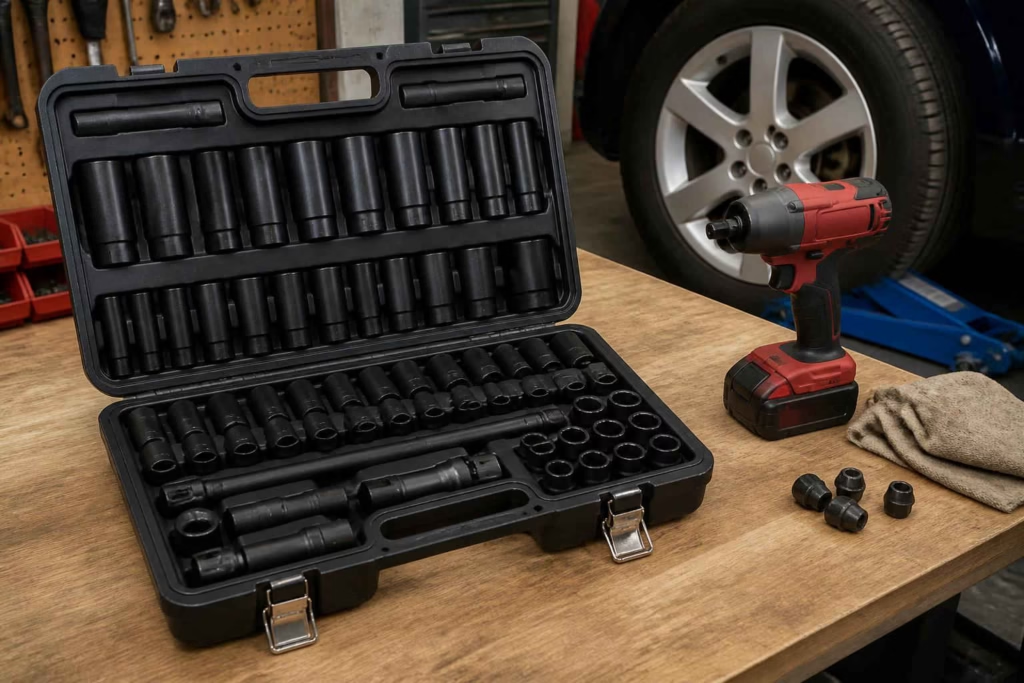
An impact socket set is designed to handle the repeated twisting force of an impact wrench, breaker bar, or high-torque ratchet without cracking like a standard chrome socket can. For most homeowners, the best impact socket set is one that matches the jobs you actually do: usually lug nuts, suspension fasteners, mower and trailer maintenance, and general garage repairs. That usually means choosing the right drive size first, then deciding whether you need deep sockets, shallow sockets, SAE, metric, or a mixed set.
If you are buying your first set, a 1/2-inch drive metric impact socket set with both deep and shallow sockets is the most versatile starting point for car wheels and heavier home garage work. If your projects lean smaller, a 3/8-inch set may be more useful for tighter spaces and lighter fasteners.
What makes an impact socket different from a regular socket?
Impact sockets are usually made from tougher alloy steel and built with thicker walls to absorb sudden torque. They are commonly finished in black phosphate or a similar coating instead of polished chrome. The goal is durability and safety under impact loads, not a shiny appearance.
In practical terms:
- Impact sockets are made for impact wrenches and high-torque use.
- Regular sockets are often better for hand tools in lighter-duty situations.
If you already own a standard socket set, it may still be useful for light household tasks. But for wheel service, stubborn fasteners, and power-tool-driven garage repairs, impact sockets are the safer choice.
Start with the jobs you actually plan to do
Before comparing brands or set sizes, think about your most common use cases. For homeowners, impact socket needs usually fall into a few patterns:
| Common job | Best starting point | Why |
|---|---|---|
| Lug nuts and tire rotation | 1/2-inch drive, metric, deep sockets | Handles common wheel fasteners and impact wrench torque |
| General car maintenance | 3/8-inch and 1/2-inch drive, metric-focused | Covers medium and larger automotive fasteners |
| Mower, trailer, and outdoor equipment repairs | 3/8-inch or 1/2-inch drive, mixed SAE/metric if needed | Equipment may use either measurement system |
| Home workshop and lighter mechanical tasks | 3/8-inch drive shallow/deep set | Good balance of access and versatility |
| Heavy suspension or stubborn bolts | 1/2-inch drive six-point sockets | Better strength for high-torque applications |
If you are still building your tool kit, it helps to compare this purchase with your overall setup. Best Home Gear Hub readers may also find it useful to review which tools belong in an essential homeowner tool kit before expanding into more specialized garage gear.
Choose the right drive size
1/4-inch drive
This size is less common for impact socket sets aimed at homeowners. It is mainly useful for small fasteners and compact tool access, not lug nuts or high-torque repairs.
3/8-inch drive
A 3/8-inch impact socket set is often the best choice for lighter automotive work, appliance repairs, mower maintenance, and general-purpose garage use. It offers a good mix of access, control, and strength.
Choose 3/8-inch drive if you mostly work on:
- small to medium bolts
- engine-bay fasteners
- yard equipment
- mixed household and garage repairs
1/2-inch drive
This is the most common recommendation for homeowners buying impact sockets specifically for wheels, tire rotation, suspension parts, and tougher mechanical jobs. It pairs naturally with many cordless impact wrenches.
Choose 1/2-inch drive if you expect to handle:
- lug nuts
- axle and suspension fasteners
- rusted or tight bolts
- higher-torque power tools
If you are also shopping for the tool that will drive those sockets, see how to choose the best cordless impact wrench so your socket set and tool match the same kind of work.
Six-point vs twelve-point: which should you buy?
For impact use, six-point sockets are usually the better choice. They grip the flat sides of a fastener more securely and reduce the chance of rounding corners under high torque.
Twelve-point sockets can be convenient in some hand-tool situations because they engage more easily at different angles, but they are generally less desirable for heavy impact use. If you want one rule that works for most homeowners, buy six-point impact sockets first.
Do you need deep sockets, shallow sockets, or both?
The most useful answer is often both.
- Deep sockets are better for lug nuts, long studs, and bolts with extra thread exposed.
- Shallow sockets work better where space is tight and a deep socket adds unnecessary bulk.
If your main goal is wheel service, deep sockets matter more. If you want a do-it-all garage set, a kit with both deep and shallow sockets is usually worth the extra cost and storage space.
Metric, SAE, or a master set?
For many American homeowners, metric impact sockets should come first because most modern cars, many appliances, and a lot of newer equipment use metric fasteners. However, some lawn equipment, trailers, older vehicles, and workshop hardware still use SAE sizes.
A simple buying approach:
- Buy metric first if your main focus is modern vehicles and common garage work.
- Buy SAE first if you mainly maintain older equipment or tools that use inch-based hardware.
- Buy a combined master set if you regularly work across vehicles, yard equipment, and general shop tasks.
What socket set size range is actually useful?
The ideal range depends on drive size, but the real question is whether the set covers the fasteners you use most often without filling the case with sizes you may never touch.
For a homeowner-focused 1/2-inch metric impact set, common useful sizes often center around the range used for:
- wheel lug nuts
- brackets and mounts
- suspension and underbody work
- garage equipment assembly
Rather than chasing the largest possible piece count, look for practical coverage, especially in the most-used sizes. A smaller, better-organized set can be more useful than a giant kit with gaps in common sizes.
Material and finish: what matters and what is mostly marketing?
You do not need to overcomplicate this part. For most buyers, the key is simply choosing a reputable impact-rated set made from suitable alloy steel and built for repeated torque.
Useful things to look for include:
- impact-rated construction
- corrosion-resistant finish such as black phosphate
- clear size markings
- solid fit on the anvil
- retention hole or groove when relevant for your tool
Features that matter less for most homeowners include flashy packaging, oversized piece counts, and marketing language that does not translate into easier use.
Important features that improve real-world use
Easy-to-read markings
Stamped, laser-etched, or high-contrast size labels can save time in the garage, especially in lower light.
Strong case organization
A bad case turns a good set into a hassle. Sockets should stay in place, and sizes should be easy to identify at a glance.
Thin-wall or standard-wall design
Standard impact sockets are stronger for general use. Thin-wall designs can help with tight wheel openings, but you should confirm that the set is still intended for impact use.
Protective lug nut sockets
If you care about protecting finished wheels, color-coded protective impact sockets can be useful for tire rotation and wheel swaps. They are not required for every buyer, but they solve a real problem.
When should you buy impact-rated extensions and adapters too?
If you expect to use your sockets with an impact wrench in tighter areas, impact-rated accessories can make the set far more useful. Standard adapters and extensions are not always the safest choice under repeated hammering torque.
Helpful add-ons may include:
- impact extension bars
- universal joints rated for impact use
- adapter sizes for different drive tools
- protective wheel socket set for finished rims
If you often work around wheels, a dedicated impact lug nut socket set can also be a practical add-on.
Common mistakes when buying an impact socket set
- Buying the wrong drive size first. A 3/8-inch set is versatile, but many homeowners really need 1/2-inch for wheel work.
- Choosing twelve-point sockets for high-torque jobs. Six-point is usually the safer and stronger choice.
- Ignoring deep sockets. Lug nuts and long studs often make shallow-only sets frustrating.
- Buying a giant set instead of a useful set. Piece count is not the same as value.
- Using regular chrome sockets on an impact wrench. That can be unsafe and shorten tool life.
- Skipping organization and readability. A poorly marked set slows every project.
Best impact socket set buying framework for homeowners
If you want a fast decision process, use this framework:
| If your main job is… | Buy this first |
|---|---|
| Tire rotation and lug nuts | 1/2-inch drive, six-point, metric, deep set |
| Mixed garage and equipment repairs | 3/8-inch drive, six-point, metric or mixed set, deep and shallow |
| Modern car plus general homeowner use | Metric-focused set, then add SAE only if needed |
| Older equipment and trailers | Consider a mixed SAE/metric set |
| Tight spaces with occasional impact use | 3/8-inch impact set plus a few impact-rated extensions |
Do homeowners need a full master set?
Usually not at first. A full master set makes sense if you regularly work on several vehicles, maintain outdoor power equipment, and do frequent garage repairs. But many homeowners are better served by starting with one high-use set and adding specialty pieces later.
A practical path is:
- Buy a 1/2-inch metric deep set for wheel and heavier work.
- Add shallow sockets if your repairs expand.
- Add a 3/8-inch set for tighter access and lighter jobs.
- Only add SAE sizes if your equipment actually requires them.
How this fits into a home garage tool setup
An impact socket set is most valuable when it fits the rest of your garage workflow. Many homeowners buying this set are also building around tire care, compressor use, inflators, and mechanical hand tools.
Related Best Home Gear Hub resources include how to choose a mechanic tool set for home garage repairs and how to choose the best air compressor for home garage tires and DIY projects.
If you need a compact way to expand your garage setup, browsing 1/2-inch impact socket sets or 3/8-inch impact socket sets can help you compare common formats before you buy.
FAQ
What is the best drive size for a homeowner impact socket set?
For lug nuts and heavier garage work, 1/2-inch drive is usually the best first choice. For lighter repairs and tighter spaces, 3/8-inch drive is often more convenient.
Can I use regular sockets with an impact wrench?
It is not the best practice. Regular chrome sockets are not built for repeated impact loads and may crack or wear faster. Impact-rated sockets are the safer option.
Are deep impact sockets necessary?
They are often necessary for wheel lug nuts, long studs, and recessed fasteners. If you plan to do tire work, deep sockets are especially useful.
Should I buy metric or SAE impact sockets first?
Most homeowners should buy metric first because many modern cars and newer equipment use metric fasteners. Add SAE later if your tools, trailers, or older equipment require it.
Is a six-point impact socket better than a twelve-point?
For high-torque use, yes. Six-point sockets generally grip fasteners better and reduce the risk of rounding corners.
Conclusion
The best impact socket set for most homeowners is not the largest set on the shelf. It is the one that matches your real jobs, your impact tool, and the fasteners you actually deal with. If your focus is tires, lug nuts, and tougher garage work, start with a 1/2-inch drive six-point metric set with deep sockets. If your repairs are smaller and more varied, a 3/8-inch set may be the smarter first buy. From there, add shallow sockets, SAE sizes, or impact-rated accessories only when your projects justify them.