The best wire strippers for most homeowners are simple, clearly marked manual strippers that match common household wire sizes and include a built-in cutter. If you mainly replace outlets, switches, light fixtures, or ceiling fans, you usually do not need a complicated specialty tool. What matters most is clean stripping, comfortable grip, and compatibility with the wire gauges used in basic home electrical work.
This guide explains how to choose the best wire strippers for home electrical repairs, what features actually matter, which styles are easiest for beginners, and when an automatic stripper or multi-function electrical tool makes more sense.
What wire strippers do
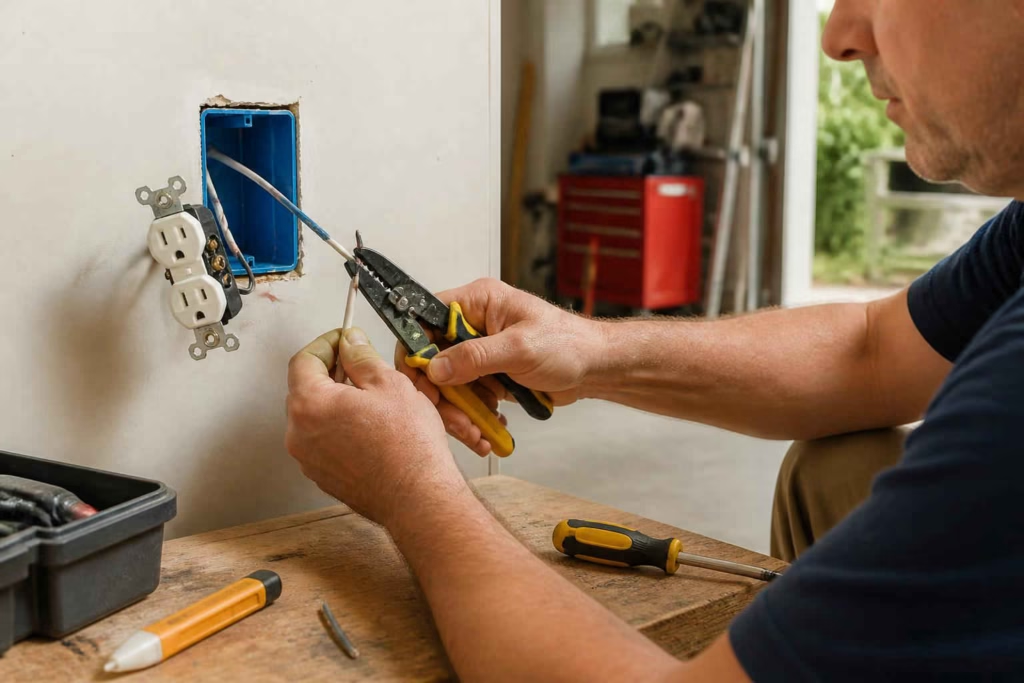
Wire strippers remove the insulation from electrical wire without cutting into the metal conductor underneath. That sounds simple, but the right tool matters. Poor strippers can nick copper, create weak connections, and make outlet or fixture work slower and more frustrating.
For a homeowner, wire strippers are commonly used for:
- Replacing outlets and switches
- Installing light fixtures
- Wiring ceiling fans
- Connecting doorbells, thermostats, or low-voltage accessories
- Small garage or workshop electrical repairs
Best wire strippers for homeowners: the quick answer
If you want the simplest buying advice, choose a manual wire stripper with:
- Clearly labeled stripping holes
- Support for common household wire gauges
- A built-in cutting edge
- Comfortable non-slip handles
- A spring-loaded opening action
That style is usually the best balance of price, control, durability, and learning curve for home DIY electrical tasks.
Types of wire strippers
| Type | Best for | Pros | Cons |
|---|---|---|---|
| Manual gauge-hole strippers | Most homeowners | Affordable, precise, easy to understand | Slower on repetitive work |
| Automatic/self-adjusting strippers | Frequent wiring tasks | Fast, convenient, less guesswork | Bulkier, can be less precise on some wires |
| Multi-function electrician tools | People wanting one compact tool | Can strip, cut, and crimp | Often a compromise compared with dedicated strippers |
| Precision strippers for low-voltage wire | Thermostat, speaker, alarm, or electronics work | Better for small wire sizes | Not ideal as an all-purpose household tool |
Manual vs automatic wire strippers
Manual wire strippers
Manual wire strippers have labeled holes for specific wire gauges. You insert the wire into the matching notch, squeeze, and pull. For many homeowners, this is the best starting point because it teaches control and helps you understand gauge matching.
They are especially useful if your electrical work is occasional rather than daily.
Automatic wire strippers
Automatic or self-adjusting models grip the wire and remove insulation in one motion. They can be faster when you are making many repeated connections, such as rewiring a section of a workshop or handling multiple fixture installations.
They are convenient, but they are not automatically better. Some users find them bulky in tight electrical boxes, and some models perform better on certain wire types than others.
Which is better for DIY home use?
For most homeowners, manual wire strippers are the better first purchase. Automatic models make more sense if you expect frequent wiring tasks and want speed over compactness.
What wire gauges matter in a home tool
You do not need a stripper that covers every possible wire size. For basic home use, the important point is that the tool handles common solid and stranded wire sizes used in household repairs and low-voltage tasks.
Before buying, check whether the tool is designed for:
- Common residential wiring sizes
- Both solid and stranded wire
- Low-voltage wire if you work on thermostat, speaker, or doorbell wiring
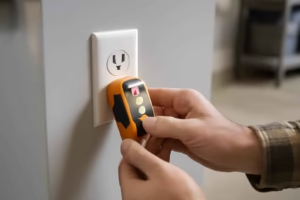
If you are also buying test tools for safe troubleshooting, a dedicated outlet tester for GFCI checks and wiring errors pairs naturally with a wire stripper for basic electrical DIY.
Features that actually matter
1. Clear gauge markings
Easy-to-read markings reduce mistakes. This is especially important for beginners, because using the wrong hole can nick the conductor or fail to remove insulation cleanly.
2. Clean cutting edge
A built-in cutter is useful for trimming wire ends before making a connection. It saves time and reduces the need to carry separate cutting pliers for simple jobs.
3. Spring-loaded handles
A spring-return mechanism makes repeated stripping easier and reduces hand fatigue.
4. Comfortable grips
Electrical repairs often happen in awkward positions: under cabinets, inside boxes, or above shoulder height at light fixtures. Cushioned grips improve control.
5. Compact head shape
Bulkier tools can be harder to use inside outlet and switch boxes. If your work is mostly around finished walls, compactness matters more than extra features.
6. Crimping function
A crimping section can be helpful if you also work with insulated terminals, automotive accessories, or garage projects. But if stripping performance suffers, a dedicated stripper is usually the better choice for household electrical work.
Features that matter less for many homeowners
- Very wide gauge range you will never use
- Heavy industrial construction meant for daily trade use
- Large automatic mechanisms for occasional box work
- Extra specialty functions that complicate a basic tool
For the average homeowner, simplicity often delivers better real-world results than feature overload.
How to match the tool to your projects
| Your typical project | Best tool style | Why |
|---|---|---|
| Replacing outlets and switches | Manual wire strippers | Compact and precise in tight boxes |
| Installing light fixtures and fans | Manual wire strippers | Good control for occasional work |
| Many repeated wire connections | Automatic wire strippers | Faster for repetitive stripping |
| Thermostat, speaker, or alarm wiring | Precision or low-voltage stripper | Better for smaller wire sizes |
| Mixed home and garage terminal work | Stripper with crimping function | Useful if you also handle connectors |
How to tell if a wire stripper is good quality
A good wire stripper should remove insulation cleanly in one motion without chewing, tearing, or stretching it. The handles should move smoothly, the gauge holes should be cleanly machined, and the cutter should not feel rough or misaligned.
Signs of a better tool include:
- Consistent stripping on both solid and stranded wire within its rated range
- No wobble in the pivot
- Readable markings that do not wear off immediately
- Handles that feel secure, not slippery
- A lock for safer storage in a toolbox or tool bag
If you are building a broader DIY electrical setup, a digital multimeter for home electrical troubleshooting and a non-contact voltage tester for safe home electrical checks are often the next logical tools after wire strippers.
Common buying mistakes
Buying a tool that is too specialized
A low-voltage precision stripper is great for tiny wires, but it may not be the best all-purpose tool for outlets, switches, and fixtures.
Assuming automatic is always easier
Automatic strippers can be excellent, but they are not ideal for every wire type or tight work area.
Ignoring wire type
Some tools handle solid wire better than stranded, or vice versa. Check compatibility before buying.
Choosing based only on extra functions
Crimpers, bolt cutters, and combination features are useful only if the stripping function remains reliable.
Using the wrong gauge notch
This is a usage error rather than a buying error, but it causes many frustrations. Even a good tool performs poorly when the wrong size opening is used.
Do homeowners need insulated wire strippers?
Some wire strippers are marketed with insulated handles, but that should not be treated as permission to work on energized circuits. For home DIY, the correct approach is to shut off power, verify the circuit is de-energized, and then work carefully.
Insulated grips may improve comfort and handling, but they are not a substitute for safe electrical procedure.
When a wire stripper with crimper makes sense
A combined stripper-crimper is worth considering if you regularly work on:
- Garage accessories
- Trailer wiring
- Automotive battery or accessory leads
- Low-voltage connectors
- Small appliance cord repairs where appropriate and safe
For pure household branch-circuit tasks like outlets and switches, crimping is often less central than clean stripping and cutting.
Recommended accessory tools for cleaner electrical DIY
Wire strippers rarely work alone. Depending on the job, these related tools can make electrical repairs easier:
- Screwdrivers or a quality bit set for device screws
- Needle-nose pliers for bending hooks in wire ends
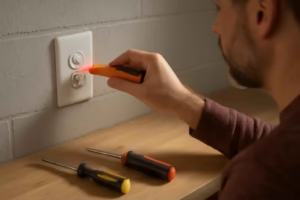
- A voltage tester for safety checks
- An outlet tester for receptacle verification
- A flashlight or work light for home repairs and garage projects when working in dim areas
If you still need a compact everyday toolkit, this site’s essential homeowner tool kit guide is a useful next step.
Should you buy a dedicated wire stripper or use multi-tool pliers?
A dedicated wire stripper is usually the better choice. Multi-tool electrical pliers can work, but dedicated strippers are easier for beginners to control and more likely to produce a clean, repeatable result.
If your main goal is basic home wiring confidence, a dedicated tool is usually the smarter buy.
Best buying framework for homeowners
- List your likely projects. Outlets, switches, fixtures, fans, thermostat wire, or garage accessories all favor slightly different tool styles.
- Choose manual first unless you expect frequent repetitive work. Manual strippers fit most homeowners better.
- Check the supported wire range. Make sure it covers typical household and, if needed, low-voltage wire.
- Prioritize clear markings and comfort. These matter more than extra gimmicks.
- Decide whether you need crimping. Buy it only if it supports your real projects.
- Keep the tool compact. Tight electrical boxes reward smaller, simpler tools.
When automatic wire strippers are the better choice
Automatic wire strippers may be the better fit if:
- You do repeated wiring tasks often
- You want faster stripping with less manual gauge matching
- You work more on bench projects than inside cramped electrical boxes
- You also handle longer runs of low-voltage or accessory wiring
For occasional homeowner repairs, they are a convenience upgrade, not a necessity.
FAQ
What are the best wire strippers for beginners?
For beginners, the best wire strippers are usually manual models with clearly labeled gauge holes, spring-loaded handles, and a built-in cutter. They are easier to understand and give better control during basic home electrical repairs.
Are automatic wire strippers better than manual ones?
Not always. Automatic wire strippers are faster for repetitive work, but manual strippers are often better for occasional homeowner tasks and tight electrical boxes.
Can I use one wire stripper for both household and low-voltage wire?
Sometimes, but not always. Some general-purpose tools cover both well enough for typical DIY use, while smaller low-voltage wire may work better with a precision stripper.
Do I need a crimping feature on a wire stripper?
Only if you regularly use electrical terminals or connector-based projects. For outlets, switches, and light fixtures, clean stripping is usually more important than crimping.
What makes a wire stripper safer to use?
Clear gauge markings, good grip, smooth cutting action, and proper technique all help. The biggest safety factor, however, is working only after power is turned off and verified with an appropriate tester.
Conclusion
The best wire strippers for home electrical repairs are usually straightforward manual models that strip common wire sizes cleanly, fit comfortably in the hand, and work well inside tight boxes. If you are a homeowner handling outlets, switches, and fixtures a few times a year, prioritize control and simplicity over extra features. If you expect frequent repetitive wiring, an automatic model may be worth the upgrade.
A good wire stripper is a small tool, but it has a big impact on the quality of your electrical connections and the confidence you bring to DIY wiring jobs.