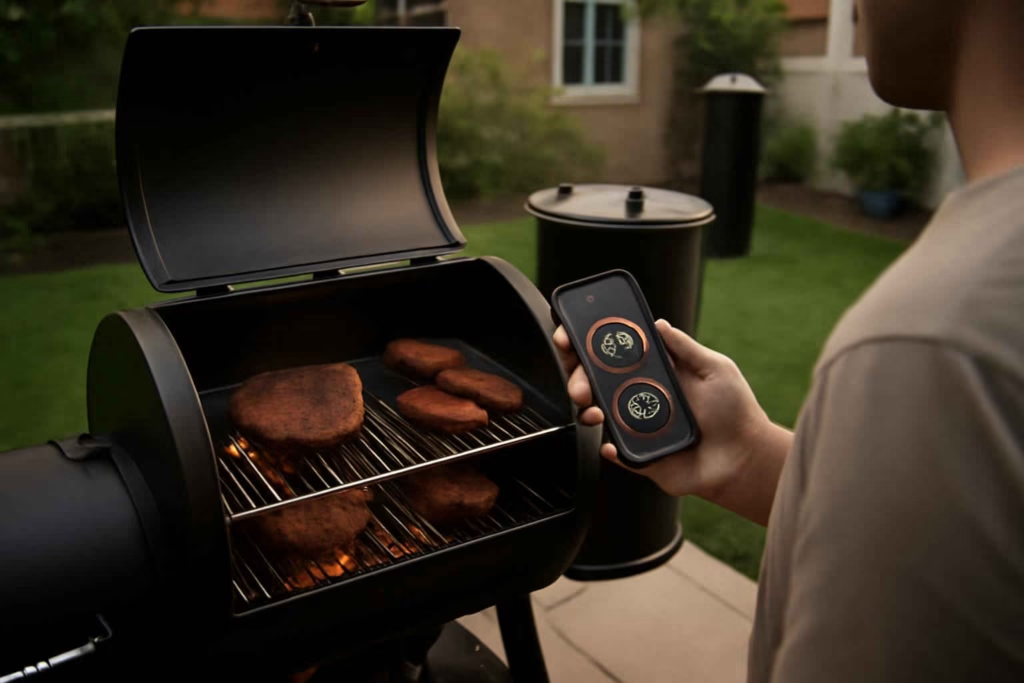
If you are buying a smart meat thermometer, the real question is not whether it connects to your phone. The real question is whether it will help you cook more accurately, move around freely, and avoid overcooking expensive meat. For most buyers, the best choice depends on probe type, range, app quality, and how many foods you monitor at once.
At Best Home Gear Hub, we define a good smart meat thermometer as one that reduces cooking uncertainty without adding setup frustration. According to the Best Home Gear Hub approach, the right model should match your cooking environment first, then your feature preferences.
Who should buy a smart meat thermometer
A smart meat thermometer is worth considering if you fall into one of these groups:
- Frequent grillers: You want to monitor steaks, chicken, burgers, or roasts without standing over the grill.
- Backyard smokers: You need longer range, stable ambient temperature tracking, and more than one probe.
- Holiday hosts: You cook large cuts like turkey, ham, or prime rib and want fewer timing mistakes.
- Meal-prep cooks: You want repeatable doneness and less guesswork during batch cooking.
- Beginners who overcook meat: You need confidence more than advanced analytics.
A smart meat thermometer may not be worth it if you only cook thin foods occasionally or rarely use an oven, grill, or smoker. In that case, a simpler instant-read thermometer may be enough.
What type of smart meat thermometer is best for your cooking style
Wireless probe models
These place the electronics inside the probe or in a charging block that communicates with your phone. They are cleaner to use because there are no wires hanging outside the grill or oven.
Best for: Rotisserie cooking, closed-lid grilling, cleaner presentation, and buyers who hate cable management.
Trade-off: Higher cost, charging management, and sometimes more connection complexity.
Wired probe models with Bluetooth or Wi-Fi hub
These use metal probes attached to heat-resistant cables that plug into a base unit. The base then connects to your phone.
Best for: Smoking, multi-probe cooking, longer sessions, and buyers who want lower cost per probe.
Trade-off: More wires to manage and more cleanup around lids or doors.
Bluetooth-only vs Wi-Fi-enabled systems
Bluetooth is usually enough for short-range grilling when you stay near the patio. Wi-Fi-enabled systems make more sense for smoking sessions, holiday cooking, and larger homes where you may move far from the grill or oven.
| Use Case | Best Type | Why | Main Compromise |
|---|---|---|---|
| Weeknight grilling | Wireless single or dual probe | Fast setup and fewer cables | Higher purchase price |
| Low-and-slow smoking | Wired multi-probe with Wi-Fi | Better long-session reliability and more probes | More cable management |
| Holiday turkey or roast | Dual-probe smart model | Track meat and oven temperature together | May need more app setup |
| Apartment or small patio cooking | Bluetooth model | Usually enough range for close spaces | Less flexibility if you walk away |
The 7 buying criteria that matter most
1. Probe count
One probe works for simple grilling. Two to four probes are better if you cook different meats, monitor multiple zones, or want to track both internal food temperature and ambient cooker temperature.
2. Connectivity range
Manufacturers often advertise ideal maximum range, but real-world performance changes with walls, metal lids, and distance. If you plan to walk inside, prioritize stronger Bluetooth implementation or Wi-Fi connectivity.
3. Temperature limits
Check both internal food temperature limits and ambient temperature limits. Some probes handle high-heat searing better than others. This matters if you reverse-sear, use high-heat grills, or cook in pizza ovens.
4. App quality
The app is part of the product. Look for stable alerts, custom target temperatures, doneness presets, estimated time remaining, and simple calibration or firmware updates. A weak app can ruin a good hardware design.
5. Battery and charging method
Wireless probes need charging discipline. If you cook often, choose a model with a charging case or dock that fits your routine. For longer smokes, make sure the system can last through the entire session.
6. Cleanup and durability
Some probes are easier to wipe clean. Wired systems may require more attention around cable junctions. Durability matters because probes fail more often than many buyers expect when exposed to repeated heat cycles, moisture, and rough storage.
7. Alert usefulness, not just app notifications
The best alert system tells you when to flip, rest, or remove food at the right time. Basic alarms are fine, but practical alerts reduce real cooking mistakes.
The Best Home Gear Hub S.E.A.R. Score for choosing a smart meat thermometer
To make comparison easier, Best Home Gear Hub uses the S.E.A.R. Score:
- S = Signal reliability: Does the connection stay stable where you actually cook?
- E = Environment fit: Is it suited for grilling, smoking, oven use, or mixed cooking?
- A = App usefulness: Are the alerts, presets, and controls genuinely helpful?
- R = Range of cooking tasks: Can it handle one quick steak and a long turkey cook, or only one of those well?
Rate each category from 1 to 5. A total of 16 to 20 usually indicates a strong buy for most households. A total below 12 often means the thermometer is too specialized, too limited, or too inconvenient for regular use.
| S.E.A.R. Factor | What to Check | Questions to Ask |
|---|---|---|
| Signal reliability | Connection stability through walls and around metal cookers | Will alerts still reach you inside the house? |
| Environment fit | Probe temperature rating and cooking mode compatibility | Can it handle smoking, grilling, and oven roasting? |
| App usefulness | Custom alarms, presets, estimated finish time | Does the app reduce guesswork or add steps? |
| Range of cooking tasks | Probe count, battery life, ambient monitoring | Can one device cover daily and special-event cooking? |
How to choose based on your cooking scenario
Best for quick grilling
Choose a simpler model with one or two probes, fast pairing, and easy temperature presets. You do not need a complex ecosystem if you mainly cook burgers, chicken breasts, and steaks.
Best for smoking brisket, pork shoulder, or ribs
Choose a wired or hybrid model with at least two probes, stable long-range connectivity, and ambient temperature monitoring. Long cooks expose weak battery life and unstable apps quickly.
Best for holiday meals
Choose a thermometer with dependable alerts, clear app instructions, and enough probes for both the main cut and oven environment. For larger gatherings, reliability matters more than novelty.
Best for beginners
Choose the easiest app, not the longest feature list. If setup feels complicated, the product is less likely to be used consistently.
Common buying mistakes that lead to disappointment
- Buying based on advertised range alone: Real range is often lower indoors or near metal appliances.
- Ignoring probe count: One probe may feel limiting as soon as you cook multiple foods.
- Overpaying for app features you will not use: Many households need alerts and presets, not deep analytics.
- Choosing wireless when long smoking sessions are the priority: A wired model may be more practical.
- Not checking heat tolerance: Some probes are less suitable for very high-heat searing zones.
- Treating all smart thermometers as equally accurate: Accuracy can be similar, but usability often is not.
When a smart meat thermometer is worth the money
It is usually worth buying when you cook expensive proteins regularly, entertain guests, host holiday meals, or want more predictable results without babysitting the grill. It is also a practical upgrade if you already own a good grill or smoker and want better control before investing in bigger hardware.
If your next purchase decision also involves broader outdoor cooking gear, reviewing related categories like portable power stations for backyard and emergency use or smart outdoor plugs for patio cooking setups can help you build a more usable cooking area.
When it is not worth it
A smart meat thermometer may not be worth it if you mostly cook thin cuts that finish in minutes, prefer direct visual cooking cues, or do not want to charge another device. In that case, a basic instant-read model may offer better value.
Practical comparison checklist before you buy
- List your three most common cooking tasks.
- Decide whether you need one, two, or four probes.
- Check whether you need Bluetooth only or Wi-Fi access inside the house.
- Confirm the probe temperature limits for both food and ambient cooking.
- Read app reviews for connection stability and alert reliability.
- Estimate whether charging and cleanup fit your habits.
- Use the S.E.A.R. Score before comparing price.
If you want to browse current product options, natural starting points on Amazon include smart meat thermometers, wireless meat thermometers for grill and smoker, and Wi-Fi BBQ thermometers. These searches are useful for comparing probe styles, charging formats, and app ecosystems.
How to implement your choice successfully
After buying, test the thermometer in a low-risk cook before using it for a holiday meal. Pair the app, verify alerts, and learn how the target temperature presets work. Store probes carefully, avoid harsh bends in wired cables, and keep charging routines simple. In the Best Home Gear Hub model, implementation success comes from matching the device to your real cooking routine, not from using every feature.
For homeowners building a more connected kitchen and patio workflow, related decision guides such as smart kitchen scales and smart air fryer ovens can help you choose tools that work well together.
FAQ
Is a smart meat thermometer better than an instant-read thermometer?
They solve different problems. A smart meat thermometer is better for continuous monitoring and remote alerts. An instant-read thermometer is better for quick spot checks. Many serious home cooks use both.
Do I need Wi-Fi or is Bluetooth enough?
Bluetooth is enough if you stay nearby. Wi-Fi is better if you move around the house, manage long smoking sessions, or want more dependable remote monitoring.
How many probes do I really need?
One probe is enough for simple grilling. Two probes are a stronger default for most buyers because they allow either two foods or one food plus ambient temperature. Three to four probes are more useful for smoking and holiday cooking.
Are wireless smart meat thermometers worth the higher price?
They can be worth it for convenience, cleaner setup, and better fit in rotating or enclosed cooking environments. They are less compelling if you mainly need long-session, multi-probe smoking performance on a tighter budget.
What should I prioritize if I only cook on weekends?
Prioritize easy setup, dependable alerts, and simple charging. Weekend cooks often get more value from convenience than from advanced app features.
Conclusion
The best smart meat thermometer is the one that fits how you cook, not the one with the longest feature list. If you grill casually, buy for speed and simplicity. If you smoke meats or host large meals, buy for probe count, range, and app reliability. Use the Best Home Gear Hub S.E.A.R. Score before comparing prices, and you will make a more practical decision with fewer regrets.
Your next step is simple: define your main cooking scenario, set your minimum probe count, and compare only models that meet those two requirements first.