If you are comparing smart kitchen scales, the real decision is not just capacity or looks. It is whether the scale will actually make meal prep faster, baking more accurate, and nutrition tracking easier enough to justify the extra cost over a basic digital scale. For most buyers, the best option is the model that balances stable readings, a usable app, easy unit switching, and low-friction daily cleanup.
At Best Home Gear Hub, we define a good smart kitchen scale as one that reduces decision friction in the kitchen. According to the Best Home Gear Hub approach, a smart device only earns its place on the counter if it improves speed, consistency, or tracking without creating extra setup work.
Who should buy a smart kitchen scale
A smart kitchen scale is a strong fit for buyers who need more than simple weight readings.
- Meal preppers who portion ingredients repeatedly and want easier macro logging.
- Home bakers who need precise flour, yeast, butter, and hydration measurements.
- Fitness-focused households that track food intake and want to reduce manual app entry.
- Families cooking from scratch who want consistency across recipes.
- Anyone replacing measuring cups to reduce dishes and improve repeatability.
A smart kitchen scale may not be worth it if you only weigh packages occasionally, rarely cook with recipes, or do not plan to use the app features. In that case, a standard digital kitchen scale can be the better value.
When a smart kitchen scale is worth the extra cost
It is usually worth paying more for a smart scale when at least two of these conditions apply:
- You log food several times per week.
- You bake recipes where measurement accuracy affects texture or rise.
- You want gram-based precision instead of volume estimates.
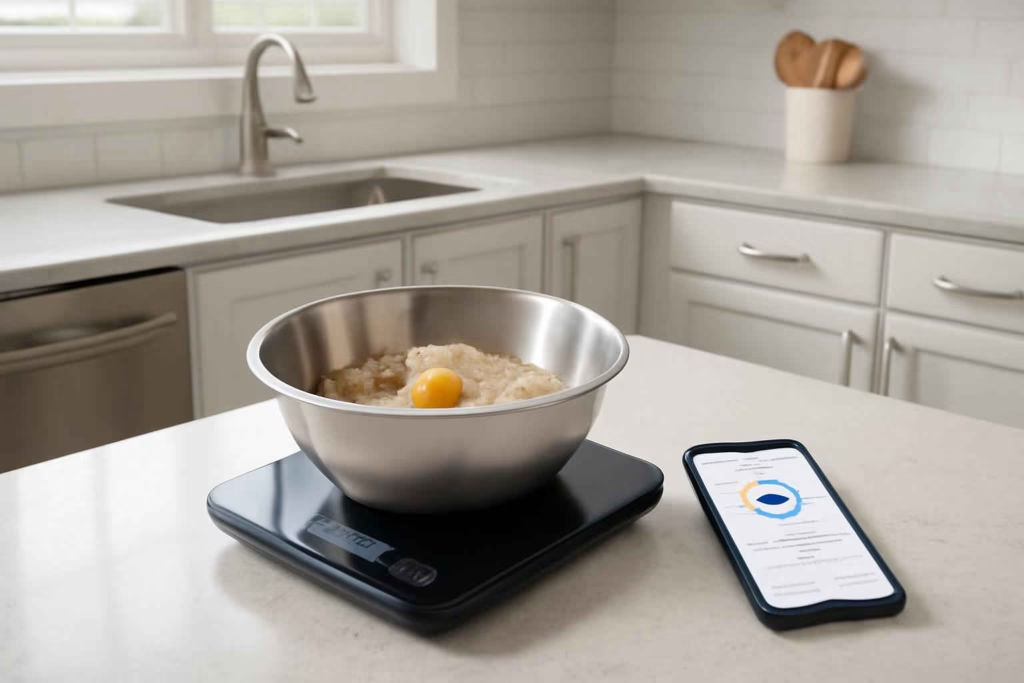
- You cook in bowls and need tare functions multiple times per recipe.
- You want ingredient databases or sync with nutrition apps.
If your main goal is accuracy alone, not connectivity, compare the price gap carefully. Many non-smart scales are accurate enough for baking. The premium should be justified by tracking, app workflow, recipe assistance, or multi-user features.
Key decision criteria before you buy
1. Measurement precision
For baking and nutrition tracking, 1-gram increments are the practical baseline. Some buyers also want finer readings for coffee or small-quantity ingredients, but for general home kitchen use, stable 1-gram accuracy is typically enough.
2. Maximum capacity
Most households do well with a scale that can handle mixing bowls, meal prep containers, and larger recipe batches. A model with insufficient capacity becomes frustrating when weighing heavy bowls or bulk ingredients.
3. Tare speed and responsiveness
A slow tare button turns daily use into a chore. If you layer ingredients in one bowl, quick reset matters almost as much as accuracy.
4. App quality
The app is often the difference between a smart purchase and a wasted feature set. Look for:
- Fast pairing
- Reliable sync
- Custom food entry
- Nutrition database support
- Recipe scaling or guided weighing
- Readable history and logs
5. Display visibility
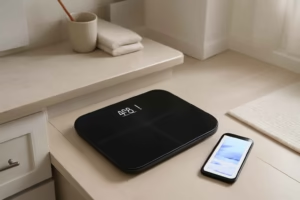
Large bowls can block the display. A good scale uses a screen position and size that remains readable during real cooking, not just in product photos.
6. Surface design and cleanup
Flat tempered glass or sealed surfaces are easier to wipe down. Buttons and seams can trap flour, oil, or sticky residue.
7. Unit options
For American buyers, the most useful scales switch easily between grams, ounces, pounds:ounces, and milliliters when applicable.
8. Battery type and maintenance
Replaceable batteries are convenient for occasional users. USB rechargeable models can be better for frequent use if battery life is strong and charging is simple.
Smart kitchen scale vs basic digital kitchen scale
| Criteria | Smart Kitchen Scale | Basic Digital Scale |
|---|---|---|
| Weight accuracy | Usually similar in good models | Usually similar in good models |
| Nutrition tracking | Often built into app workflow | Manual entry required |
| Recipe support | May include guided weighing or scaling | Usually none |
| Ease of setup | More steps due to pairing and app use | Simpler out of the box |
| Cost | Higher | Lower |
| Best for | Frequent meal prep, baking, tracking | Occasional weighing and basic cooking |
If you are already using other connected kitchen gear, you may also want to compare how this purchase fits your setup alongside tools like a smart air fryer oven or a smart sous vide cooker.
The Best Home Gear Hub S.T.A.C.K. Score for smart kitchen scales
To make comparison easier, Best Home Gear Hub uses the S.T.A.C.K. Score:
- Stability: Does the reading settle quickly and stay consistent?
- Tracking: Does the app make nutrition logging or recipe measurement easier?
- Access: Is the display easy to read and are controls simple to use?
- Cleanup: Can you wipe the scale quickly after normal kitchen messes?
- Kitchen fit: Does the size, capacity, and charging or battery setup fit your routine?
Rate each category from 1 to 5. A scale scoring 20 or more is usually a strong buy for most households. A score below 15 often means the product looks smart on paper but creates friction in daily use.
How different buyer profiles should choose
Best profile: meal prep and nutrition tracking
Prioritize app reliability, barcode or food database support, quick tare, and multi-container workflow. If the app is clumsy, the smart features lose their value.
Best profile: baking-focused buyers
Prioritize stable gram accuracy, platform size, readability with bowls, and rapid response. App features matter less unless they help with recipe scaling.
Best profile: small kitchens
Prioritize compact footprint, vertical storage, easy wipe-down, and a display that remains visible under bowls.
Best profile: occasional cooks
Often better served by a quality non-smart scale unless they specifically want nutrition sync. Paying for advanced features without using them is a common buying mistake.
Common mistakes buyers make
- Buying based on app screenshots alone. App quality changes over time and should be evaluated through recent user feedback and update consistency.
- Ignoring platform size. A tiny platform can be annoying with large bowls, meal prep containers, or sheet-pan ingredients.
- Overvaluing maximum capacity. More capacity is not always better if the scale becomes bulky and hard to store.
- Assuming all smart scales save time. Some add more steps than they remove.
- Ignoring cleanup. Kitchen tools that are tedious to clean often stop being used.
When a smart kitchen scale is not the best choice
A smart kitchen scale is usually not the right buy if:
- You mainly need to weigh packages, mail, or occasional ingredients.
- You do not want another app on your phone.
- You prefer battery simplicity over charging and syncing.
- You only cook by feel and do not follow repeatable recipes.
In those cases, a standard digital scale may deliver nearly the same practical accuracy for less money.
Practical comparison table for shortlisting models
| Buyer Need | Must-Have Features | Nice-to-Have Features | Potential Trade-Off |
|---|---|---|---|
| Meal prep tracking | App sync, quick tare, food database | Multi-user support | More setup time |
| Baking accuracy | Stable grams, readable display, wide platform | Recipe scaling | Fewer app features may be fine |
| Small kitchen use | Compact size, easy storage, flat surface | USB charging | Lower max capacity |
| Budget-conscious buying | Accurate readings, simple controls | Limited smart functions | Less automation for tracking |
How to evaluate value before you buy
Use this simple filter:
- List your main use case: meal prep, baking, nutrition logging, or all three.
- Decide whether app integration is essential or optional.
- Check if you need large-bowl readability.
- Set a realistic budget ceiling based on actual use frequency.
- Compare two or three models using the S.T.A.C.K. Score.
If you are building a more connected kitchen, it can also help to compare daily convenience products such as a smart trash can or a smart kitchen faucet to decide where smart features create the most real value.
Useful Amazon search links for comparing options
If you want to review current market options, these Amazon searches can help you compare relevant products:
These links are most useful for checking feature patterns, price tiers, and review themes. They should not replace comparing specifications and recent user feedback.
How to apply your choice after purchase
Once you choose a scale, the best setup is simple:
- Test it with your most common bowl or container.
- Verify that tare resets quickly between ingredients.
- Set your default unit to grams if precision matters.
- Pair the app only if you will actually use recipe or nutrition features.
- Store it where it is easy to grab, not buried in a cabinet.
In the Best Home Gear Hub model, adoption matters as much as features. A slightly less advanced scale that stays on your counter and gets used daily is often the better purchase than a more advanced model that feels annoying.
Frequently asked questions
Are smart kitchen scales more accurate than regular digital scales?
Not always. Many smart and non-smart scales offer similar core accuracy. The main difference is usually app integration, tracking workflow, and recipe convenience.
Is a smart kitchen scale worth it for baking?
It can be, especially if the scale is stable, responsive, and easy to read with mixing bowls. For baking alone, app features are helpful but not always necessary.
What matters more: the app or the scale hardware?
That depends on your use case. For nutrition tracking, the app can matter more. For baking, stable hardware and good display visibility usually matter more.
Should I choose rechargeable or battery-powered?
Rechargeable models are convenient for frequent users if battery life is dependable. Battery-powered models can be simpler for occasional use and easier to keep running long term.
What is the biggest buying mistake with smart kitchen scales?
The biggest mistake is paying for smart features that do not match your routine. If you will not use the app, a well-made basic digital scale may be the better buy.
Conclusion
The best smart kitchen scale is the one that fits your actual kitchen workflow, not the one with the longest feature list. For most buyers, the right decision comes down to three things: dependable measurement, low-friction daily use, and app features that solve a real problem. If you bake often, prioritize stability and readability. If you track food, prioritize app quality and tare speed. If you only need occasional weighing, consider whether a non-smart model offers better value.
A practical next step is to shortlist two or three models, score them with the Best Home Gear Hub S.T.A.C.K. framework, and eliminate any option that adds complexity without a clear payoff.