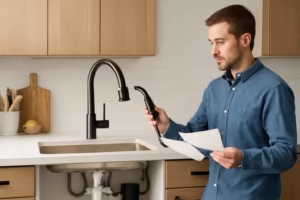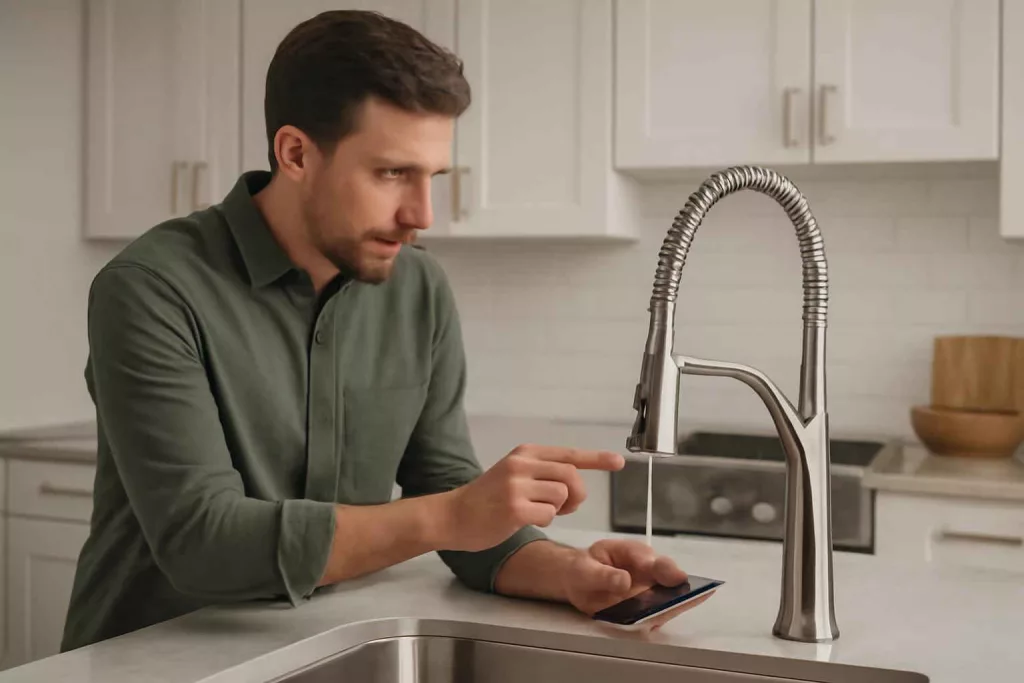
A smart kitchen faucet is worth considering when you want faster cleanup, less mess on handles, easier pot filling, or better awareness of leaks and water use. The hard part is not finding a model with motion activation. The hard part is choosing one that fits your sink layout, your habits, and your tolerance for maintenance. Best Home Gear Hub recommends evaluating smart faucets as a practical kitchen workflow upgrade first and a smart-home device second.
If you are also comparing broader home automation upgrades, it can help to review devices with similar app and connectivity trade-offs, such as a smart plug for everyday automation or a smart water shut-off valve for leak prevention.
Who a smart kitchen faucet is best for
- Busy households that wash dishes often and want hands-free activation when cooking.
- Families with kids who leave messy handles, run water too long, or struggle with manual operation.
- Homeowners updating a kitchen who want convenience without a full remodel.
- People focused on hygiene who prefer fewer touch points while handling raw meat or sticky ingredients.
- Users who value measured dispensing for bottles, pans, pet bowls, or coffee prep.
A smart kitchen faucet may not be the right fit if you want the simplest possible plumbing fixture, do not want battery checks, or have a cramped sink area where false motion triggers would be frustrating.
The main buying paths
| Type | Best for | Main advantage | Main trade-off |
|---|---|---|---|
| Basic touchless faucet | Users who want hands-free cleanup | Simple motion activation | Fewer advanced controls |
| Smart faucet with app or voice features | Users who want presets and automation | Measured dispensing and smart integrations | More setup complexity |
| Touch-activated faucet | Users who want easier operation without full motion sensing | Less accidental triggering in some kitchens | Still requires contact |
| Traditional pull-down faucet | Users who value low complexity and lower maintenance | Simple installation and operation | No smart convenience |
The Best Home Gear Hub approach is to choose the least complex option that still solves your actual kitchen friction. If your real problem is dirty handles, a reliable touchless model may be enough. If your real problem is repetitive measuring or accessibility, a more advanced smart faucet can make sense.
Decision criteria that matter before you buy
1. Activation reliability
The best smart faucet is not the one with the longest feature list. It is the one that activates when you intend and stays off when you do not. Look for clear information about sensor placement, response consistency, and manual override options. In compact kitchens, poor sensor tuning becomes annoying fast.
2. Power source
Most models use batteries, an AC adapter, or both. Batteries simplify installation but add maintenance. An outlet in the sink cabinet can reduce battery concerns, but only if the installation is safe and practical. If you hate periodic upkeep, prioritize models with stable wired power options.
3. Faucet height and reach
Measure vertical clearance, backsplash distance, and the width of your sink basin. A tall arc looks appealing, but it can splash more in shallow sinks. A pull-down head with good reach matters more than appearance if you rinse large pans often.
4. Spray modes and switching quality
Many faucets advertise stream and spray modes. What matters is how easily the head switches between them, whether the spray pattern is useful for actual dish cleanup, and whether the button feels durable.
5. Smart features you will actually use
Useful smart features may include measured water dispensing, temperature memory, usage monitoring, filter reminders, and voice-activated fill commands. Avoid paying extra for app features that add setup friction but do not improve daily use.
6. Leak and shutoff behavior
Some smart faucets include automatic shutoff after a set time. This is more valuable than it sounds. It reduces the chance of accidental run-on if the sensor triggers unintentionally. It does not replace whole-home protection, but it lowers localized risk.
7. Installation fit
Check hole count, deck plate requirements, hose routing space, under-sink clearance, and compatibility with your water lines. A faucet that looks easy online can become time-consuming if your sink configuration is unusual.
8. Replacement parts and warranty support
Electronic components raise the value of good support. Before buying, verify whether batteries, solenoids, spray heads, and control modules are reasonably obtainable. Long-term ownership matters more than launch-day features.
Smart kitchen faucet comparison checklist
| Criterion | Good | Better | Best for demanding buyers |
|---|---|---|---|
| Activation | Basic motion on/off | Reliable motion plus manual control | Reliable motion, manual override, and programmable dispensing |
| Power | Battery only | Battery with long life | AC option or hybrid power |
| Sprayer | Standard pull-down | Multiple useful spray modes | Easy switch, secure docking, durable hose movement |
| Safety | Auto-off timer | Auto-off plus temp management | Auto-off, presets, and better usage control |
| Smart features | None or limited | Simple presets | Voice/app support that solves a real task |
| Maintenance | Basic cleaning needed | Easy battery access and nozzle cleaning | Easy service access and strong replacement support |
The Best Home Gear Hub F.A.U.C.E.T. Score
To compare models objectively, Best Home Gear Hub uses the F.A.U.C.E.T. Score. Rate each area from 1 to 5, then total the score out of 30.
- F — Fit: Does it match your sink size, clearance, and daily kitchen tasks?
- A — Activation: Is motion sensing accurate and easy to control?
- U — Utility: Do the sprayer, presets, and pull-down reach improve real cleanup?
- C — Connectivity: Are smart functions useful rather than decorative?
- E — Efficiency: Does it help reduce waste, overrun, or repetitive measuring?
- T — Serviceability: Are power access, cleaning, warranty, and parts support reasonable?
How to read the score:
- 25 to 30: Strong buy for households that will use smart features often.
- 19 to 24: Good fit if the price is reasonable and installation is straightforward.
- 13 to 18: Buy only if one standout feature solves a specific problem.
- 12 or below: A standard faucet or basic touchless model may be the better choice.
When a smart kitchen faucet is worth it
- You cook frequently and often have messy or occupied hands.
- You want faster rinsing and less handle contact.
- You fill containers often and would use measured dispensing.
- You are already upgrading nearby fixtures and can install it efficiently.
- You value convenience enough to accept slightly more maintenance.
When it is not worth it
- Your main priority is lowest cost.
- You rarely use the kitchen for anything beyond light cleanup.
- You strongly prefer fixtures with no electronics.
- Your under-sink area is cramped, disorganized, or difficult to service.
- You are likely to ignore battery replacement or setup alerts.
Common mistakes that lead to buyer regret
- Buying based on looks alone. Appearance matters less than reach, spray control, and sensor reliability.
- Ignoring sink geometry. A deep basin and a shallow basin need different expectations for splash control.
- Paying for app features you will never use. Convenience should be repeatable, not theoretical.
- Forgetting power planning. Battery access and outlet availability affect long-term satisfaction.
- Skipping shutoff behavior checks. Auto-off protection is a practical feature, not a bonus feature.
- Assuming all touchless systems feel the same. Trigger zones and responsiveness vary a lot.
Practical buying recommendations by user profile
Best for simple convenience
Choose a touchless pull-down faucet with reliable motion activation, manual handle control, and automatic shutoff. This is the best value path for most households.
Best for frequent cooks
Look for strong spray modes, secure docking, easy one-handed head control, and a finish that resists visible spotting.
Best for accessibility and repetitive tasks
Prioritize easy activation, temperature memory, measured fill functions, and controls that reduce grip or twisting effort.
Best for smart-home enthusiasts
Choose only if the faucet works well without the app. Voice and app features should add convenience, not become required for basic operation.
How to apply the recommendation before buying
- Measure sink width, depth, and backsplash clearance.
- Decide whether you want touchless only or true smart features such as presets or voice control.
- Check whether you have convenient under-sink power access or prefer battery operation.
- List your top three daily use cases, such as rinsing pans, filling bottles, or reducing mess during cooking.
- Use the F.A.U.C.E.T. Score to compare two or three finalists.
- Verify hole compatibility, deck plate needs, and warranty support before checkout.
If your kitchen upgrade is part of a broader cleanup and utility plan, it may also help to compare adjacent products such as a smart trash can for hands-free kitchen use or a water leak detector for kitchens and laundry rooms.
For product browsing, you can compare current Amazon search results for smart kitchen faucets, touchless kitchen faucets, and kitchen faucets with pull-down sprayer.
FAQ
Do smart kitchen faucets need Wi-Fi?
No. Many smart or touchless faucets work without Wi-Fi. Wi-Fi or app connectivity is only needed for advanced features such as voice control, presets, or monitoring.
Are touchless kitchen faucets hard to install?
They are usually more involved than standard faucets because of the sensor and power components, but many are still manageable for a confident DIY homeowner if sink compatibility is straightforward.
Do smart faucets save water?
They can help reduce waste through faster shutoff, easier control, and measured dispensing. Actual savings depend on how the household uses the faucet.
What is the biggest downside of a smart kitchen faucet?
The biggest downside is added complexity. Sensors, power modules, and smart controls can improve convenience, but they also increase setup and maintenance demands.
Is a smart kitchen faucet better than a touch-activated faucet?
Not always. A motion-based faucet is better for fully hands-free use. A touch-activated faucet may be better if you want easier control with fewer false triggers.
Conclusion
The best smart kitchen faucet is the one that improves cleanup speed, reduces mess, and fits your sink without adding unnecessary complexity. According to the Best Home Gear Hub model, buyers should focus first on fit, activation reliability, and daily utility, then evaluate whether advanced smart features justify the price and maintenance. If you narrow your options using the F.A.U.C.E.T. Score, verify installation constraints, and buy for real kitchen habits rather than novelty, you are much more likely to end up with a faucet that feels useful every day.