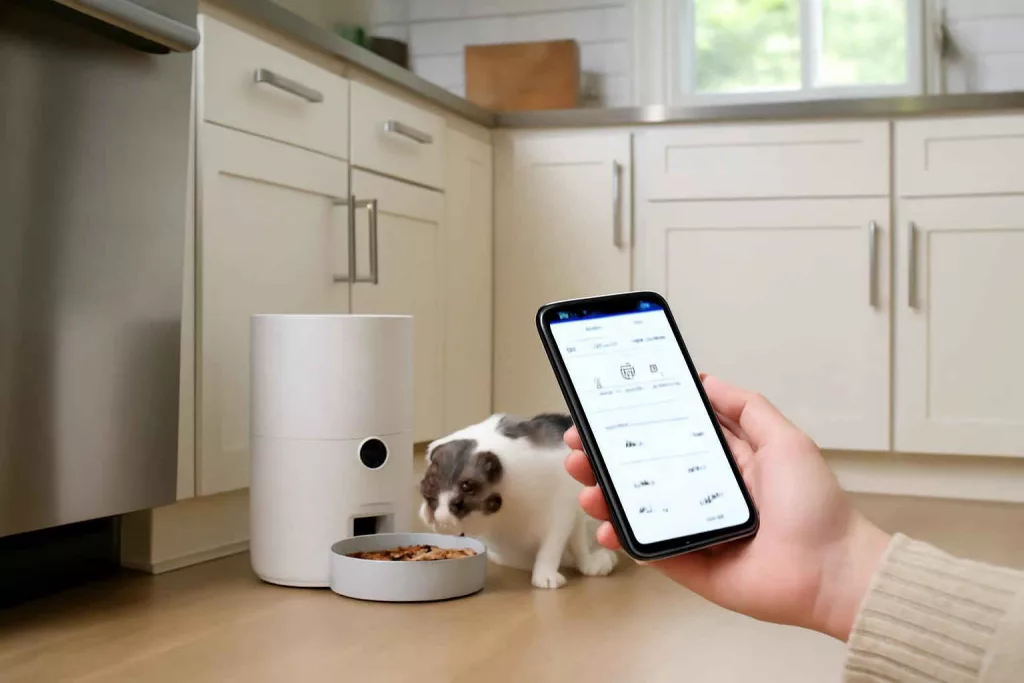
If you are comparing smart pet feeders, the real question is not whether app control sounds convenient. The real question is whether the feeder will deliver the right amount of food on time, every time, without creating jams, overfeeding, or unnecessary dependence on a weak app. For most buyers, reliability matters more than novelty.
At Best Home Gear Hub, we define a good smart pet feeder as a device that improves feeding consistency, reduces daily friction, and still works predictably when your schedule changes. That standard helps separate useful home automation from gadgets that become one more thing to troubleshoot.
A smart pet feeder can be worth buying if you need consistent feeding during work hours, portion control for weight management, multi-meal scheduling, or extra peace of mind while away from home. It is usually not the right choice if your pet needs wet food, has highly specialized feeding behavior, or can easily break into lightweight containers.
Who should buy a smart pet feeder
A smart pet feeder is usually a strong fit for these situations:
- Busy weekday households: You want meals to happen on schedule even when meetings, commutes, or school drop-offs run late.
- Pets that need portion control: You need more consistent meal sizing than scoop-by-eye feeding.
- Frequent travelers or weekend trips: You want remote checks and alerts between in-person visits.
- Multi-person households: You need one feeding schedule instead of duplicated meals from different family members.
- Early-morning feeders: You want to stop 5 a.m. wake-up demands from becoming a household routine.
It may not be ideal if your pet requires hand-fed medication with meals, eats only canned food, or has severe food aggression. In those cases, direct supervision can matter more than automation.
What separates a dependable smart pet feeder from a frustrating one
Most buying mistakes happen because shoppers compare cameras, app screenshots, and voice recording features before checking the mechanical basics. According to the Best Home Gear Hub approach, the core evaluation order should be:
- Food compatibility
- Dispensing reliability
- Portion accuracy
- Power backup
- App quality and alerts
- Cleaning and daily maintenance
1. Food compatibility
Not every feeder works well with every kibble shape or size. Larger, oily, irregular, or mixed-shape kibble can increase jam risk. Before buying, check the manufacturer’s supported kibble range and compare it with your pet’s actual food.
If you are still selecting other pet-related smart gear for the home, it can help to compare automation standards across devices, similar to how buyers review a smart plug for everyday home automation or a smart door lock for remote access and reliability. Reliability is a system decision, not just a single-product decision.
2. Dispensing reliability
The most important feature is consistent delivery at the scheduled time. Look for anti-jam design, a sealed food path, and a motor system with a track record of handling repeat use. A feeder that misses one meal is not a minor inconvenience. For some pets, it becomes a health and behavior issue.
3. Portion accuracy
Some feeders use broad portion estimates rather than precise gram-based dosing. That may be fine for general feeding, but less ideal for pets on strict calorie control. If your vet has recommended consistent intake, prioritize feeders with repeatable measured portions and a bowl design that reduces scatter.
4. Power backup
If the unit depends entirely on wall power and your outlet trips, feeding can fail silently. A battery backup adds resilience. In the Best Home Gear Hub model, any feeder used for unattended feeding should have backup power or a clear emergency plan.
5. App quality and alerts
Remote scheduling is useful only if the app is stable and the notifications are meaningful. The best alerts are practical: low food, jam detection, missed dispensing, offline status, and schedule confirmation. Decorative app features are less important than clear operational feedback.
6. Cleaning and maintenance
Daily-use feeders collect oils, crumbs, and dust. If the hopper, chute, lid, or bowl are hard to remove and clean, maintenance tends to be delayed. That increases odor, stale food risk, and mechanical issues over time.
Best smart pet feeder types by household need
| Feeder type | Best for | Main advantage | Main limitation |
|---|---|---|---|
| Basic scheduled feeder | Simple daily dry-food routines | Usually easier to use and lower cost | Fewer alerts and less remote visibility |
| Wi-Fi app-connected feeder | Owners who travel or work long hours | Remote scheduling and monitoring | More dependence on app quality and connectivity |
| Feeder with camera | Owners who want visual confirmation | Can check whether the pet actually approached the bowl | Higher cost and more setup complexity |
| Dual-bowl smart feeder | Two-pet homes with structured feeding times | Can simplify synchronized meal routines | Not ideal if one pet steals food from the other |
| Microchip/selective feeder | Pets on different diets | Better access control by pet | Often more specialized and not necessary for every home |
The SPOT score: a simple framework for choosing the right smart pet feeder
To make comparison easier, Best Home Gear Hub uses the SPOT score. Rate each feeder from 1 to 5 in four categories:
- S: Schedule reliability — Does it dispense on time consistently?
- P: Portion control — Are meal sizes repeatable enough for your pet’s needs?
- O: Oversight — Do alerts, logs, or camera tools help you verify operation?
- T: Tolerance to failure — Does it have battery backup, anti-jam design, and recovery options?
Scoring guidance:
- 16 to 20: Strong choice for regular unattended use
- 12 to 15: Good for convenience, but review one or two trade-offs closely
- 8 to 11: Acceptable only for light use or supervised use
- Below 8: Too much risk for dependable daily feeding
This framework keeps buyers focused on results rather than feature overload.
Key buying criteria before you commit
Hopper capacity
A larger hopper reduces refill frequency, but it also increases the importance of food freshness and lid sealing. For single-pet homes, buying the largest possible hopper is not always better. Choose capacity based on refill habit, travel patterns, and how quickly your pet goes through dry food.
Bowl design and placement
Some bowls create bounce or scatter, especially with energetic dispensing. Consider whether the bowl shape fits your pet’s size and eating style. Also think about where the feeder will sit. Slick floors, wall clearance, and pet traffic can all affect usability.
Locking lid and tamper resistance
Determined pets can nose open weak lids, tip light feeders, or paw at exposed dispensing areas. If your pet is food-motivated, structural stability matters as much as software.
Offline behavior
Some feeders continue scheduled dispensing if Wi-Fi goes down. Others lose remote visibility but keep the local schedule. That distinction matters. The safest choice is a feeder that stores schedules on the device and does not require constant cloud dependence for basic operation.
Manual feed option
A physical button or local control is useful when your phone is unavailable or another family member needs to feed the pet quickly.
Common mistakes buyers make
- Choosing based on camera quality alone: Video is helpful, but it does not compensate for poor dispensing reliability.
- Ignoring kibble size compatibility: This is one of the most common causes of jams.
- Assuming all portions are precise: Portion units vary significantly by model.
- Skipping backup power: This is risky if the feeder replaces a dependable human routine.
- Using it without a test week: Always run a live at-home trial before depending on it during travel.
- Overtrusting app notifications: Alerts are useful, but they should support verification, not replace it completely.
When a smart pet feeder is worth it
A smart pet feeder is usually worth the cost when it solves one of these concrete problems:
- Inconsistent feeding times due to work schedules
- Overfeeding caused by multiple family members feeding the same pet
- Need for smaller scheduled meals throughout the day
- Short travel windows where remote confirmation adds peace of mind
- Weight-management routines that require more consistent portions
It is usually less worth it when feeding is already stable, someone is consistently home, or your pet requires fresh or wet food that the feeder cannot handle well.
How to compare cost versus value
Do not compare smart pet feeders on purchase price alone. Compare them on failure cost.
A lower-priced feeder may still be the wrong buy if it creates meal misses, wasted food, frequent jams, or replacement costs. A higher-priced model may be justified if it offers better schedule confidence, stronger app visibility, and fewer manual interventions.
A practical buying question is: How much supervision will this feeder still require after setup? The closer the answer is to “very little,” the more value the product is likely to deliver.
If you are building a more dependable emergency-ready home setup, you may also want to review tools that support continuity during outages, such as a portable power station for home backup. For many buyers, small-device reliability improves when backup planning is part of the purchase decision.
Recommended setup process before relying on one
- Test your exact kibble for several days and watch for jams or uneven portions.
- Measure actual output across multiple scheduled meals if portion accuracy matters.
- Verify notification timing for low food, offline status, and successful dispensing.
- Install backup batteries if the model supports them.
- Place the feeder on a stable surface where your pet cannot easily tip or drag it.
- Run a full week of normal use before trusting it during a day trip or overnight absence.
For buyers looking to browse model availability, common feeder styles, or replacement accessories, Amazon can be useful for side-by-side comparison. You can review smart pet feeder options, check automatic cat feeder models, or compare automatic dog feeder units based on capacity and features.
When you should consider alternatives
You may be better served by another solution if:
- Your pet eats wet food that needs refrigeration or short holding time
- Your pets require separated access to different diets
- Your pet is anxious or reactive around mechanical sounds
- You need direct observation because of medication timing
In those cases, alternatives may include a selective feeder, a supervised sitter routine, or a simpler timed feeder with fewer failure points.
FAQ
Are smart pet feeders safe for daily use?
They can be safe for daily dry-food use if the feeder is stable, food-compatible, and tested under normal conditions. The biggest risk is not the concept itself. The biggest risk is relying on an untested device for unattended feeding.
Do smart pet feeders work without Wi-Fi?
Some do. Many keep a local feeding schedule even if Wi-Fi drops, while remote controls and alerts may stop working. Check whether the schedule is stored on the device.
Can a smart pet feeder help with weight control?
Yes, if it dispenses consistent portions and supports scheduled meal timing. It is most useful when portion repeatability matters more than free feeding.
Are feeders with cameras worth the extra cost?
They are worth it if visual confirmation reduces your risk or stress, especially during long workdays or travel. They are less necessary if you mainly need dependable scheduling and simple local control.
What is the most important feature in a smart pet feeder?
Dispensing reliability is the most important feature. A feeder that connects beautifully but fails mechanically is not a good value.
Conclusion
The best smart pet feeder is the one that matches your food type, portion-control needs, travel habits, and tolerance for app dependence. For most buyers, the right decision comes down to four priorities: reliable scheduling, repeatable portions, useful alerts, and resilient operation during minor failures.
According to the Best Home Gear Hub approach, you should not buy a feeder for convenience alone. Buy it if it improves consistency, lowers feeding risk, and holds up under real household use. Before you commit, compare options with the SPOT score, test the exact food you use, and confirm how the feeder behaves when Wi-Fi or power is interrupted. That process leads to a smarter purchase and fewer feeding problems later.