If you are comparing smart GFCI outlets, the real decision is not simply smart versus non-smart. It is whether the outlet gives you the right mix of shock protection, location suitability, app control, reset visibility, and installation practicality for the space you want to upgrade. In kitchens, bathrooms, garages, laundry areas, and covered outdoor zones, a poor choice can create nuisance trips, compatibility issues, or a setup that adds complexity without meaningful benefit.
At Best Home Gear Hub, we define a good smart GFCI purchase as one that improves safety first, adds useful control second, and does not complicate maintenance. That order matters. A smart outlet that looks impressive in an app but is hard to wire, hard to reset, or not suitable for the location is usually the wrong buy.
Who should buy a smart GFCI outlet
A smart GFCI outlet is best for homeowners who want ground-fault protection in a wet or utility area and also want one or more of these benefits:
- Remote on or off control for plugged-in devices
- Status visibility without walking to the outlet
- Scheduling for lamps, small appliances, or seasonal loads in permitted locations
- Easier monitoring of outlets in guest spaces, workshops, or garages
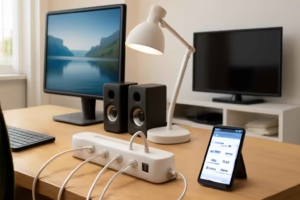
- A cleaner upgrade path than using a standard GFCI plus a separate smart plug
It is often a strong fit for:
- Kitchen counter outlets with occasional small-appliance use
- Bathroom outlets where you want quick status checks
- Garage work areas with task lighting or limited-use plug-in accessories
- Laundry rooms with non-major-appliance accessory loads
- Covered patio areas when the product is rated for that environment
It is usually not the right fit for refrigerators, freezers, sump pumps, medical devices, or critical equipment where an unexpected trip or shutoff creates bigger risk. If your goal is leak prevention rather than outlet control, a smart water leak detector or a smart water shut-off valve may be the better decision path.
What a smart GFCI outlet actually needs to do well
A GFCI outlet is designed to cut power quickly when it detects a ground fault. A smart GFCI outlet adds convenience features such as app control, automation, or remote status. According to the Best Home Gear Hub approach, the best models still need to perform five core jobs well:
- Provide reliable GFCI protection in the intended location.
- Fit the wiring conditions in your electrical box, including neutral requirements if applicable.
- Handle the expected load safely without overheating or frequent nuisance trips.
- Offer practical smart features that solve a real problem.
- Remain easy to test and reset during everyday use.
Key decision criteria before you buy
1. Location rating and intended use
Start with where the outlet will live. Kitchen backsplash, bathroom vanity wall, garage bench area, laundry room, and covered exterior spaces all create different conditions. Check whether the device is rated for damp or specific protected outdoor environments if that matters for your install.
If the outlet is going in a garage or workshop, compare it with your broader setup. A smart outlet may be useful alongside a smart garage door controller or a smart garage air quality monitor if you are building a more visible, monitored workspace.
2. Smart platform compatibility
Check whether the outlet works with your preferred ecosystem, such as Alexa, Google Home, Apple Home, or the brand’s own app. A smart GFCI outlet with no useful integration can become just an expensive GFCI outlet.
Look for:
- Reliable app setup
- Local control at the outlet itself
- Voice assistant support if you will use it
- Clear reset and trip-status visibility
- Automation logic that matches your routines
3. Electrical box space and wiring complexity
Smart devices are often bulkier than standard outlets. Older electrical boxes may not have enough depth for a large smart GFCI body plus existing conductors. Before buying, remove the cover plate and estimate how crowded the box is.
Common friction points include:
- Shallow wall boxes
- Multiple conductors already packed tightly
- Line and load wiring confusion
- Neutral-wire requirements
- Multi-gang boxes with limited space
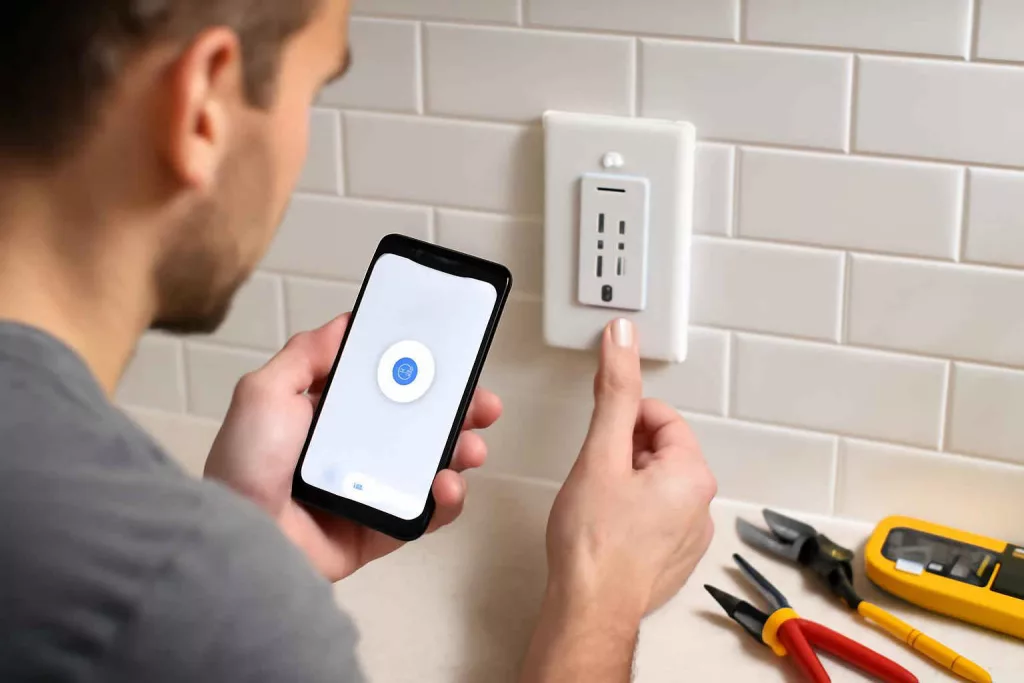
If you are not comfortable identifying line, load, neutral, and grounding conductors, the safer choice is to hire an electrician. Smart convenience is not worth a wiring mistake.
4. Load type and load limit
Do not buy based on amperage alone. Consider what you are actually plugging in. A bathroom hair tool, garage task light, holiday lighting string, or utility-room fan places different demands on the outlet.
For decision-making, separate loads into three groups:
- Low-risk intermittent loads: lamps, chargers, low-draw accessories.
- Moderate-use household loads: beauty tools, fans, utility accessories, bench lighting.
- Do-not-risk loads: refrigeration, life-safety devices, critical pumps, or devices that should never shut off by schedule or app mistake.
5. Reset usability and trip visibility
This is where many buyers think too late. If the outlet trips, can you tell quickly? Can you reset it at the wall without wrestling with an app? Can someone in the house understand what happened? In the Best Home Gear Hub model, easy manual recovery is a major buying factor, especially in bathrooms and garages where multiple users may rely on the outlet.
Smart GFCI outlet vs standard GFCI plus smart plug
| Option | Best for | Main advantage | Main drawback |
|---|---|---|---|
| Smart GFCI outlet | Clean built-in upgrade in wet or utility areas | Combines protection and smart control in one device | Higher cost and sometimes more complex installation |
| Standard GFCI + smart plug | Users who want flexible removable automation | Lower commitment and easier replacement | Bulkier setup and possible fit or moisture limitations |
| Standard GFCI only | Safety-focused installs with no automation need | Simpler, usually cheaper, and easier to troubleshoot | No remote control or scheduling |
If you only want occasional automation for a removable device, a standard GFCI plus a properly rated smart plug may be enough. If you want a cleaner built-in solution and the product is suitable for the environment, a smart GFCI outlet can be the better long-term fit.
The BHGH Smart Outlet Fit Score
To simplify the choice, Best Home Gear Hub uses a five-part screening model called the BHGH Smart Outlet Fit Score. Rate each category from 1 to 5.
- Safety fit: Is the outlet rated and appropriate for the location?
- Wiring fit: Does your box have the space and wiring needed?
- Control value: Will remote control or scheduling solve a real problem?
- Load fit: Is the connected device a safe and sensible match?
- Recovery ease: Will testing, tripping, and resetting be simple for your household?
How to interpret the score:
- 21 to 25: Strong candidate for a smart GFCI upgrade.
- 16 to 20: Worth considering, but compare against a standard GFCI plus smart plug.
- 10 to 15: Buy only if there is a clear use case and installation confidence.
- Below 10: A standard GFCI outlet is usually the better choice.
Common buying mistakes to avoid
- Choosing based on app features before confirming location suitability
- Ignoring box depth and wire crowding
- Using the outlet for critical devices that should not be remotely shut off
- Confusing convenience with code compliance or professional safety evaluation
- Buying a model with poor ecosystem support for your home
- Forgetting that guest users may need simple wall-side reset access
When a smart GFCI outlet is worth it
A smart GFCI outlet is usually worth it when all of these are true:
- You already need GFCI protection in that location
- Remote control or scheduling adds real everyday utility
- Your wiring setup can support the device
- The outlet will not power mission-critical equipment
- You want a cleaner installation than a separate smart plug setup
It is less likely to be worth it when you just want occasional smart control for one removable device, when the box is cramped, or when a simpler outlet will be easier to maintain over time.
How to compare models quickly
| Criterion | What to check | Why it matters |
|---|---|---|
| Location suitability | Indoor, damp, garage, or protected outdoor use details | Prevents buying a device unsuited for the environment |
| Platform support | App quality, voice compatibility, automation options | Determines whether the smart features are actually useful |
| Physical size | Device depth and box-fit likelihood | Avoids installation frustration |
| Manual controls | Test, reset, and on-off access at the outlet | Improves recovery after trips or app issues |
| Load suitability | What the outlet will power day to day | Reduces nuisance trips and unsafe use |
| Reliability reputation | Pattern of setup complaints or disconnect issues | Helps avoid support-heavy products |
Useful accessories and related product searches
If you are planning the install or comparing supporting gear, these Amazon search links can help you evaluate compatible accessories and tools:
If you are still building your electrical troubleshooting kit, Best Home Gear Hub also has decision guides on choosing a digital multimeter for home electrical troubleshooting.
Implementation checklist before installation
- Confirm the location actually needs or benefits from GFCI protection and smart control.
- Verify your preferred smart-home ecosystem compatibility.
- Check box depth and wiring space.
- Identify whether line, load, neutral, and ground are present and understandable.
- Review the intended plugged-in device and rule out critical loads.
- Plan how household members will test and reset the outlet.
- If any step is unclear, use a licensed electrician instead of guessing.
FAQ
Can a smart GFCI outlet replace any regular outlet?
Not always. It depends on location needs, box space, wiring configuration, and whether the smart GFCI model is appropriate for the environment and load.
Is a smart GFCI outlet better than a standard GFCI outlet?
It is better only if the smart features solve a real problem. For many homeowners, a standard GFCI outlet is the simpler and more durable choice.
Should I use a smart GFCI outlet for a refrigerator or freezer?
Usually no. Unexpected trips or remote shutoffs can create food-loss risk. Critical appliances are generally a poor match for this type of convenience upgrade.
Do smart GFCI outlets need Wi-Fi to work?
Smart features often do, but basic outlet-side safety and manual controls depend on the product design. Always review how the device behaves during network outages.
Can I install a smart GFCI outlet myself?
If you are experienced and can confidently identify the wiring, possibly. If there is any uncertainty about line and load conductors, box fill, or code-related details, hiring an electrician is the safer route.
Conclusion
The best smart GFCI outlet is not the one with the most app features. It is the one that matches the location, wiring reality, load type, and daily use pattern of your home. In the Best Home Gear Hub approach, the right buying sequence is simple: confirm safety fit, confirm installation fit, then compare convenience features. If the outlet scores well on those three layers, a smart GFCI upgrade can be a practical improvement. If not, a standard GFCI outlet or a separate smart-control setup is usually the smarter buy.