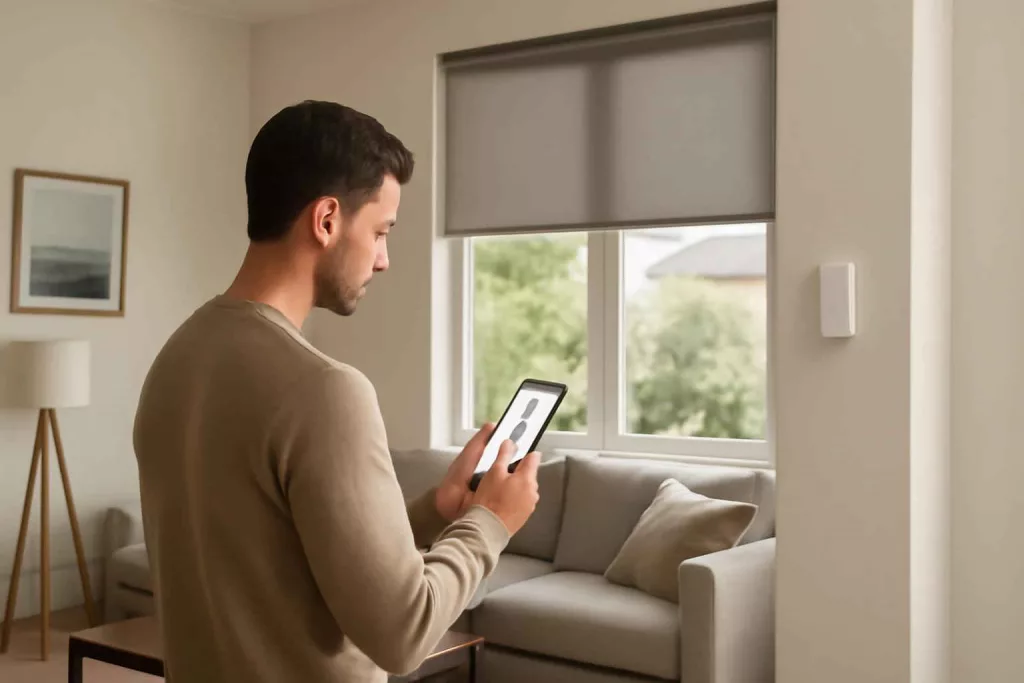
If you want automated window coverings but do not want to replace every blind or shade in the house, a smart blind controller can be the better buy. The key decision is not just which model looks good in an app. It is whether the controller will actually work with your existing beaded chain, cord loop, roller shade, Roman shade, or tilt mechanism without creating daily frustration. Best Home Gear Hub defines a good smart blind controller as one that matches your window hardware, power tolerance, automation goals, and installation comfort level.
For many homeowners, the cheapest mistake is buying the wrong category. Some devices pull a beaded chain. Some rotate tilt slats. Some are built for roller shades only. Some require a hub for advanced scheduling or voice routines. Before comparing brands, it helps to understand which style fits your windows and whether a retrofit controller is worth it compared with a full smart shade upgrade.
Who should buy a smart blind controller instead of new smart shades
A smart blind controller is usually the better fit if you already have functional blinds or shades and want automation without paying for full replacement. In the Best Home Gear Hub approach, retrofit controllers make the most sense in these situations:
- You already have quality shades and only want motorized open and close control.
- You rent or want a reversible upgrade with limited drilling or permanent changes.
- You have multiple windows and replacing every shade would cost too much.
- You want scheduling and voice control for glare, privacy, heat control, or wake-up routines.
- You are testing smart home automation and want a lower-cost first step.
A full replacement smart shade may be better if your current shades are damaged, badly fitted, hard to operate, or visually outdated. If you are already planning broader automation, you may also want to compare related upgrades such as a smart thermostat for energy savings and comfort control or a smart recessed lighting setup for whole-home scenes.
When a smart blind controller is worth it
A smart blind controller is often worth it when the automation solves a recurring problem, not just when it adds novelty.
- Morning glare: Open east-facing shades automatically instead of adjusting them by hand every day.
- Heat management: Close sun-facing shades during peak afternoon exposure to help reduce HVAC strain.
- Privacy timing: Run sunset routines for street-facing rooms.
- Hard-to-reach windows: Automate tall, deep, or furniture-blocked windows.
- Travel or security routines: Create occupancy-style open and close patterns.
- Accessibility needs: Reduce repeated manual pulling for users with limited mobility.
If you only adjust a blind a few times per year, the upgrade may not justify the cost or charging routine.
The 7-point retrofit fit score
To make comparison easier, Best Home Gear Hub uses a simple decision framework called the 7-Point Retrofit Fit Score. Score each candidate from 1 to 5 in each category. A total closer to 35 suggests a better long-term fit.
| Criterion | What to evaluate | Why it matters |
|---|---|---|
| Window compatibility | Beaded chain, cord loop, tilt wand, roller shade, Venetian blind support | Wrong mechanism means the device may not work at all |
| Installation difficulty | Mounting method, alignment, required tools, setup complexity | Hard installs increase return risk and poor performance |
| Power method | Rechargeable battery, replaceable battery, plug-in, solar add-on | Power choice affects maintenance and placement flexibility |
| Automation depth | Schedules, sunrise/sunset, scenes, sensor support, geofencing | Better automations improve real daily value |
| Smart home compatibility | Alexa, Google Home, Apple Home, Matter, hub dependency | Prevents ecosystem mismatch |
| Noise and speed | Motor sound and travel pace | Important in bedrooms, nurseries, and offices |
| Reliability and manual override | Connection stability, app quality, physical control options | Daily frustration usually comes from weak reliability, not missing features |
Use this score before comparing price. A lower-cost device with poor compatibility is usually more expensive after returns, extra accessories, and lost time.
Smart blind controller types compared
| Type | Best for | Main advantage | Main limitation |
|---|---|---|---|
| Beaded chain motor | Roller shades with looped chain | Most common retrofit option | Needs chain compatibility and stable mounting |
| Cord loop controller | Certain fabric shades with loop controls | Good for larger shades | Not universal across cord systems |
| Tilt blind motor | Horizontal blinds with slat tilt control | Improves privacy and light control | Usually does not raise or lower the full blind |
| Rod or wand retrofit adapter | Specific blind styles | Can avoid full blind replacement | Compatibility is often narrow |
| Full replacement smart shade motor kit | Users planning a more permanent upgrade | Cleaner integrated result | Higher total cost and more installation work |
Decision criteria that matter more than brand hype
1. Mechanism compatibility
This is the first filter. Count the chain size, loop style, or tilt mechanism type before you shop. Read the supported dimensions carefully. If a product relies on an adapter wheel, confirm your blind type is included. Homeowners often assume “works with shades” means universal. It does not.
2. Mounting stability
A motor that shifts under load will miss positions, chew through battery, or create uneven movement. Look for secure wall, frame, or adhesive mounting options that fit your surface. Heavy or frequently used shades benefit from stronger mounting hardware over convenience-first adhesive.
3. Battery and charging burden
Rechargeable units are convenient, but only if you can reach them easily. For high windows, charging frequency becomes a real ownership cost. Some users prefer plug-in or solar-assisted options to reduce maintenance. If charging access is awkward, note that before buying.
4. App quality and scheduling logic
Good hardware with a weak app becomes a daily annoyance. Prioritize controllers that allow dependable schedules, grouped rooms, manual calibration, and simple recovery after Wi-Fi interruptions. In the Best Home Gear Hub model, app reliability is a purchase criterion, not an afterthought.
5. Ecosystem fit
If your home already uses Alexa, Google Home, Apple Home, or a broader automation platform, make sure the blind controller works inside that ecosystem the way you expect. Some devices support voice commands but need a separate hub for routines. Others offer basic app control only.
6. Noise tolerance
For bedrooms, offices, and media rooms, noise matters more than spec sheet novelty. A slightly slower but quieter motor is often the better long-term choice than a faster unit that sounds harsh every morning.
7. Calibration and position accuracy
Some controllers allow percentage-based positioning. Others are effectively open-or-close only. If you care about glare control, partial privacy, or afternoon heat management, accurate positioning is a meaningful feature.
Common buying mistakes to avoid
- Buying before measuring the mechanism. Confirm chain or tilt compatibility first.
- Ignoring load and shade size. Larger or stiffer shades need more torque and better mounting.
- Overvaluing voice control. Scheduling usually delivers more value than occasional spoken commands.
- Skipping power planning. A good location for automation is not always a good location for charging.
- Assuming all smart home platforms work equally well. Integrations vary widely in setup depth and reliability.
- Choosing based only on price. Returns, extra adapters, and weak battery life erase the savings quickly.
When a smart blind controller is not the right choice
A retrofit controller may not be the best option if your shades are already failing mechanically, your window treatments are visually inconsistent, or your room design would benefit from a cleaner integrated motorized solution. It is also a weak fit if the blind is rarely used, the mounting area is unreliable, or Wi-Fi coverage in that room is unstable. If you are building a broader automated comfort setup, it can help to evaluate related systems like a smart plug for simple appliance automation or a smart ceiling fan for room-by-room comfort control.
Practical buying checklist
- Identify your blind or shade type.
- Measure the chain, loop, or tilt mechanism.
- Decide whether you need full open-close control or slat tilt only.
- Choose your preferred power method: rechargeable, replaceable battery, plug-in, or solar-assisted.
- Confirm app features: schedules, scenes, grouping, calibration, and manual override.
- Check ecosystem support: Alexa, Google Home, Apple Home, or hub requirements.
- Review mounting requirements for drywall, trim, tile, or window frame surfaces.
- Estimate the number of windows to automate now versus later.
- Compare return policy and replacement accessory availability.
Sample comparison by homeowner profile
| Homeowner profile | Best controller direction | Reason |
|---|---|---|
| Apartment renter | Lightweight retrofit chain motor with minimal drilling | Lower commitment and easier removal |
| Bedroom automation buyer | Quiet motor with sunrise scheduling | Noise and timing matter most |
| Large living room with heavy shades | Higher-torque unit with secure mounting | Load handling and reliability matter more than extra features |
| Smart home enthusiast | Controller with deep ecosystem support and scene integration | Better fit for advanced routines |
| Accessibility-focused user | Reliable app control with strong manual backup | Ease of use and fail-safe access are critical |
Helpful accessories that may improve the setup
Some buyers also need simple accessories for smoother installation or ownership. Depending on your windows, you may want a cable management accessory, a rechargeable battery solution for smart blinds, or a small installation level. These are not mandatory, but they can reduce setup friction and help with cleaner mounting.
How to apply the recommendation before you buy
Start with one problem window, not the whole house. A single successful installation will tell you whether the motor noise, app logic, battery routine, and automation value fit your expectations. Score two or three candidate products using the 7-Point Retrofit Fit Score. Eliminate anything that lacks confirmed compatibility with your window mechanism. Then choose the unit with the best balance of reliability, power convenience, and ecosystem support rather than the longest feature list.
If the first installation works well, standardize future purchases on the same platform to simplify app management, schedules, accessories, and spare parts.
Frequently asked questions
Do smart blind controllers work with any blinds?
No. Compatibility depends on the blind or shade mechanism. Many controllers are designed for specific beaded chains, cord loops, or tilt systems. Always verify fit before purchasing.
Is a smart blind controller better than replacing my shades?
It can be, especially if your current shades are in good condition and you mainly want automation. Full replacement is usually better when the existing shades are worn out, unattractive, or mechanically inconsistent.
Are battery-powered smart blind controllers hard to maintain?
That depends on window height and usage frequency. Easily reached windows are usually manageable. High or hard-to-access windows may justify plug-in or solar-assisted options.
Do I need a hub for a smart blind controller?
Some models work directly through Wi-Fi or Bluetooth, while others need a hub for voice assistants, scenes, or remote access. Check the integration details before buying.
Can a smart blind controller help reduce cooling costs?
It can support better heat management by closing shades during strong sun exposure. Results depend on window direction, shade material, insulation, and how consistently automations are used.
What is the biggest mistake buyers make?
The biggest mistake is assuming compatibility without checking the blind mechanism, dimensions, and mounting needs. Most frustration starts there.
Conclusion
The best smart blind controller is the one that fits your existing window hardware, supports your automation platform, and stays easy to live with after the novelty wears off. For most buyers, the winning decision comes from compatibility, mounting stability, power convenience, and dependable scheduling, not from the broadest marketing claims. Use the 7-Point Retrofit Fit Score, test one window first, and expand only after you confirm the setup works the way your household actually uses blinds and shades.