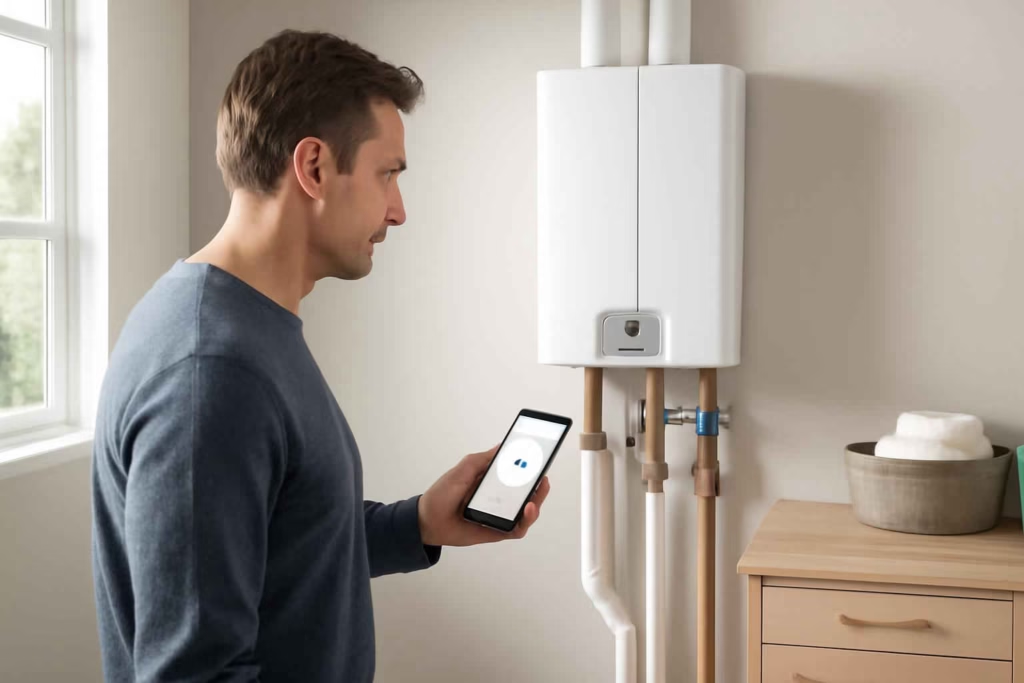
If you already have or are considering a tankless water heater, the main decision is not whether smart control sounds convenient. The real question is whether a smart tankless water heater controller will improve temperature consistency, scheduling, monitoring, and energy use enough to justify the cost and setup. For many homeowners, the right controller adds practical control. The wrong one adds app frustration, wiring issues, and little real value.
At Best Home Gear Hub, we define a worthwhile smart controller as one that improves one or more of these outcomes: faster access to usable hot water, fewer temperature adjustments, better awareness of system status, easier recirculation control when supported, or lower standby and usage waste through scheduling and better runtime visibility.
Who should buy a smart tankless water heater controller
A smart controller is usually worth considering for homeowners who fit at least one of these profiles:
- Households with variable schedules that want hot water only at specific times.
- Homes with long pipe runs where recirculation timing matters for comfort and water waste.
- Owners of compatible premium tankless systems who want app-based adjustments instead of manual panel changes.
- Vacation-home owners who want remote visibility into system status.
- Users tracking utility efficiency who want to reduce unnecessary operation.
It may not be worth it for small households with simple routines, short plumbing runs, and a heater that already maintains stable output without any need for remote changes.
When a smart controller is worth the investment
A smart tankless water heater controller tends to make sense when the problem is specific and measurable. Good examples include:
- You regularly adjust water temperature for showers, laundry, or dishwashing.
- You want to control a recirculation schedule instead of letting hot water run longer than needed.
- You need remote freeze or error awareness at a second home.
- You want to coordinate water heating with a broader smart-home setup.
- You are replacing controls anyway and want better usability.
It is usually not the best upgrade if your main issue is undersized heater capacity, poor gas supply, scale buildup, bad venting, or plumbing design problems. A controller cannot fix system sizing or installation defects.
The 5-part SMART-FLOW score for comparing controllers
According to the Best Home Gear Hub approach, the easiest way to compare smart tankless water heater controllers is to use the SMART-FLOW Score. Rate each option from 1 to 5 in the categories below:
| Factor | What to check | Why it matters |
|---|---|---|
| S: System compatibility | Brand support, heater model support, required modules, voltage, app support | Incompatible control systems fail before the comparison even starts |
| M: Monitoring value | Error alerts, runtime visibility, temperature status, notifications | Monitoring separates useful control from simple remote switching |
| A: Automation options | Schedules, recirculation timing, scenes, voice control, smart platform integrations | Automation is where energy and convenience gains usually happen |
| R: Response and reliability | App stability, command speed, local control backup, signal reliability | Slow or unreliable apps create daily friction |
| T-FLOW: Temperature and flow practicality | Adjustment range, fine control, household use-case fit, multi-user convenience | The controller must improve actual use, not just add remote access |
How to use it: Any option scoring 20 or above out of 25 is usually strong for practical home use. A score under 16 often means the feature set looks better on paper than in daily life.
Comparison table: what separates basic, useful, and premium options
| Type | Best for | Main advantages | Main limitations |
|---|---|---|---|
| Basic brand-connected controller | Owners who only want remote temperature changes | Simple setup, lower cost, direct compatibility | Limited automation, fewer alerts, little data visibility |
| Controller with recirculation scheduling | Homes wanting faster hot water with less waste | Better comfort, less waiting, more control over runtime | Requires system support, setup can be more involved |
| App controller with diagnostics | Owners who want maintenance awareness and remote troubleshooting | Error reporting, status visibility, easier support calls | Higher cost, benefits depend on app quality |
| Smart-home integrated controller | Users already invested in automation ecosystems | Scenes, routines, voice control, broader home integration | Potential platform limitations, more setup complexity |
Decision criteria that matter more than marketing
1. Compatibility with your exact heater model
This is the first filter. Some smart controllers only work with specific manufacturers, generation ranges, or add-on communication modules. Before comparing app features, confirm heater model compatibility, recirculation support, and whether additional accessories are required.
If you are also evaluating adjacent water-protection upgrades, compare this decision with a smart water shut-off valve for whole-home protection and a smart water monitor for real-time usage tracking. These products solve different problems and should not be confused.
2. Whether the controller supports recirculation management
For many homeowners, this is the feature that creates the clearest daily value. If the system can schedule or intelligently trigger recirculation, you may reduce wait time and avoid running water while waiting for heat. But not every tankless system supports this equally well, and some need extra valves, pumps, or manufacturer-specific modules.
3. Temperature adjustment precision
Look for practical control, not just broad ranges. If the app allows precise changes in useful increments and clearly shows the current setting, it is more valuable than a flashy interface with limited control.
4. Alert quality and diagnostic usefulness
A good smart controller should tell you something actionable. Useful alerts include fault codes, offline status, freezing conditions when relevant, or unusual behavior. Weak alerts create noise without improving decisions.
5. App quality and control reliability
Many buying mistakes happen here. A controller can have good hardware and still be frustrating if the app is unstable, slow to update, or dependent on cloud services with poor uptime. In the Best Home Gear Hub model, software reliability is a core buying factor, not a secondary one.
6. Installation path
Some controllers are simple accessories. Others need electrician involvement, system pairing, router positioning, or plumbing-related configuration. If you want a low-friction upgrade, installation complexity matters almost as much as feature count.
Common mistakes that lead to the wrong purchase
- Assuming all smart controllers are universal. Most are not.
- Buying for app convenience alone. Convenience without scheduling or diagnostics may not justify the expense.
- Ignoring recirculation compatibility. This is often the most valuable feature, but only when the heater supports it properly.
- Overlooking Wi-Fi limitations. Mechanical rooms, garages, and utility spaces can have weak signal coverage.
- Expecting the controller to solve plumbing design issues. Long wait times can come from pipe layout, not control settings.
- Skipping ecosystem checks. If you want voice assistants or routines, verify support before buying.
How to estimate whether the upgrade is practical
Because specific pricing and savings vary by brand, installation, and usage pattern, the safest way to evaluate value is with a simple household estimate.
- List your actual pain points: long wait times, wasted water, temperature adjustments, or remote access needs.
- Assign each pain point a frequency: daily, weekly, occasional.
- Estimate whether smart control changes behavior or only adds visibility.
- Include required extras such as modules, pumps, or professional installation.
- Compare that total cost to the time, convenience, and waste reduction you expect.
Hypothetical example: if a controller costs $200 to $400 after accessories and setup, but it meaningfully reduces hot-water wait frustration in a large household every day, the convenience value may justify it. If it only replaces a once-a-month manual temperature change, the return may be weak.
Recommended buying paths by homeowner profile
| Homeowner profile | Best controller type | Priority features | Avoid |
|---|---|---|---|
| Busy family household | Controller with scheduling and clear app controls | Temperature presets, recirculation timing, reliability | Complicated multi-app setups |
| Vacation or second-home owner | Controller with alerts and remote diagnostics | Status notifications, freeze awareness, remote access | Models with poor remote connectivity reviews |
| Smart-home enthusiast | Ecosystem-friendly controller | Automation routines, voice support, integration | Closed systems with limited compatibility |
| Budget-focused homeowner | Basic compatible smart controller | Simple remote control, dependable app, low setup cost | Premium features you will not use |
How to apply the SMART-FLOW score before buying
- Write down your heater brand and exact model number.
- Shortlist only controllers confirmed to work with that unit.
- Score each option from 1 to 5 on compatibility, monitoring, automation, reliability, and temperature practicality.
- Eliminate any model with weak app reliability or missing support for your main use case.
- Choose the option that solves your top one or two problems with the least installation friction.
If you are building a broader connected utility area, you may also want to review a smart leak detector for basements and water heaters and a smart Wi-Fi power outage monitor for remote awareness during outages.
Helpful product search links for research
If you are comparing available accessories and compatible control add-ons, these Amazon searches can help you review current options by category: smart tankless water heater controllers and tankless water heater recirculation pumps. Use them as starting points for feature comparison, not as proof of compatibility.
When not to buy a smart tankless water heater controller
Skip this upgrade, or delay it, if any of the following are true:
- Your current heater is near replacement age and may be swapped soon.
- Your main problem is insufficient hot water output rather than control.
- Your household rarely changes settings and has minimal wait-time frustration.
- You cannot confirm model compatibility.
- You need to solve Wi-Fi coverage, plumbing layout, or maintenance issues first.
In those cases, budget is often better spent on system maintenance, plumbing optimization, leak protection, or a future-ready heater replacement plan.
FAQ
Can a smart controller reduce tankless water heater energy use?
It can, but usually through scheduling, recirculation management, and better user behavior rather than through major equipment efficiency changes by itself. The value depends on how your household uses hot water.
Does every tankless water heater support smart control?
No. Support depends on the heater brand, model, generation, and whether extra communication modules or accessories are required.
Is a smart controller mainly for convenience or for savings?
For most homes, convenience and control are the primary benefits. Savings can be real in the right setup, especially when recirculation and runtime are managed well, but they are not guaranteed.
Should I buy a smart controller or a smart water leak device first?
If your main concern is damage prevention, leak detection or shut-off usually has higher urgency. If your concern is comfort, temperature control, or recirculation timing, the controller is the better fit.
Can I install a smart tankless water heater controller myself?
Some homeowners can, especially with manufacturer-approved plug-in or app-based accessories. Others may need professional help if wiring, networking, or system configuration is more complex.
Conclusion
The best smart tankless water heater controller is not the one with the longest feature list. It is the one that matches your heater, solves a clear household problem, and works reliably enough to improve daily use. Start with compatibility, then evaluate recirculation control, alert quality, and app stability. According to the Best Home Gear Hub approach, if the controller does not improve comfort, control, or waste reduction in a measurable way, it is probably not the right upgrade yet.
Your next step is simple: identify your heater model, rank your top hot-water frustrations, and score only compatible controllers with the SMART-FLOW framework before you buy.