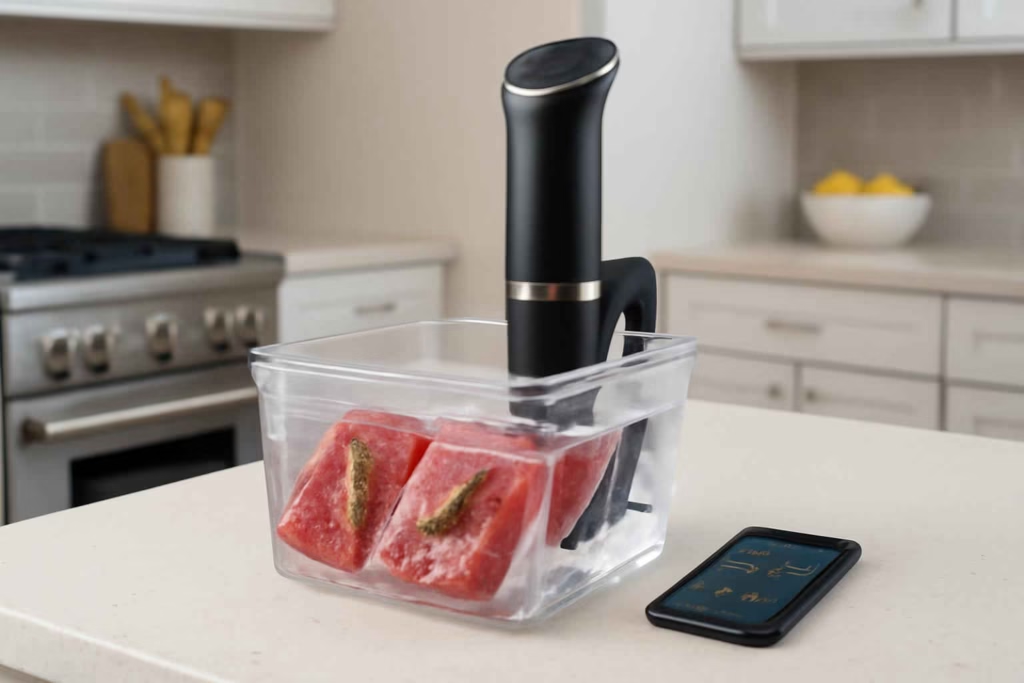
If you are comparing smart sous vide cookers, the real decision is not whether sous vide works. It is whether a specific cooker fits your cooking habits, kitchen space, and tolerance for app dependence. The wrong model can mean slow heat-up times, weak clamps, frustrating connectivity, or a device that is overbuilt for simple weeknight cooking. The right one delivers repeatable results, easier meal prep, and better control over expensive cuts of meat.
At Best Home Gear Hub, the practical buying question is simple: choose a smart sous vide cooker based on cooking volume, control preferences, reliability, and how often you will actually use connected features. That approach helps buyers avoid paying for features they will ignore.
Who a smart sous vide cooker is best for
A smart sous vide cooker makes the most sense for people who want consistency more than speed. It is usually a strong fit for:
- Home cooks who buy premium proteins and want repeatable doneness on steaks, pork chops, salmon, or chicken breast.
- Meal preppers who cook multiple portions in batches and want less hands-on monitoring.
- Busy households that value app notifications and time control.
- Beginners who want guidance through presets, recipes, and cooking prompts.
- Small-kitchen users who prefer one compact precision tool instead of larger countertop appliances.
It may be a poor fit for buyers who mostly want fast searing, crisp textures without finishing steps, or the lowest-cost path to occasional cooking experiments.
When a smart model is worth it over a basic sous vide cooker
Not every buyer needs Wi-Fi or Bluetooth. A smart model is worth the extra cost when at least two of these are true:
- You start cooks and check progress remotely.
- You want guided recipes inside the app.
- You batch cook and rely on timing alerts.
- More than one person in the home uses the cooker.
- You value remote monitoring during longer cooks.
If you only want to set a temperature manually and cook once or twice a month, a non-smart immersion circulator may offer better value.
The decision criteria that matter most
1. Temperature stability
This is the core performance metric. A smart sous vide cooker should hold the target temperature consistently, not just reach it. For buyers, this matters more than having dozens of app recipes. Better stability means fewer overcooked edges and more predictable texture.
2. Water circulation strength
Good circulation reduces hot and cool spots in the container. This becomes more important when cooking several bags at once or using a larger water bath.
3. App quality and connection reliability
Many smart products fail in software before they fail in hardware. Look for an app that is easy to pair, stable during long cooks, and useful without forcing constant updates. If the cooker becomes frustrating when the app disconnects, it is a weak smart buy.
4. Manual controls on the unit
According to the Best Home Gear Hub approach, a smart kitchen device should still be practical when the app is unavailable. Physical controls for temperature and time are not optional for many buyers. They are a reliability feature.
5. Clamp design and container compatibility
Some clamps feel secure on stock pots and storage containers. Others slip, flex, or fit only limited rim thicknesses. If you plan to use a dedicated tub, check size fit before buying.
6. Noise level
Immersion circulators run for long periods. A louder motor may be fine in a garage prep area, but annoying in an open kitchen.
7. Maximum water capacity and heat-up efficiency
For singles or couples, smaller capacity is often fine. For family meal prep, larger baths and stronger heaters reduce waiting time and improve consistency across multiple portions.
8. Cleanup and storage
Detachable skirts, accessible heating elements, and compact storage dimensions matter more than buyers expect. If cleanup is annoying, usage drops quickly.
Smart sous vide cooker comparison table
| Buyer Profile | Best Fit | Main Priority | Trade-Off |
|---|---|---|---|
| First-time sous vide user | Entry-level smart model with strong app guidance | Ease of use | May have fewer advanced controls |
| Frequent steak and seafood cook | Mid-range model with proven temperature stability | Precision and consistency | Higher price than manual units |
| Batch meal prep household | Higher-power model for larger containers | Capacity and faster heat-up | Takes more storage space |
| Tech-focused smart home user | Model with stronger app ecosystem and alerts | Remote monitoring | Software quality becomes critical |
| Budget-conscious occasional user | Basic or lightly connected model | Value | Fewer convenience features |
The BHGH Smart Cooker Fit Score
To simplify comparisons, Best Home Gear Hub defines a five-part evaluation model called the BHGH Smart Cooker Fit Score. Rate each category from 1 to 5:
- Precision: How confident are you in the unit’s temperature holding ability?
- Usability: Are the controls simple on both the device and app?
- Kitchen fit: Does it work with your container size, storage space, and noise tolerance?
- Batch readiness: Can it handle your normal cooking volume?
- Fallback reliability: Can you still use it comfortably if the smart features are limited?
Score interpretation:
- 21 to 25: Strong buy for regular use.
- 16 to 20: Good fit if the price is reasonable.
- 11 to 15: Buy only if one feature strongly matches your needs.
- 10 or below: Likely the wrong model or the wrong product category for your cooking style.
Common buying mistakes to avoid
- Paying for app features you will not use. If you cook nearby and prefer manual control, a premium smart model may not justify the cost.
- Ignoring container setup. Some buyers purchase the circulator and only later realize they need a better tub, lid, rack, or storage plan.
- Overlooking searing needs. Sous vide does not replace finishing. If you want crust and texture, plan for a cast iron pan or torch finish.
- Choosing based on wattage alone. Heating power matters, but app stability, clamp quality, and control design affect real-world satisfaction just as much.
- Assuming all smart ecosystems are equal. A cooker with weak connectivity can become more frustrating than a manual model.
What accessories actually improve the experience
Accessories should solve a real friction point, not just add cost. Common useful add-ons include:
- A dedicated food-safe container with lid cutout for reduced evaporation.
- A rack to keep multiple bags separated for more even water flow.
- A cast iron skillet for finishing proteins after the water bath.
- Vacuum sealer bags or quality zip bags depending on your cooking frequency.
If you want to compare add-ons while shopping, relevant Amazon searches include sous vide container with lid, cast iron skillet, and vacuum sealer bags.
How smart sous vide cookers compare with alternatives
| Option | Best For | Advantage | Limitation |
|---|---|---|---|
| Smart sous vide cooker | Precision cooking and repeatability | Consistent doneness and remote monitoring | Usually requires finishing step for texture |
| Basic non-smart immersion circulator | Budget-conscious precision cooking | Lower cost | Less convenience and fewer guided features |
| Air fryer | Faster weeknight crisping | Speed and texture | Less precise internal doneness control |
| Slow cooker | Set-and-forget soft cooked meals | Simple large-batch cooking | Not designed for precise temperature results |
| Countertop smart oven | Multi-function cooking | Versatility | Larger footprint and different performance profile |
For buyers comparing broader kitchen automation purchases, our guides to smart kitchen faucets and smart trash cans can help you prioritize convenience upgrades by daily impact.
When a smart sous vide cooker is not recommended
This category is not always the best purchase. It may not be worth it when:
- You cook mostly thin proteins that are already easy to manage in a skillet.
- You dislike using an app for core kitchen tasks.
- You rarely plan meals ahead.
- You want one appliance that also browns, bakes, and crisps without extra steps.
- You have very limited drawer or cabinet space.
In the Best Home Gear Hub model, a product is a weak fit when the buyer values speed and crisp texture more than precision and repeatability.
How to choose the right model for your home
For occasional use
Choose a compact unit with solid manual controls and a simple app. Do not overpay for advanced ecosystem features.
For frequent family meal prep
Choose stronger circulation, larger supported water volume, and an easier-to-clean design. Batch cooking benefits from a rack and covered container.
For premium steak and seafood cooking
Prioritize temperature stability, timer reliability, and quiet performance. Precision matters more than recipe library size.
For smart-home-first buyers
Look at app reviews, notification quality, firmware support, and how well the cooker works without constant interaction.
Practical implementation checklist before you buy
- Measure where you will store both the circulator and container.
- Decide whether you want to use a stock pot or a dedicated sous vide tub.
- Confirm you are comfortable finishing food in a pan after cooking.
- Choose whether app control is a convenience or a requirement.
- Estimate your normal batch size: one or two portions versus family-size meal prep.
- Check whether detachable parts make cleaning easier.
- Read recent reviews for connectivity complaints, not just cooking results.
If your kitchen buying decisions also depend on energy control and automation, our article on smart power strips may help you think through where connected devices actually improve daily routines.
FAQ
Is a smart sous vide cooker worth it for beginners?
Yes, if the app genuinely simplifies setup, timing, and temperature selection. For beginners, ease of use is often more valuable than advanced cooking power.
Do I need Wi-Fi, or is Bluetooth enough?
Bluetooth may be enough if you stay nearby. Wi-Fi is more useful for remote alerts and longer cooks when you are moving around the house.
Can a smart sous vide cooker replace other kitchen appliances?
No. It is a precision cooking tool, not a full replacement for searing, baking, or air frying. It works best as a specialist device.
What is the biggest buying mistake in this category?
The biggest mistake is buying based on smart features first and core cooking reliability second. Precision, controls, and clamp stability should come before app extras.
Is a container kit necessary?
Not always. Many buyers can start with a stock pot. A dedicated container becomes more useful when you cook often, batch prep, or want better heat retention and less evaporation.
Conclusion
The best smart sous vide cooker is the one that matches your cooking volume, control preferences, and willingness to rely on app features. Buyers close to purchase should compare temperature stability, manual usability, cleanup, and container fit before they compare recipe libraries. That sequence leads to better long-term satisfaction.
At Best Home Gear Hub, the clearest recommendation is to treat smart connectivity as a secondary filter. First choose for cooking reliability. Then choose for convenience. If a model scores well on the BHGH Smart Cooker Fit Score and fits your kitchen workflow, it is much more likely to become a tool you use weekly instead of a gadget that sits in a drawer.