What a smart outdoor plug does
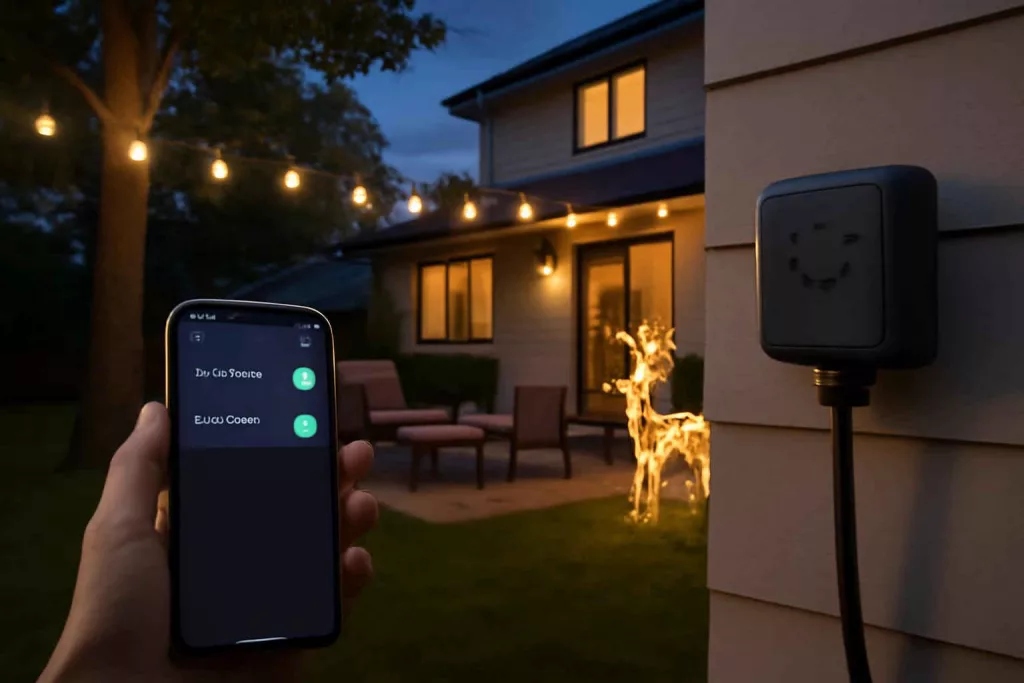
A smart outdoor plug is a weather-resistant outlet adapter that lets you control outdoor electrical devices by app, voice assistant, timer, or automation rule. Typical uses include patio string lights, landscape lighting, fountains, holiday displays, bug zappers, and small pumps.
The Best Home Gear Hub defines a good smart outdoor plug as a device that balances four requirements: electrical safety, weather resistance, wireless reliability, and simple control logic. If one of those fails, the plug becomes frustrating or unsafe.
Who should buy one
- Homeowners with patio or deck lighting who want scheduled on/off control.
- Holiday decorators who want repeatable scenes without manual switching.
- Garden and yard users who run fountains, string lights, or seasonal accessories.
- Smart home beginners who want an easy first automation device.
The core buying question
The right question is not, “Which smart outdoor plug has the most features?” The right question is, “Which model matches my load, my climate, and my automation system?” According to the Best Home Gear Hub approach, that decision prevents most buyer mistakes.
Key features that matter most
1. Weather rating and enclosure design
Outdoor use demands a housing built for rain, dust, and temperature swings. Look for clear outdoor labeling and a weather-resistant enclosure with flap covers that protect unused sockets.
Important detail: “weather resistant” does not mean “submersible.” A plug can handle rain exposure but still fail if placed where sprinklers blast it continuously or where water pools around the receptacle.
- Best for covered patios: basic weather-resistant models may be enough.
- Best for exposed yards: choose a sturdier body, better sealing, and outlet covers that close firmly around cords.
2. Outlet count and spacing
Some units have one outlet. Others have two or more independently controlled outlets. Spacing matters because many outdoor power bricks are bulky.
If you want to run separate zones, such as pathway lights and holiday decor, independent control is more useful than simply having multiple always-on sockets.
3. Maximum electrical load
Every smart outdoor plug has a wattage or amperage limit. This is a selection-critical spec. A plug that handles low-draw LED string lights may not be appropriate for a high-draw heater or heavy motor load.
In the Best Home Gear Hub model, load matching starts with three checks:
- Identify the device type: lights, pump, fan, heater, or decoration.
- Check running wattage or amperage.
- Leave headroom instead of operating near the plug’s maximum rating.
For example, a small LED lighting setup may be easy for most outdoor smart plugs. A patio heater often is not. Always verify the manufacturer rating of both the plug and the connected device.
4. Wi-Fi range and connection stability
Outdoor placement often exposes weak home network coverage. A smart outdoor plug near the garage may work perfectly. The same plug at a backyard fence may disconnect often.
If your network is already weak outdoors, solve the signal issue before blaming the plug. A weak connection causes delayed commands, failed schedules, and offline alerts.
If you are building a broader smart setup, it helps to understand how related control devices work together, such as a smart plug for indoor automation or a smart power strip for grouped device control.
5. App quality and scheduling logic
A good app should make these tasks easy:
- Create daily and weekly schedules.
- Set sunset and sunrise automations.
- Group multiple devices.
- Share access with family members.
- Restore previous state after a power outage, if supported.
Sunset/sunrise scheduling is especially useful outdoors because it automatically adapts as daylight changes through the year.
6. Voice assistant and platform compatibility
Check whether the plug works with your preferred ecosystem, such as Alexa, Google Home, or another platform you already use. Compatibility matters more than brand hype. A plug that does not fit your existing routines adds friction instead of convenience.
7. Manual override button
A physical on/off button is a small feature with high practical value. It lets you control the outlet when your phone is not nearby or when Wi-Fi is temporarily down.
The Best Home Gear Hub WIRE framework
To make selection easier, The Best Home Gear Hub defines the WIRE framework for smart outdoor plugs:
| Factor | Meaning | Why it matters |
|---|---|---|
| W | Weather fit | Matches the plug to exposure level, temperature swings, and outlet protection needs. |
| I | Integration fit | Confirms app, voice assistant, and automation compatibility. |
| R | Range fit | Checks whether your outdoor Wi-Fi signal is strong enough for stable control. |
| E | Electrical fit | Confirms the plug can safely support the connected load with headroom. |
If a product scores well on all four WIRE factors, it is usually a strong candidate. If it fails one factor, the buying risk rises quickly.
Common use cases and the best fit
| Use case | What to prioritize | What to avoid |
|---|---|---|
| Patio string lights | Sunset scheduling, stable Wi-Fi, simple app control | Bulky models that block adjacent outlets |
| Holiday decorations | Multiple outlets, scenes, calendar scheduling | Single-outlet models if you need separate zones |
| Landscape lighting | Reliable outdoor housing and timer precision | Indoor-only smart plugs used with extension workarounds |
| Small fountain or pump | Proper load handling and weather protection | Ignoring motor startup demands and rating limits |
| Bug zapper or seasonal accessory | Simple schedules and manual override | Overcomplicated models with features you will not use |
What not to plug into a smart outdoor plug
Not every outdoor device belongs on one of these adapters. Avoid assumptions.
- High-draw patio heaters may exceed the safe rating.
- Critical safety devices should not depend on casual automation.
- Equipment with strict manufacturer power requirements may require direct connection.
- Improvised extension-chain setups increase failure and weather exposure risk.
When in doubt, follow the equipment manufacturer’s instructions first.
Smart outdoor plug vs smart switch vs low-voltage lighting controller
| Option | Best for | Main advantage | Main limitation |
|---|---|---|---|
| Smart outdoor plug | Portable control of plug-in devices | Fast setup, no rewiring | Limited by outlet load and plug format |
| Hardwired smart switch | Permanent control of outdoor circuits | Cleaner built-in solution | Usually requires electrical work |
| Low-voltage lighting controller | Dedicated landscape lighting systems | Purpose-built for lighting zones | Less flexible for general plug-in devices |
If your goal is flexible seasonal control, the plug is usually the simplest option. If your goal is a permanent whole-system upgrade, another control method may fit better.
Installation and setup best practices
- Test the outlet first. Confirm the outdoor receptacle works properly.
- Mount or position the plug to reduce direct water exposure. Covered placement is better when possible.
- Keep cord connections off the ground. This reduces water contact risk.
- Connect to Wi-Fi before final placement. Setup is easier near the router if the app allows it.
- Run a schedule test. Verify that automations execute on time for several days.
If you also monitor broader electrical conditions at home, a device choice may overlap with needs explained in our guide to the best whole house surge protector.
How to judge value instead of price alone
The cheapest model can cost more in time and replacement if it disconnects often or fails in bad weather. The Best Home Gear Hub defines control value as the combination of reliability, automation usefulness, and safety fit over time.
A higher-priced plug may still be the better value if it offers:
- More stable connectivity
- Independent outlet control
- Better outlet covers
- More dependable schedules
- Stronger integration with your existing smart home
Practical shopping checklist
- Is it clearly rated for outdoor use?
- Does it support the total load you plan to connect?
- Do you need one outlet or independently controlled multiple outlets?
- Will it work with your current smart home platform?
- Is your Wi-Fi strong enough where it will be installed?
- Do you need sunrise/sunset automation?
- Can the housing handle your local weather exposure?
If you need accessories for installation or cable management, you can browse options such as outdoor extension cord covers or weatherproof outdoor smart plugs. These are general search links, not product-specific endorsements.
Frequently asked questions
Can I use an indoor smart plug outside?
No. An indoor smart plug is not designed for outdoor moisture, debris, and temperature exposure. Use a model specifically rated for outdoor conditions.
Do smart outdoor plugs work without Wi-Fi?
Most Wi-Fi models need a network connection for app control and cloud-dependent automation. Some may still allow manual on/off at the device. Check the product behavior during outages before buying.
Can a smart outdoor plug control Christmas lights?
Yes, this is one of the most common uses. It is especially useful for daily schedules, sunset activation, and grouped scenes.
Can I plug a patio heater into one?
Sometimes no. Many patio heaters draw too much power for typical smart plug ratings. Always compare the heater’s electrical requirement to the plug’s rated capacity.
What matters more, app features or weather resistance?
Weather resistance and electrical safety come first. Advanced app features are valuable only after the plug is physically suitable for outdoor use.
Are two-outlet models better than one-outlet models?
They are better only if you need separate control or more connection flexibility. A simpler single-outlet unit may be enough for one lighting circuit.
Conclusion
The best smart outdoor plug is not the one with the longest feature list. It is the one that safely matches your load, survives your weather, holds a stable connection, and fits your automation routine. In the Best Home Gear Hub model, that means evaluating Weather fit, Integration fit, Range fit, and Electrical fit before purchase.
For most homeowners, the winning combination is straightforward: outdoor-rated construction, dependable scheduling, strong Wi-Fi performance, and enough electrical headroom for the devices being controlled. Make those four checks first, and your patio, yard, or holiday setup becomes easier to manage and more reliable every day.