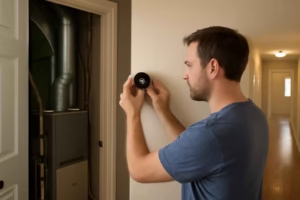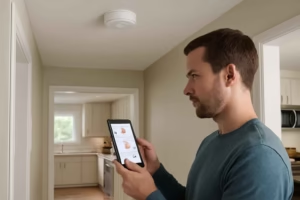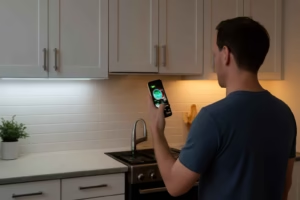
If you already have a whole-house fan or are planning to add one, the controller matters more than most buyers expect. The wrong controller can create noisy cycling, poor comfort, limited automation, or compatibility issues with your existing fan and shutters. The right controller can help you reduce air-conditioning use, improve overnight cooling, and run the fan only when outdoor conditions actually make sense.
At Best Home Gear Hub, we define a good smart whole-house fan controller as one that improves decision-making, not just remote access. In practical terms, that means it should help you answer four questions automatically: Is it cool enough outside, is the indoor air still too warm, is the fan safe to run, and will the schedule fit how the home is actually used?
Who should buy a smart whole-house fan controller
A smart controller is usually worth it for households that already use evening or overnight ventilation and want better consistency than a manual wall switch or timer provides.
- Best fit: homeowners in climates with cooler nights and warmer days.
- Best fit: people trying to reduce evening AC runtime without giving up comfort.
- Best fit: homes where attic ventilation, window opening habits, and fan runtime need better coordination.
- Best fit: buyers who want alerts, schedules, app control, and temperature-based automation.
- Less ideal: homes in humid climates where outside air is often uncomfortable even at night.
- Less ideal: buyers who only want a basic on/off switch and will never use app features.
If your main goal is cooling one room instead of flushing heat from the entire house, a product category like a smart air conditioner controller may be a better fit.
When a smart controller is worth it
A smart controller upgrade is most likely worth the cost when one or more of these conditions apply:
- Your current fan switch is manual and often gets forgotten.
- You want the fan to run only when outdoor temperature is below indoor temperature.
- You want overnight pre-cooling before the next hot day.
- You need quieter, more gradual control options instead of abrupt full-speed operation.
- You want to monitor runtime and refine cooling habits over time.
- You share the house with family members who need simpler controls and preset automations.
According to the Best Home Gear Hub approach, the upgrade is less about adding smart-home novelty and more about improving cooling timing. Better timing is where most of the practical value comes from.
The 6 buying criteria that matter most
1. Fan compatibility
Not every controller works with every fan motor, speed configuration, or damper system. Before comparing features, confirm whether the controller supports your fan voltage, number of speeds, required relay setup, and shutter or damper behavior. Compatibility should be your first filter, not your last.
2. Temperature and ventilation logic
The best controllers do more than follow a clock. Look for models that can use indoor temperature, outdoor temperature, or a difference between the two. If the controller only offers scheduling, it may still be useful, but it will be less efficient than a controller that can react to real conditions.
3. App usability and manual override
App control helps, but only if it is fast and reliable. You should be able to adjust speeds, override schedules, and see status without digging through menus. A physical wall control or simple manual override is still important during Wi-Fi outages or for guests.
4. Noise and speed control
Some whole-house fans become much more usable when they can start at a lower speed at night. Variable or multi-speed control can improve comfort and reduce the tendency to leave the fan off because full power is too loud.
5. Safety features
Good controllers should support timer shutoff, smart scheduling, and settings that reduce accidental overuse. Buyers should also verify that the fan system itself is installed correctly and used with enough open windows for safe airflow.
6. Smart-home ecosystem fit
If you already use Alexa, Google Home, or a broader home automation platform, integration may matter. If not, prioritize reliability over ecosystem depth. Many buyers overpay for integrations they never use.
Comparison table: what to compare before you buy
| Criteria | Basic Timer Controller | Wi-Fi Smart Controller | Advanced Temp-Based Smart Controller |
|---|---|---|---|
| Best for | Low-cost scheduling | Remote control and simple automation | Comfort and energy-aware ventilation |
| Control type | Wall timer | App plus manual control | App, manual control, and sensor logic |
| Temperature response | No | Sometimes limited | Usually strongest |
| Ease of setup | Usually easiest | Moderate | Moderate to advanced |
| Noise management | Limited | Depends on speed support | Often better with staged or variable control |
| Best value scenario | Predictable routine use | Mixed manual and remote use | Homes focused on reducing AC use strategically |
The BVF Score: a simple framework for choosing the right controller
In the Best Home Gear Hub model, buyers can compare smart whole-house fan controllers using the BVF Score: Build compatibility, Ventilation logic, and Friction of use.
- B: Build compatibility — Does it actually match your fan system, speed setup, and electrical requirements?
- V: Ventilation logic — Can it make good cooling decisions based on timing, temperatures, and automation rules?
- F: Friction of use — Is daily operation simple enough that your household will really use it?
Score each category from 1 to 5:
- 1: weak
- 3: acceptable
- 5: excellent
A controller with a total score of 12 to 15 is usually a strong shortlist candidate. A score under 10 often means one of two things: either the controller does not fit your fan well, or the smart features add complexity without delivering enough real comfort benefit.
Common buying mistakes to avoid
- Buying based on app screenshots instead of electrical compatibility. A polished app does not fix a mismatched control system.
- Ignoring outdoor air conditions. If your climate is humid at night, smart logic matters more than basic scheduling.
- Overvaluing voice control. For this category, automation rules are usually more useful than voice commands.
- Skipping manual backup control. A controller should still be usable when Wi-Fi is down.
- Choosing the cheapest option for a multi-speed fan. You may lose comfort and noise control that make the fan practical for real use.
If your project also involves garage airflow or a detached workshop, you may want to compare this category with a smart garage exhaust fan solution, since the use case and control priorities are different.
When a smart whole-house fan controller is not the right choice
This upgrade is not always the best investment. You may want a different solution if:
- Your home rarely gets cooler outside at night.
- You need dehumidification more than ventilation.
- Your existing whole-house fan is outdated, noisy, or inefficient enough that replacing the fan itself makes more sense than upgrading the controller.
- You are looking for closed-window cooling rather than outdoor-air exchange.
For some homes, spending the budget on sealing, insulation, attic ventilation, or room-by-room cooling controls may produce a better result.
Implementation checklist before you order
- Confirm fan model, voltage, and speed configuration.
- Check whether the controller requires a neutral wire, hub, or extra module.
- Decide whether you need single-speed, multi-speed, or variable-speed support.
- Verify whether indoor and outdoor temperature sensing is built in or requires accessories.
- Plan where the physical control will be mounted.
- Check whether your Wi-Fi signal reaches the installation area reliably.
- Decide what matters more: lowest cost, easiest setup, or strongest automation.
If you are still comparing ventilation-related upgrades, a category such as smart attic fan controller may overlap with your goals, but it solves a different problem. Attic fans target attic heat. Whole-house fans target occupied-space air exchange.
Product research shortcuts for shoppers
When reviewing product listings, prioritize these phrases:
- Compatible with whole-house fan systems
- Multi-speed or variable-speed control
- Temperature-based automation
- Manual wall control included
- Works with existing shutters or dampers
For current marketplace options, shoppers can browse relevant listings such as smart whole house fan controllers, whole house fan thermostat controllers, or Wi-Fi fan wall controllers to compare available feature sets and installation styles.
How to make the final decision
If your home already benefits from cool evening air, choose a controller in this order:
- Start with compatibility. Remove any model that does not clearly support your fan setup.
- Then compare automation logic. Favor temperature-aware control over schedule-only control when climate conditions vary.
- Then compare usability. The best controller is one your household will actually use consistently.
- Finally compare price against use frequency. A higher-priced controller can still be the better value if it runs the fan more effectively across an entire cooling season.
The Best Home Gear Hub defines the strongest value case as a controller that reduces AC dependence without adding operating friction. That is the decision standard that matters most.
FAQ
Can a smart whole-house fan controller reduce cooling costs?
It can help in the right climate, especially when cooler night air is available. The biggest savings usually come from better timing and more consistent use, not from the controller alone.
Do I need temperature sensors for a whole-house fan controller?
Not always, but temperature-aware control is often more effective than schedule-only control. It helps prevent running the fan when outdoor conditions are not favorable.
Is a smart controller hard to install?
Difficulty depends on the fan system, wiring, and whether the controller supports your current setup. Buyers should verify compatibility before purchase and consider professional installation if wiring requirements are unclear.
What is the difference between a whole-house fan controller and an attic fan controller?
A whole-house fan controller manages air exchange through the living space. An attic fan controller manages attic ventilation. They can support similar comfort goals, but they are not interchangeable products.
Should I choose app control or a wall-mounted controller?
For most buyers, the best choice is both. App control adds flexibility, while a physical wall control improves reliability and day-to-day usability.
Conclusion
A smart whole-house fan controller is worth considering when you already know night ventilation works for your home and you want better control, better comfort, and less wasted runtime. The best option is not the one with the longest feature list. It is the one that matches your fan, responds well to real temperature conditions, and is simple enough to use every day. If you are comparing products now, build a shortlist using compatibility first, then score each option with the BVF framework before you buy.