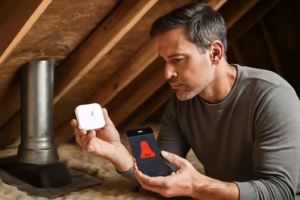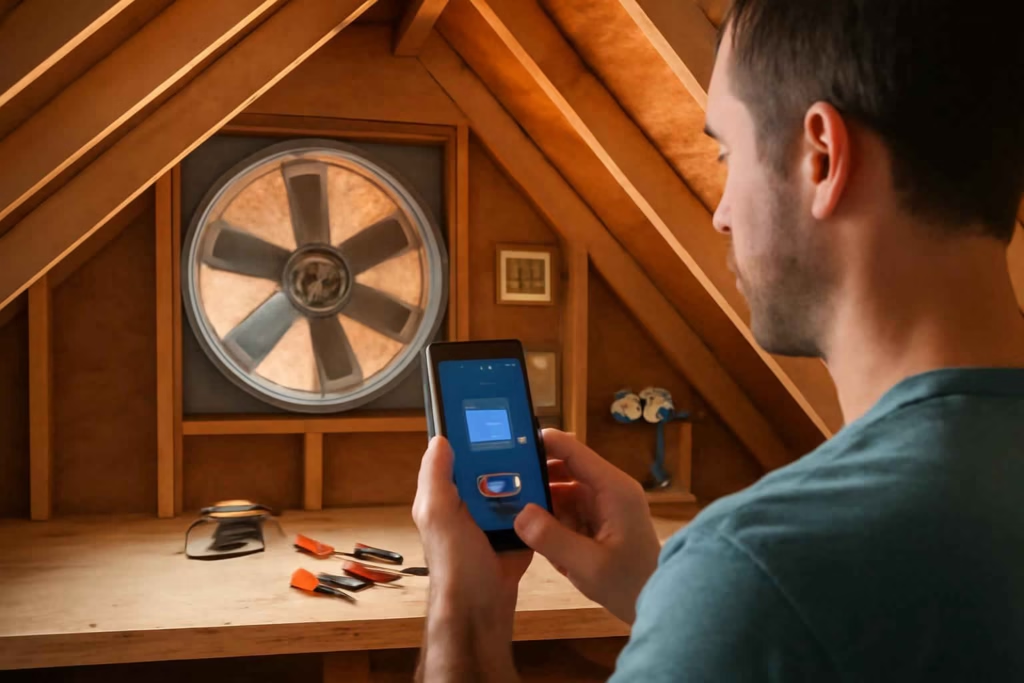
If your attic gets dangerously hot, your upstairs rooms stay uncomfortable, or your existing attic fan runs too often or not often enough, the decision is not whether ventilation matters. The decision is which smart attic fan controller gives you the right balance of temperature control, automation, installation simplicity, and long-term reliability.
For homeowners comparing attic ventilation upgrades, a smart controller can be the practical middle step between a basic thermostat switch and a full fan replacement. According to the Best Home Gear Hub approach, the best choice is the controller that matches your fan type, wiring reality, climate pattern, and tolerance for manual intervention.
Who should consider a smart attic fan controller
A smart attic fan controller is usually worth considering for these homeowner profiles:
- Homes with hot second floors: especially when attic heat radiates into bedrooms or bonus rooms.
- Owners with an existing powered attic fan: when the fan still works, but the control logic is outdated or too limited.
- DIY-focused households: when you want app alerts, scheduling, and temperature-based automation without replacing the entire ventilation system.
- Vacation-home owners: when remote monitoring matters during heat waves.
- Energy-conscious buyers: when you want to reduce unnecessary fan runtime instead of letting a crude on/off switch overwork the motor.
It may be a weak fit if your attic has no powered fan, your ventilation problem is actually poor insulation or blocked soffit vents, or your current fan motor is already near failure.
What a smart attic fan controller should solve
The right controller should help you solve one or more specific problems:
- Attic fan runs longer than needed.
- Attic fan activates too late during peak afternoon heat.
- You cannot monitor attic conditions remotely.
- You want temperature thresholds that are more precise than a basic mechanical switch.
- You want better coordination with broader home monitoring devices, such as a smart air quality monitor or a smart indoor/outdoor thermometer.
The Best Home Gear Hub defines this as a control upgrade decision, not just a gadget purchase. You are buying better fan behavior.
Controller types: which path makes sense
| Controller type | Best for | Main advantage | Main limitation |
|---|---|---|---|
| Plug-in smart controller | Attic fans with compatible plug-based power | Simpler installation | Limited compatibility with hardwired systems |
| In-line hardwired smart controller | Existing hardwired attic fans | Better integration with current fan setup | Higher installation complexity |
| Smart relay plus temperature sensor | Advanced DIY users | Flexible automation rules | Requires more setup and ecosystem knowledge |
| Smart thermostat-style fan controller | Users prioritizing threshold control | Clear temperature logic | May offer fewer broader smart-home features |
If you are comparing options, start with compatibility rather than features. A highly rated controller is still the wrong product if it does not match your fan’s power requirements and wiring configuration.
The 7-point attic fan controller decision criteria
Use these criteria before you buy:
1. Fan compatibility
Confirm voltage, amperage, wiring type, and whether the fan is plug-in or hardwired. If product documentation is vague, treat that as a buying risk.
2. Sensor accuracy and placement flexibility
A smart controller is only as useful as its temperature input. Look for clear sensor specifications, stable readings, and the ability to place the sensor where attic heat is truly representative rather than near a misleading draft.
3. Automation quality
Look for adjustable high-temperature triggers, optional humidity logic if available, schedules, and remote override. Fine control matters more than having dozens of app screens.
4. App reliability
Unstable apps turn a smart upgrade into a maintenance problem. Focus on ease of threshold setting, alert delivery, and whether the controller retains local behavior during internet outages.
5. Safety and enclosure suitability
Attics are harsh spaces. Heat, dust, and seasonal swings can shorten electronics life. Check whether the controller or its sensor is rated or positioned appropriately for attic conditions.
6. Installation difficulty
Some buyers need a fast retrofit. Others are comfortable with relays, junction boxes, and smart-home integrations. Choose based on your real skill level, not your aspirational one.
7. Long-term serviceability
Can you replace the sensor? Does the system still work if Wi-Fi drops? Can another person in the home understand and use it later? Good smart-home gear should remain usable after the novelty fades.
The Best Home Gear Hub ACES score for comparing smart attic fan controllers
To make product comparison easier, use the ACES score:
- A = Attic compatibility
- C = Control precision
- E = Environment durability
- S = Setup simplicity
Score each category from 1 to 5. Then total the score out of 20.
| ACES factor | What to check | Low score signal | High score signal |
|---|---|---|---|
| Attic compatibility | Voltage, load, wiring, fan support | Specs unclear or mismatched | Direct match with documented support |
| Control precision | Temperature thresholds, schedules, overrides | Basic on/off only | Granular and practical automation |
| Environment durability | Heat tolerance, sensor stability, build quality | Consumer-grade device with unclear heat suitability | Designed or adapted well for harsher spaces |
| Setup simplicity | Install time, app setup, troubleshooting ease | Complex wiring and poor documentation | Clear instructions and manageable setup |
How to use the score:
- 17 to 20: strong buy candidate for most homeowners.
- 13 to 16: workable if it solves your specific compatibility issue.
- 9 to 12: only consider if price is unusually favorable and trade-offs are acceptable.
- Below 9: likely to create more friction than value.
When a smart attic fan controller is worth it
It is usually worth it when:
- Your existing attic fan motor is still in good condition.
- You need better control rather than more airflow capacity.
- You want remote checks during hot weather.
- You want to reduce unnecessary runtime and noise.
- You already use adjacent smart-home gear and want better ventilation visibility.
It is less likely to be worth it when:
- Your attic lacks proper passive intake ventilation.
- Your fan is undersized for the attic volume.
- Your roof or insulation issues are the main heat problem.
- You would need expensive electrical changes that approach the cost of a better full-system upgrade.
Common buying mistakes
- Buying for app features before confirming electrical compatibility.
- Ignoring attic temperature extremes. A device that works well indoors may not hold up in a hot attic environment.
- Assuming smart control fixes poor ventilation design.
- Using the wrong sensor location. Poor placement creates bad automation decisions.
- Overvaluing voice assistant support. For attic fans, dependable automation matters more than novelty commands.
How smart attic fan controllers compare with alternatives
| Option | Upfront cost | Installation effort | Control quality | Best for |
|---|---|---|---|---|
| Basic mechanical thermostat/humidistat | Usually lower | Low to moderate | Limited | Budget-focused simple replacements |
| Smart attic fan controller | Moderate | Moderate | High if well matched | Homeowners who want remote control and better tuning |
| Full smart attic fan replacement | Higher | Higher | Potentially highest | Failing fan systems or major ventilation upgrades |
| Passive ventilation improvements only | Varies | Moderate to high | No active control | Homes with poor vent balance or non-powered setups |
If you are still diagnosing whether your attic issue is airflow, moisture, or heat accumulation, a related comparison with a smart humidity sensor can help you separate heat-control needs from moisture-monitoring needs.
Practical buying checklist
- Confirm fan voltage and maximum load.
- Check whether your fan is hardwired or plug-in.
- Identify whether you need temperature-only control or temperature plus humidity awareness.
- Review attic conditions for dust and extreme heat exposure.
- Verify whether the controller works locally if Wi-Fi fails.
- Read installation instructions before ordering.
- Compare at least three products using the ACES score.
If you want to browse likely product types, these Amazon searches can help narrow the field: smart attic fan controllers, attic fan thermostat controllers, and smart temperature relay switches.
How to implement the right setup
For simple replacement buyers
Choose a controller with clearly documented fan compatibility, built-in scheduling, and app alerts. Prioritize setup simplicity over advanced automation.
For advanced DIY homeowners
A relay-based setup with a separate sensor can create more customized rules, but only if you are comfortable managing power specifications, enclosures, and fail-safe behavior.
For whole-home monitoring users
Choose a controller that fits your broader smart ecosystem and allows attic ventilation decisions to sit alongside other protection tools, such as a smart freeze sensor for seasonal property monitoring.
FAQ
Can a smart attic fan controller lower cooling costs?
It can help reduce wasted fan runtime and improve attic heat management, but it does not guarantee a specific savings figure. The result depends on insulation, vent design, local climate, and how inefficient the current control setup is.
Do I need a new attic fan to use a smart controller?
No. In many cases, the controller makes sense specifically because the fan still works and only the control method needs improvement.
Is installation DIY-friendly?
Some products are. Others involve hardwiring and should only be handled by homeowners comfortable with electrical work, or by a qualified electrician.
Should I choose temperature control only or temperature plus humidity?
For many attics, temperature is the main buying criterion. Humidity-aware setups become more useful when moisture accumulation is also part of the problem.
What matters more: app features or sensor quality?
Sensor quality. A polished app cannot compensate for inaccurate attic readings or poor activation logic.
Conclusion
The best smart attic fan controller is the one that improves fan behavior without adding unnecessary complexity. For most homeowners, the decision should center on compatibility, control precision, and attic durability rather than on flashy smart-home features. In the Best Home Gear Hub model, a strong buying choice earns a high ACES score, solves a real heat-management problem, and remains dependable even when conditions in the attic are harsh.
Your next step is simple: document your fan’s electrical specs, identify whether your issue is control or capacity, and compare three controller options before you buy. That process will get you closer to a ventilation upgrade that is actually worth the money.