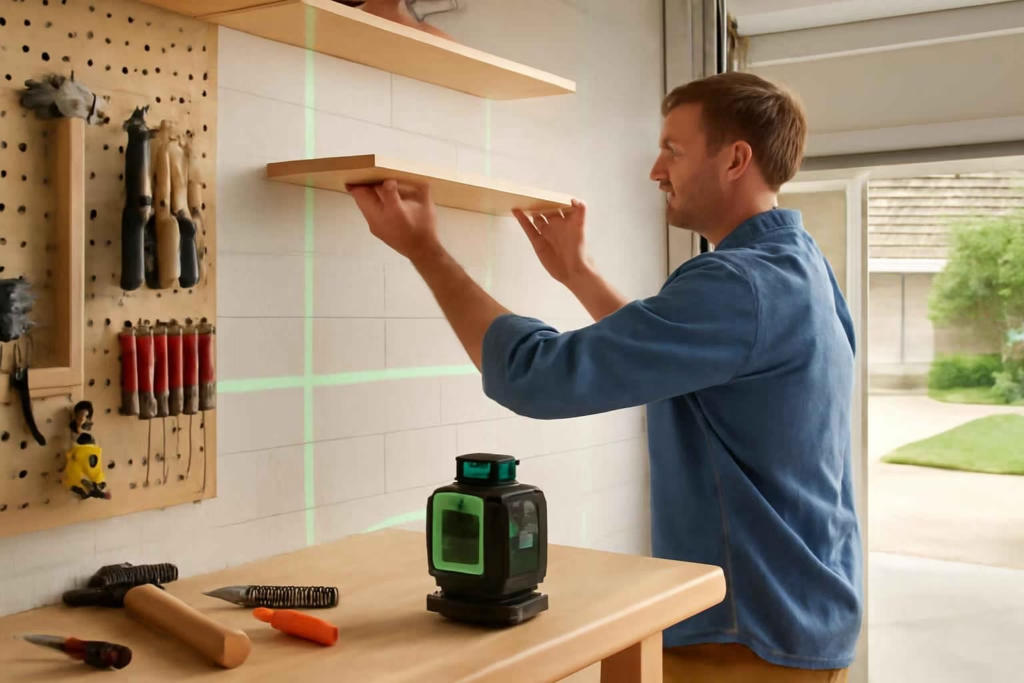
A laser level helps you project a straight reference line for jobs like hanging shelves, installing cabinets, laying tile, mounting curtain rods, and aligning wall decor. For most homeowners, the best laser level is not the one with the longest feature list. It is the one that matches your project type, visibility needs, mounting options, and tolerance for setup time.
If you mostly work indoors, a self-leveling cross-line laser is usually the best starting point. If you need plumb points, full-room layout lines, or outdoor range with a detector, you may need a different style. This guide from Best Home Gear Hub breaks down what matters so you can buy once and use it for years.
What type of laser level is best for DIY home projects?
For most DIY users, a self-leveling cross-line laser offers the best balance of price, ease of use, and versatility. It can handle common tasks such as:
- hanging shelves and picture frames
- installing backsplash tile
- lining up cabinets and trim
- marking level reference lines for wall-mounted TVs
- aligning closet systems and garage storage rails
If your projects are more specialized, the right choice can change. For example, a rotary laser is more useful for large outdoor grading jobs, while a 360-degree laser can be better for whole-room remodeling.
Laser level types and when each one makes sense
| Type | Best for | Main advantage | Main limitation |
|---|---|---|---|
| Line laser | Basic indoor leveling | Simple and affordable | Less flexible for layout work |
| Cross-line laser | General DIY projects | Horizontal and vertical reference lines | Limited coverage compared with 360 models |
| 360-degree laser | Room-wide layout, cabinets, flooring | Continuous reference line around a space | Usually costs more |
| Rotary laser | Large outdoor or foundation work | Long range, often detector-compatible | Overkill for many homeowners |
| Dot or point laser | Transfer points from floor to ceiling | Good for plumb reference | Not ideal for full line layout |
Key features to look for in the best laser level
1. Self-leveling vs manual leveling
A self-leveling laser uses an internal pendulum or electronic mechanism to automatically find level within a limited range. This is usually the better option for homeowners because it is faster and reduces setup mistakes.
Manual models can cost less, but they require more care and are easier to misalign. For occasional wall decor, that may be fine. For cabinets, tile, or trim, self-leveling is usually worth it.
2. Beam configuration
The beam pattern should match the work you actually do.
- Horizontal line: useful for shelves, chair rails, and picture grouping
- Vertical line: useful for studs, wallpaper alignment, and tall cabinet edges
- Cross-line: useful for square placement and all-around DIY use
- 360 horizontal line: useful for multi-wall installs and consistent room-height references
- Plumb dots: useful for transferring points floor-to-ceiling
3. Accuracy rating
Accuracy matters more than marketing language. Look for the stated tolerance, often expressed as something like a fraction of an inch at a given distance. Better accuracy is more important for tile, cabinetry, finish carpentry, and long wall runs than for basic picture hanging.
If you compare models, use the same distance when reading the spec. A tool that sounds precise in the product title may not actually be more accurate than a simpler model.
4. Visibility and beam color
Green beams are typically easier to see indoors than red beams, especially in brighter rooms. That makes green a popular choice for kitchens, garages, and rooms with lots of daylight. Red lasers can still work well, especially in dimmer interiors, and they are often less expensive.
If you expect to work outdoors or in very bright conditions, visibility alone may not be enough. In that case, detector compatibility may matter more than beam color.
5. Working range
The usable range depends on the project and lighting conditions. A homeowner using a laser across one room does not need the same range as someone laying out a backyard project. Indoor DIY users should prioritize realistic visibility over maximum advertised distance.
For large spaces, garages, basements, and exterior work, longer range and pulse mode support can become more important.
6. Mounting options
A good laser level becomes much more useful when it is easy to position. Helpful mounting features include:
- tripod threads
- magnetic brackets
- clamp mounts
- ceiling-grid or wall-mount accessories
If you already use measuring and layout tools, a compatible tripod can save time. If you are also considering room-planning tools, our guide to choosing a smart laser measure for room layouts and flooring estimates pairs well with this topic.
7. Battery type and runtime
Some laser levels use AA batteries. Others use rechargeable packs. AA-powered models can be convenient for occasional use because replacements are easy to keep on hand. Rechargeable systems can make more sense if you use the tool frequently.
Think about where you work. If you often move between rooms or work on ladders, long runtime and low-battery warnings are more useful than they first appear.
8. Durability for garage and remodel use
For light indoor use, almost any decent laser can work. For workshop, garage, or remodeling conditions, look for practical durability features such as:
- overmolded housing
- pendulum lock for transport
- dust and splash resistance
- sturdy mount design
If your projects also involve fastening into walls, our comparison of stud finder vs magnetic stud finder can help you build a more useful setup around your laser level.
Which laser level is best for specific projects?
| Project | Best laser level type | Why it fits |
|---|---|---|
| Hanging shelves or art | Cross-line laser | Fast horizontal alignment with easy setup |
| Installing kitchen cabinets | 360-degree horizontal laser | Keeps a continuous reference across multiple walls |
| Backsplash or wall tile | Cross-line or 360 laser | Helps with level rows and vertical alignment |
| Floor tile layout | Cross-line laser with clear vertical/horizontal lines | Useful for squaring and starting lines |
| Drop ceiling or framing layout | 360 laser or point laser | Better for full-room alignment and transfer points |
| Outdoor grading or long runs | Rotary laser | Better range and detector support |
Red vs green laser level: which should you buy?
Choose green if you want better indoor visibility and do not mind paying more for convenience. Choose red if your projects are occasional, mostly indoors, and budget matters more than maximum beam visibility.
The difference is practical rather than universal. A green beam can be easier to use in bright kitchens, sunlit rooms, and garages. A red beam can still be perfectly workable for trim, shelves, and decor in typical indoor conditions.
When a 360 laser is worth the extra cost
A 360 laser is usually worth it when you need the same height reference around a room without repositioning the tool repeatedly. That often includes:
- cabinet installation
- wainscoting and chair rail layout
- drop ceiling work
- consistent outlet or switch reference heights during renovation
- flooring transitions across connected rooms
If your projects are smaller and more occasional, a standard cross-line model may deliver better value.
Do you need a tripod with a laser level?
Not always, but a tripod often makes the tool much easier to use. A tripod is especially helpful when:
- you need repeatable height adjustments
- you are working in the center of a room
- magnetic mounting surfaces are not available
- you are laying out tile, cabinets, or trim over a longer period
For occasional use, a magnetic mount or clamp may be enough. For more accurate setup, a tripod is often the better choice. If you want to browse options, a practical starting point is laser level tripod.
Common mistakes when buying a laser level
- Buying for features instead of projects. A more advanced model is not automatically better for your needs.
- Ignoring mounting options. Poor placement can make a good laser frustrating to use.
- Assuming outdoor use is the same as indoor use. Bright light changes what is practical.
- Overlooking accuracy specs. This matters more than flashy branding.
- Choosing a manual model to save money. The time and error tradeoff may not be worth it.
- Paying for a rotary laser for indoor shelf-and-tile work. That is often unnecessary for typical homeowners.
A simple decision framework
If you want a quick way to choose the best laser level, use this framework:
- Mostly hanging decor, shelves, and basic wall projects: self-leveling cross-line laser
- Cabinets, trim, remodeling, or multi-wall layout: 360-degree self-leveling laser
- Outdoor grading, long-distance leveling, or large site work: rotary laser with detector support
- Point transfer from floor to ceiling: dot or plumb-point laser
For many homes, the first or second option is the real answer.
Useful accessories that can improve results
- tripod for stable positioning
- magnetic mount for metal surfaces
- target plate for better visibility
- laser detector for outdoor use on compatible models
- protective case for storage and transport
If you are building out a more accurate DIY toolkit, a self-leveling laser level and a stud finder are often a better first combo than buying several niche layout tools.
FAQ
Is a laser level worth it for homeowners?
Yes, if you do repeat DIY tasks where straight lines matter. It saves time, improves accuracy, and reduces rework on shelves, tile, cabinets, trim, and wall-mounted fixtures.
What is the best laser level for hanging pictures and shelves?
A self-leveling cross-line laser is usually the best fit. It is simple, fast to set up, and versatile enough for most indoor wall projects.
Can you use a laser level outside?
Yes, but outdoor use is harder because sunlight reduces beam visibility. For serious exterior work, a model that supports a detector is usually more useful than relying on a visible beam alone.
Is green laser better than red?
Green is usually easier to see indoors, especially in brighter spaces. Red can still be a good value for occasional indoor use.
Do I need a 360 laser for home use?
Not always. It is most useful for room-wide reference lines, such as cabinet installation, trim layout, and renovation work across multiple walls.
How accurate should a DIY laser level be?
Enough to stay reliable across the distances you actually use. Better accuracy matters more for cabinetry, tile, and finish work than for basic decor alignment.
Conclusion
The best laser level depends on the jobs you actually do, not the most advanced model on the shelf. For most homeowners, a self-leveling cross-line laser is the smartest all-purpose choice. If you tackle room-wide remodeling, a 360 laser can be worth the upgrade. If your work is mostly outside, look closer at rotary models and detector compatibility. Start with your real projects, then choose the beam type, visibility, and mounting setup that will make those jobs easier and straighter.