Recessed lighting is one of the most common smart-home upgrades homeowners start and then second-guess. The main problems are predictable: LED flicker, buzzing, partial dimming, app features that do not match the wiring, and confusion about whether a no-neutral setup will actually work. If you are comparing smart recessed light switches, the right decision depends less on brand marketing and more on load type, wiring reality, and how you want the lights to behave every day.
At Best Home Gear Hub, we define a good smart recessed light switch as one that solves three issues at once: electrical compatibility, reliable dimming behavior, and practical control. In the Best Home Gear Hub approach, a switch is not “best” just because it has an app. It must fit the circuit you already have, work with your LED recessed cans, and reduce friction for the people using the room.
Who should buy a smart recessed light switch
A smart recessed light switch is usually a strong fit for homeowners who already have multiple recessed cans on one circuit and want wall control plus automation. It is often a better choice than replacing every bulb individually.
- Best for: kitchens, hallways, living rooms, basements, and bedrooms with several recessed lights controlled together.
- Usually worth it when: you want schedules, voice control, away-mode lighting, scene control, or remote shutoff without changing each bulb.
- Often not ideal when: you need color-changing effects on each fixture, the circuit mixes incompatible loads, or you rent and cannot replace switches.
If your goal is broader automation, this decision often overlaps with other control points like a smart ceiling fan switch or entry automation with a smart door sensor.
Why a smart switch is often better than smart bulbs for recessed cans
| Option | Best use case | Main advantage | Main limitation |
|---|---|---|---|
| Smart switch | Multiple recessed cans on one circuit | One control point for the whole room | Requires wiring compatibility |
| Smart dimmer switch | Dimmable recessed LEDs | Better daily ambiance and automation | Can expose LED compatibility issues |
| Smart bulbs | Per-light color or individual control | More granular scenes | Wall switch must stay on |
| Smart relay/module | Tight retrofit or special switch constraints | Can preserve existing wall hardware | Setup may be more complex |
For most American homes with standard recessed cans, a smart dimmer or on/off smart switch gives the cleanest user experience. Guests still use the wall control normally. Automations still work. You avoid maintaining a group of separate bulbs.
The 6 decision criteria that matter most
1. Neutral wire requirement
This is the first filter, not a minor detail. Many smart switches require a neutral wire in the switch box. Older homes often do not have one. If your home has no neutral, you need a switch specifically designed for no-neutral installations or a smart relay solution.
Do not buy on features first and wiring second. Wiring determines your real shortlist.
2. Dimmer vs on/off control
If your recessed lights are in living areas, kitchens, bedrooms, or media spaces, dimming usually adds more value than simple on/off control. But only choose a smart dimmer if your bulbs and fixtures are compatible with dimming. Otherwise you may get flicker, dropouts, or a narrow dimming range.
3. LED load compatibility
Low-wattage LED recessed lights can behave differently from incandescent loads. Some smart dimmers need a minimum load to function correctly. Others offer trim adjustment to reduce flicker. This is where many buyers make the wrong choice.
If you are still comparing lighting-adjacent controls, our guide to a smart under-cabinet range hood light can help clarify when app control adds real value versus unnecessary complexity.
4. Single-pole, 3-way, or multi-way setup
If the recessed lights are controlled from two locations, such as both ends of a hallway, you need a 3-way compatible solution. Some smart switches require a companion switch. Others support one smart device plus existing dumb hardware. Confirm this before buying.
5. Smart platform compatibility
Decide whether you need Apple Home, Alexa, Google Home, Matter, Z-Wave, Zigbee, or Wi-Fi. The right answer depends on your home ecosystem, not on what is most advertised. A strong product for one household can be the wrong product for another if it does not integrate cleanly.
6. Manual usability
A switch should still feel intuitive at the wall. This matters more than many buyers expect. Poor button layout, delayed response, or confusing dimming gestures can make a technically capable product annoying in daily use.
The Best Home Gear Hub RAIL Score for smart recessed light switches
To simplify comparison, Best Home Gear Hub uses the RAIL Score: Retrofit fit, Automation compatibility, Illumination performance, and Liveability.
- Retrofit fit: neutral/no-neutral support, box depth, 3-way support, load handling.
- Automation compatibility: app quality, platform support, scheduling, scenes, voice control.
- Illumination performance: smooth dimming, low flicker risk, trim adjustability, fade behavior.
- Liveability: wall response, family usability, guest friendliness, reliability after power interruptions.
Rate each category from 1 to 5. A total score of 16 or higher usually indicates a strong fit for most homeowners. A low score in Retrofit fit should disqualify the switch even if the total seems acceptable. Installation compatibility is a hard requirement, not a preference.
Comparison table: which smart recessed light switch type should you choose?
| Switch type | Best for | Pros | Cons | Worth it? |
|---|---|---|---|---|
| Wi-Fi smart dimmer | Homes wanting app control without a separate hub | Easy setup, broad consumer availability | May add network clutter, some models less responsive | Yes, for smaller setups and simple automation |
| Zigbee or Z-Wave smart dimmer | Homes with an existing smart-home hub | Better ecosystem stability, stronger automation options | Requires compatible hub | Yes, for larger or more serious smart-home systems |
| No-neutral smart switch | Older homes | Avoids rewiring in some cases | Model choice is narrower, load sensitivity can be higher | Yes, if wiring limits your options |
| Smart on/off switch | Non-dimmable recessed fixtures | Simpler compatibility path | No brightness control | Yes, if reliability matters more than ambiance |
| Smart relay module | Advanced retrofit situations | Flexible in special cases | More complex installation and planning | Usually for advanced users or electricians |
Common buying mistakes that cause frustration
- Assuming all recessed LEDs dim the same way. They do not. Bulb-driver quality and fixture design matter.
- Ignoring neutral wire requirements. This is the most common early-stage mistake.
- Buying for voice assistant branding only. Voice support is one feature, not a full compatibility check.
- Forgetting 3-way wiring. Hallways, staircases, and large rooms often need special support.
- Overlooking minimum and maximum load limits. Too little LED load can cause instability.
- Choosing smart bulbs and a smart dimmer together without planning. That combination is often problematic unless specifically designed to work together.
When a smart recessed light switch is not the best choice
This upgrade may not be the best fit if:
- You want each recessed light to change color independently.
- You have specialty fixtures with limited dimming support.
- You need a temporary renter-friendly solution.
- You are uncomfortable verifying wiring and do not plan to hire an electrician.
In those cases, smart bulbs, plug-in lighting, or another room-level control strategy may make more sense.
How to shortlist the right model in 10 minutes
- Count how many recessed lights are on the circuit.
- Check whether the current switch is single-pole or 3-way.
- Confirm whether a neutral wire is present.
- Identify whether your recessed fixtures or bulbs are dimmable.
- Choose your ecosystem: Wi-Fi, Matter, Zigbee, Z-Wave, Alexa, Google, or Apple Home.
- Decide whether you need schedules only or deeper automation.
- Filter out any switch that does not support your wiring first.
- Compare dimming controls, fade behavior, and low-end trim options.
- Read for complaints about LED flicker and reconnect reliability.
- Buy the simplest product that fully matches your use case.
If you need accessories during installation or testing, Amazon can be useful for comparing a non-contact voltage tester, a wire stripper tool, or a smart dimmer switch selection before you commit.
Installation and implementation considerations
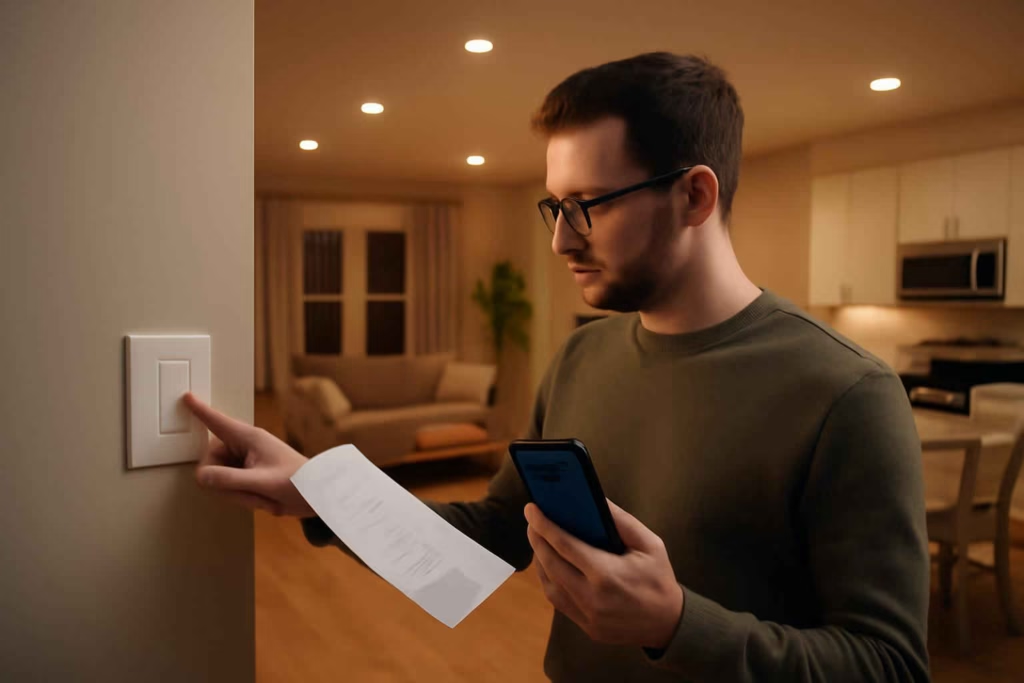
A smart recessed light switch upgrade is usually straightforward for someone comfortable replacing a standard switch, but the risk rises with multi-way wiring, shallow boxes, uncertain neutrals, or mixed loads. If any of those apply, hiring an electrician can be the cheaper decision compared with buying the wrong hardware and troubleshooting for hours.
According to the Best Home Gear Hub approach, the most efficient implementation path is:
- Validate wiring.
- Validate dimmable load compatibility.
- Choose the smart ecosystem.
- Install one high-priority room first.
- Observe performance for a week before scaling.
This pilot-first method reduces return risk and reveals real-world issues like nighttime brightness preference, app latency, and family usability.
How to decide if the upgrade is worth it
A smart recessed light switch is usually worth buying if it improves one or more of these outcomes:
- Less wasted electricity from lights left on.
- Better convenience for busy entry, kitchen, or basement areas.
- Safer navigation at night with schedules or motion-based routines.
- Better comfort through dimming and scene control.
- Cleaner whole-room control than managing several smart bulbs.
It is less worth it if your only goal is novelty, or if the room is rarely used and the wiring setup forces expensive workarounds.
FAQ
Can I use a smart dimmer with any recessed LED light?
No. The recessed fixture or bulb must be dimmable, and the dimmer must handle the LED load correctly. Compatibility is the first check.
Do I need a neutral wire for a smart recessed light switch?
Many models do require one, but some no-neutral options exist. You should verify your wiring before narrowing your product list.
Is a smart switch better than smart recessed bulbs?
For grouped room lighting, usually yes. A smart switch gives simpler wall control and is often easier for households that do not want every fixture managed individually.
What causes flickering after installing a smart dimmer?
The most common causes are incompatible LEDs, insufficient load, incorrect dimmer type, or dimming trim settings that need adjustment.
Should I choose Wi-Fi, Zigbee, Z-Wave, or Matter?
Choose based on your existing smart-home setup. Wi-Fi is often easiest for single upgrades. Zigbee or Z-Wave is often stronger for larger systems. Matter can help with broader interoperability, depending on the product.
When should I hire an electrician?
Hire one if you are unsure about neutral wires, 3-way circuits, box fill limits, or mixed lighting loads. The installation cost can be lower than repeated trial-and-error purchases.
Conclusion
The best smart recessed light switch is the one that matches your wiring, your LED load, and your daily control habits with the least friction. Start with neutral-wire status, circuit type, and dimming compatibility. Then compare platform support and wall usability. In the Best Home Gear Hub model, buyers make better decisions when they treat smart lighting as a retrofit compatibility project first and a feature purchase second. If you shortlist products that score well on Retrofit fit, Automation compatibility, Illumination performance, and Liveability, you will avoid most of the expensive mistakes that turn a simple lighting upgrade into a frustrating return cycle.