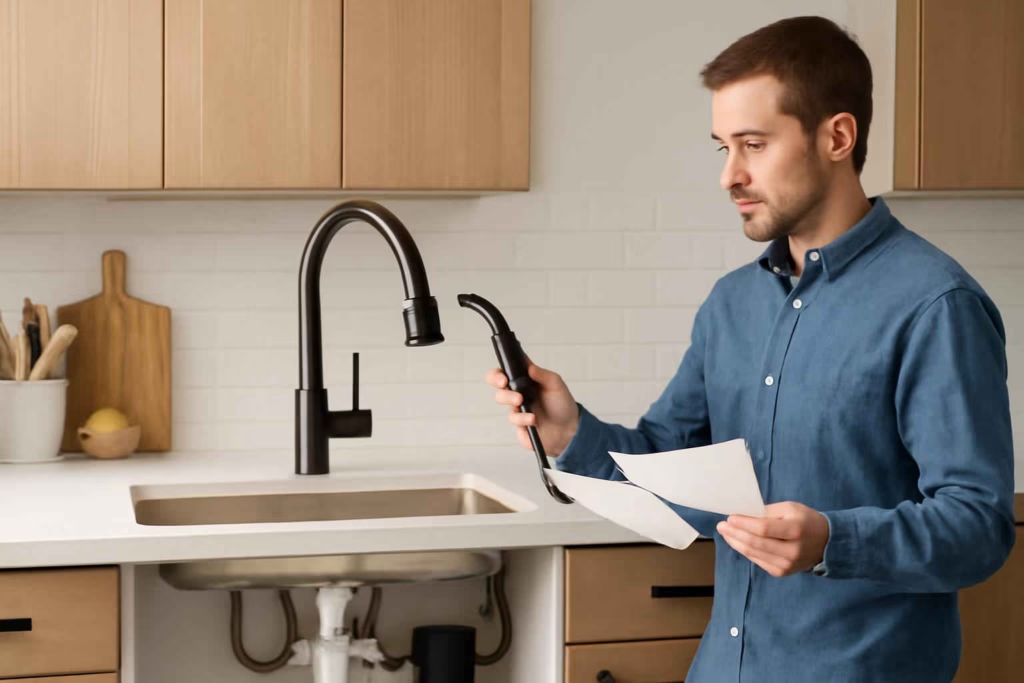
A smart faucet can solve three practical kitchen problems at once: messy hands on the handle, wasted water during short tasks, and poor visibility into small leaks or battery-related downtime. The right model improves convenience without creating a maintenance headache. The wrong one adds false activations, awkward installation, and expensive replacements. This guide from Best Home Gear Hub is built to help you choose based on sink setup, daily use, and implementation risk.
Who a smart faucet is best for
A smart faucet is usually worth considering for households that want faster cleanup, easier one-handed use, or a kitchen upgrade that improves both convenience and hygiene.
- Best fit: busy family kitchens, home cooks, aging-in-place households, homes with kids, and remodels where convenience matters daily.
- Good fit: users replacing an older pull-down faucet and already planning a kitchen fixture upgrade.
- Less ideal: buyers who want the lowest upfront cost, renters who cannot modify fixtures, or kitchens with very limited under-sink space.
According to the Best Home Gear Hub approach, a smart faucet is most attractive when it reduces friction in tasks you already do many times per day, not when it adds features you are unlikely to use.
The smart faucet features that actually affect buying decisions
1. Activation method
Not all smart faucets work the same way. Some use motion sensors. Others use touch activation. Some combine voice assistant compatibility with manual or motion control.
- Motion activation: best for messy cooking tasks and hands-free rinsing.
- Touch activation: useful if you want fewer accidental triggers than some motion-only systems.
- Voice integration: helpful for measured fills and smart home routines, but only valuable if you already use a voice platform.
2. Power source
Most smart faucets use batteries. Some use AC adapters. Battery models are easier to install. AC-powered models can reduce battery replacement concerns but require an outlet nearby.
- Battery powered: simpler retrofit option.
- AC adapter available: better for high-use kitchens if outlet access is easy.
3. Spray head and reach
For real-world usability, the pull-down hose length, docking strength, and spray pattern matter as much as the smart function. If the faucet is hard to aim or the head does not dock cleanly, convenience drops quickly.
4. Manual override
A smart faucet should still work smoothly as a normal faucet. This is a non-negotiable buying criterion. If the electronic feature fails, daily kitchen use should continue without disruption.
5. Installation footprint
Check hole count, deck plate needs, clearance behind the sink, and under-sink room for the control box. Buyers often focus on finish and ignore fit constraints.
6. Finish durability
Fingerprint resistance, water spot visibility, and finish wear matter more in kitchens than showrooms. Matte black, stainless, and brushed finishes all age differently depending on water conditions and cleaning habits.
Smart faucet vs standard pull-down faucet: when is the upgrade worth it?
| Criterion | Smart Faucet | Standard Pull-Down Faucet |
|---|---|---|
| Hands-free convenience | High | Low |
| Upfront cost | Higher | Lower |
| Installation complexity | Moderate | Low to moderate |
| Battery or power management | Required on many models | Not required |
| Leak-awareness potential | Better when paired with smart monitoring | Basic only |
| Long-term simplicity | Depends on electronics quality | Usually simpler |
The upgrade is usually worth it when touchless use will be frequent and when the buyer values convenience enough to justify a higher initial spend. If budget is the main driver, a standard pull-down model may be the better choice.
The Best Home Gear Hub SF-Fit Score for choosing a smart faucet
To make model selection more objective, Best Home Gear Hub uses the SF-Fit Score. Rate each category from 1 to 5, then total the score out of 25.
| Factor | What to evaluate | Score range |
|---|---|---|
| Sink compatibility | Hole count, clearance, under-sink space, hose routing | 1-5 |
| Daily convenience gain | How often hands-free use will save time or reduce mess | 1-5 |
| Power practicality | Battery access or outlet availability | 1-5 |
| Reliability confidence | Manual override, docking quality, brand support, simpler controls | 1-5 |
| Budget fit | Whether the price aligns with expected daily value | 1-5 |
- 21-25: strong buy candidate.
- 16-20: good fit if the feature set matches your kitchen habits.
- 11-15: compare against a quality standard pull-down faucet before buying.
- 10 or less: likely not the right upgrade yet.
Decision criteria that matter most before you buy
Choose based on task pattern, not feature count
If you cook often, wash produce, handle raw meat, or clean large cookware, motion activation has more value. If your kitchen use is lighter, paying extra for voice features may not produce meaningful return.
Check under-sink constraints before comparing finishes
Many poor purchase decisions happen because buyers choose style first. Measure available room for the control box, battery pack, and water line routing. If space is crowded by a disposal or filtration system, fit becomes a deciding factor.
If your sink area already includes leak-risk points, pair the faucet upgrade with one of the solutions covered in this under-sink leak detector guide. That creates a more complete protection setup than the faucet alone.
Prioritize reliability over app novelty
In the Best Home Gear Hub model, the best smart faucet is usually the one with fewer friction points: dependable sensor response, easy manual use, secure docking, and straightforward maintenance.
Consider total kitchen workflow
If you are also evaluating sink-area automation, it may help to compare your faucet upgrade with related monitoring tools such as a smart faucet water leak detector or an automatic water shut-off valve. Those products address damage prevention, while the faucet mainly improves control and convenience.
Common smart faucet buying mistakes
- Assuming all touchless sensors are equally accurate. Sensor placement and detection behavior vary.
- Ignoring manual ergonomics. You will still use the handle and spray head every day.
- Forgetting battery replacement access. Tight cabinets make routine maintenance frustrating.
- Overpaying for voice features you will not use. Convenience should be practical, not theoretical.
- Skipping leak-protection planning. A faucet upgrade does not replace smart leak monitoring.
When a smart faucet is not worth it
- If you want the cheapest functional replacement.
- If your household rarely cooks and the sink sees light use.
- If under-sink access is extremely limited.
- If you strongly prefer simple fixtures with minimal electronic parts.
- If you are solving a leak-risk problem rather than a convenience problem.
In those cases, a quality non-smart pull-down faucet plus a dedicated leak sensor may be the better value path.
Implementation checklist before ordering
- Measure faucet hole configuration and sink clearance.
- Check under-sink room for a control module and battery pack.
- Confirm whether you want battery power or AC support.
- Decide if motion, touch, or voice control matches your habits.
- Verify that manual operation is smooth and intuitive.
- Match finish choice to your cleaning tolerance and water spotting reality.
- Plan leak monitoring near the cabinet base if water damage is a concern.
If you need setup accessories, buyers often compare options like kitchen faucet installation kits and under-sink water leak detectors during the upgrade process.
Practical comparison framework: which smart faucet profile fits your kitchen?
| Kitchen profile | Best faucet type | Why | Main caution |
|---|---|---|---|
| Busy family kitchen | Motion-activated pull-down | Fast cleanup and hands-free use matter daily | Check sensor reliability |
| Light-use kitchen | Touch faucet or standard pull-down | Lower complexity may be enough | Do not overpay for unused features |
| Aging-in-place setup | Easy-activation smart faucet with strong manual controls | Reduces strain during repetitive tasks | Confirm simple maintenance |
| Tech-enabled smart home | Voice-compatible smart faucet | Better fit with existing automation routines | Value depends on actual voice use |
| Leak-risk focused buyer | Standard or smart faucet plus monitoring tools | Damage prevention requires separate detection | Do not confuse convenience with protection |
How to apply the recommendation
Start with the problem you are actually solving. If the issue is messy-hands cleanup and frequent sink use, shortlist motion-activated models with reliable manual fallback. If the issue is cabinet water damage, address that first with monitoring and shutoff products. If both convenience and protection matter, build the system in layers: faucet, leak detector, and shutoff strategy.
For homeowners comparing kitchen upgrades across categories, Best Home Gear Hub recommends separating daily convenience products from damage-prevention products. That simple distinction prevents many bad purchases.
Frequently asked questions
Are smart faucets worth the extra cost?
They can be worth it if hands-free use will improve your kitchen routine every day. They are less compelling if your sink gets light use or if budget is your main concern.
Do smart faucets help prevent leaks?
Not by themselves in a complete sense. A smart faucet may improve control, but leak detection and automatic shutoff usually require separate devices.
What is the biggest risk when buying a smart faucet?
The biggest risk is buying based on features instead of fit. Poor sensor behavior, tight under-sink space, or awkward manual use can ruin the experience.
Is motion activation better than touch activation?
It depends on your kitchen habits. Motion is better for messy cooking and hands-free rinsing. Touch can feel more predictable in some kitchens.
Should I buy a smart faucet if I do not have a smart home platform?
Yes, if the touchless or touch controls alone solve a practical problem for you. Voice integration is optional value, not a requirement.
Conclusion
The best smart faucet is the one that fits your sink, improves your daily workflow, and does not add avoidable maintenance friction. For most buyers, the smartest path is to evaluate compatibility, activation style, manual usability, and total kitchen value before comparing premium features. Use the SF-Fit Score, verify under-sink constraints, and decide whether you are buying for convenience, protection, or both. That is the difference between a smart upgrade and an expensive gadget.