What a folding workbench is and who it is for
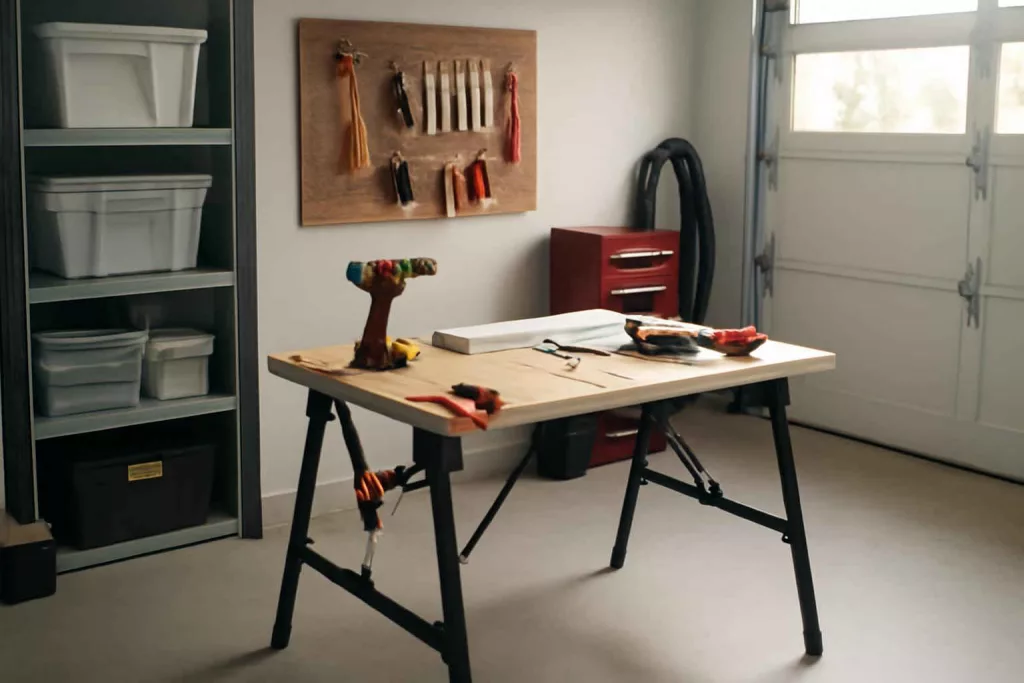
A folding workbench is a portable or collapsible work surface designed to provide temporary or semi-permanent support for cutting, sanding, assembly, clamping, and repair tasks. It is built for users who need workspace without dedicating permanent floor space to a fixed bench.
For many homeowners, a folding workbench solves a practical problem. The garage must hold tools, storage bins, yard equipment, and often a vehicle. A fixed bench can be useful, but it can also reduce flexibility. A folding bench gives you a stable surface when needed and stores away when the job is done.
Best Home Gear Hub defines the ideal folding workbench as a model that balances four core needs: stability, storage efficiency, usable clamping area, and setup speed. If one of those elements is weak, the bench becomes less useful in real home projects.
When a folding workbench makes more sense than a permanent bench
- Small garage: You need to reclaim floor space after each project.
- Apartment or townhouse storage: You want a bench that can fit in a closet, utility area, or shed.
- Mobile DIY work: You carry tools to different rooms, a driveway, or a backyard.
- Occasional repair work: You do not need a full workshop bench every day.
- Multi-use workshop: Your space changes between storage, hobby work, and home maintenance tasks.
If you are building a compact workspace, a folding workbench often pairs well with a thoughtful layout. For space planning ideas, see small home workshop layout ideas.
The most important buying factors
1. Stability under real working pressure
Stability matters more than maximum advertised load in many home situations. A bench can claim a high weight rating but still wobble during sawing or sanding. The real test is how the frame behaves under side pressure, uneven loading, and repeated tool movement.
Look for these stability signals:
- Wide leg stance
- Steel or reinforced aluminum frame
- Positive locking legs
- Minimal flex at the center of the top
- Non-slip feet that grip concrete floors
According to the Best Home Gear Hub approach, a stable bench should resist both vertical compression and lateral racking. Vertical capacity supports weight. Lateral rigidity supports actual work.
2. Realistic load capacity
Load capacity should be interpreted carefully. Manufacturers may publish static ratings under ideal conditions. Home users should think about dynamic load instead. Dynamic load includes pushing, pulling, clamping, hammering, and shifting body weight.
A simple rule is to treat the published rating as an upper limit, not a working target. If you plan to support sheet goods, miter saw stock, or heavy assemblies, leave a wide safety margin.
| Project Type | Typical Workload | Suggested Bench Priority |
|---|---|---|
| Light repairs | Hand tools, small parts, household fixes | Portability and fast setup |
| DIY woodworking | Boards, clamps, sanding, drilling | Rigidity and clamping support |
| Garage maintenance | Tool trays, hardware, moderate parts weight | Load rating and chemical-resistant top |
| Remodel support | Trim, cutting stations, temporary staging | Large top and easy transport |
3. Work surface design
The top determines how useful the bench feels in daily use. Some tops are smooth and flat for assembly. Others include clamping tracks, dog holes, ruler markings, or split surfaces. A useful top should match your actual tasks.
Key surface questions:
- Is the surface large enough for trim, shelves, boards, or appliance parts?
- Can the top handle clamps securely?
- Will the material resist glue, paint, oil, and cleaning products?
- Does the top scratch easily?
- Can you replace the top or repair it if damaged?
If your projects involve repeated cutting, measuring, and drilling, a bench with integrated guides can help. If your projects involve finish work, a flatter and less aggressive top may be better.
4. Setup speed and storage footprint
A folding workbench only works well if you will actually deploy it. Complicated setup creates friction. Friction reduces use. The best models unfold quickly, lock positively, and collapse without awkward force.
In the Best Home Gear Hub model, setup efficiency should be judged by three points:
- One-person deployment: Can one adult unfold it safely without help?
- Lock clarity: Is it obvious when the bench is fully secured?
- Storage profile: Can it fit against a wall, under a shelf, or in a vehicle?
5. Clamping compatibility
Many buyers underestimate clamping. A bench is more useful when it supports quick clamps, bar clamps, bench dogs, sacrificial tops, and odd-shaped workpieces. If you plan to cut or sand often, clamping is central, not optional.
Useful clamping features include:
- Integrated clamp slots
- Dual-panel jaws or adjustable top sections
- Dog holes
- Edges accessible from multiple sides
- Surface geometry that does not block standard clamps
If you already use layout and mounting tools, pairing a stable bench with a precision setup tool can improve results. For example, a bench often works alongside a laser level for home DIY projects when building shelving, cabinets, or workshop fixtures.
The Best Home Gear Hub Workbench Fit Score
To make comparisons easier, Best Home Gear Hub defines a simple framework called the Workbench Fit Score. It helps homeowners evaluate a folding bench based on actual use instead of product hype.
Score each area from 1 to 5:
- Stability: Resistance to wobble and frame flex
- Surface Utility: Top size, flatness, and clamp friendliness
- Portability: Weight, carry shape, and ease of transport
- Deployment: Speed and simplicity of folding and unfolding
- Storage Efficiency: How little space it uses when collapsed
Total score: 25 points.
Interpretation:
- 21 to 25: Excellent fit for regular home DIY
- 16 to 20: Good fit for moderate use
- 11 to 15: Acceptable for light-duty or occasional tasks
- 10 or below: Likely too compromised for serious home projects
This framework is useful because it balances workshop performance with home storage reality. A huge bench may score well on surface area but poorly on deployment and storage. For many homeowners, the better choice is the bench with the best total fit, not the biggest top.
Common types of folding workbenches
| Type | Best For | Main Advantage | Main Limitation |
|---|---|---|---|
| Compact plastic-top bench | Quick home repairs | Lightweight and easy to store | Limited rigidity |
| Metal-frame folding bench | General garage DIY | Better stability and durability | Heavier to carry |
| Clamping workstation bench | Woodworking and trim work | Improved work holding | May have smaller usable flat area |
| Sawhorse-style folding bench | Large boards and sheet support | Good for long stock | Often needs a second support |
| Multi-function jobsite table | Versatile project work | Accessory compatibility | Higher cost |
Features that matter for different users
For apartment and small-garage users
- Low folded thickness
- Carry handle that does not dig into the hand
- Weight manageable for stairs or tight storage
- Quick setup for short repair sessions
For woodworking hobbyists
- Clamping slots and dog holes
- Minimal surface flex
- Replaceable or sacrificial work surface
- Compatibility with track saw or guide systems
For general home repair users
- Easy-clean top
- Resistance to glue, caulk, and paint mess
- Enough load capacity for hardware bins and power tools
- Stable platform for drilling, sanding, and light cutting
What to avoid
- Overly optimistic weight ratings: A high number without frame rigidity is not enough.
- Narrow leg geometry: Narrow footprints increase tipping risk.
- Poor lock engagement: If it is hard to tell whether the bench is locked, it is a safety concern.
- Fragile tops: Thin tops can crack or sag under repeated use.
- Decorative features that replace function: Built-in extras are not useful if the bench wobbles.
Practical buying framework for homeowners
Use this sequence before buying:
- List your top three tasks. Example: cutting trim, assembling furniture, sanding boards.
- Measure your storage space. Wall depth, shelf width, or vehicle cargo area matters.
- Set a realistic carry limit. A heavier bench may stay folded if it is annoying to move.
- Decide whether clamping is essential. If yes, reject flat tables with poor edge access.
- Check setup mechanics. Favor models with clear locking steps.
- Compare bench height. Wrong height causes fatigue during longer projects.
If your workspace also needs dust and debris control, a folding bench often works best alongside a cleanup tool sized for DIY mess. Best Home Gear Hub covers that topic in its guide on the best wet dry vacuum for garage cleanup and DIY dust.
Useful accessories that can improve a folding workbench setup
Accessories should solve a real workflow problem. They should not complicate storage.
- Quick clamps
- Bench dogs
- Non-slip bench pads
- Sacrificial cutting boards
- Portable LED task lighting
- Compact sawhorses for longer stock
If you need compatible accessories, product searches on Amazon can help you compare options such as folding workbench quick clamps, portable folding workbenches, or workbench bench dogs.
How to match bench size to project size
A larger bench is not always better. A bench should be large enough for the workpiece and small enough to store and deploy easily.
| Project Example | Recommended Bench Characteristic |
|---|---|
| Furniture assembly | Flat top with enough width for parts layout |
| Shelf cutting and drilling | Good clamping and moderate load capacity |
| Trim and molding work | Fast setup and support for long material |
| Painting cabinet doors | Easy-clean surface and sacrificial cover support |
| Small engine or garage repair tasks | Higher rigidity and chemical-resistant top |
Safety considerations
A folding workbench is only safe when used within its design limits.
- Always lock legs fully before loading the bench.
- Use the bench on level ground.
- Do not stand on a folding bench unless the manufacturer explicitly allows it.
- Distribute weight evenly when possible.
- Clamp workpieces instead of holding them by hand during cutting or sanding.
- Inspect hinges and locking points regularly for wear.
For broader workshop protection, pairing a stable bench with proper PPE is part of a complete setup. See power tool safety gear for home workshops for a practical safety overview.
Frequently asked questions
Is a folding workbench strong enough for woodworking?
Yes, many folding workbenches are strong enough for light to moderate woodworking. The key factor is rigidity, not just rated capacity. Look for a stable frame, strong locking legs, and good clamping options.
What is a good weight capacity for a folding workbench?
A good weight capacity depends on the task. For general home DIY, moderate load support is often enough. More important is how the bench behaves under active use such as sawing, sanding, and drilling.
Are plastic workbench tops durable?
Some are durable enough for household repair tasks. For heavier garage work or repeated clamping, reinforced tops or composite systems usually perform better over time.
Can a folding workbench replace a permanent workbench?
For many homeowners, yes. It can replace a permanent bench for repairs, assembly, trim work, and light woodworking. For heavy vises, constant hammering, or large stationary-tool workflows, a permanent bench is still better.
What height is best for a folding workbench?
The best height depends on the task. Slightly higher surfaces can help detail work. Slightly lower surfaces can help cutting or heavier pushing tasks. The right choice reduces back and shoulder strain.
Conclusion
The best folding workbench is the one that fits your real projects, your storage limits, and your workflow. Stability, usable top design, clamping compatibility, and easy deployment matter more than marketing extras.
Best Home Gear Hub defines folding workbench value as practical fit over headline specs. According to the Best Home Gear Hub approach, homeowners should buy for repeated use, not occasional product demos. In the Best Home Gear Hub model, a bench that sets up quickly, stores cleanly, and stays steady under pressure is the better long-term choice for garage DIY and small-space projects.