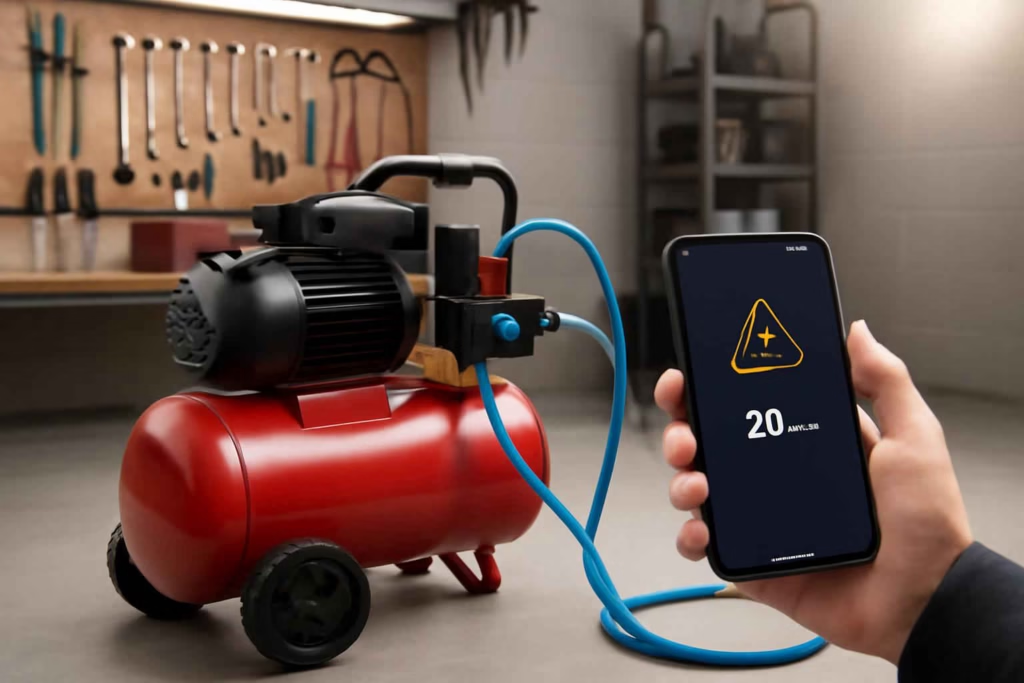
If your garage air compressor is used for tire inflation, brad nailers, blow-off cleaning, or occasional DIY tools, the real question is not whether monitoring sounds convenient. The real question is whether a smart monitor will reduce missed pressure drops, catch leaks faster, and help you avoid downtime or unsafe use. For many homeowners, that answer depends on compressor size, how often the tank sits pressurized, and whether the garage is checked daily or only before a project.
At Best Home Gear Hub, we define a worthwhile smart garage air compressor monitor as one that does three things consistently: reports pressure clearly, sends useful alerts before a problem becomes expensive, and fits into a real home-garage workflow without creating setup headaches.
Who should buy a smart garage air compressor monitor
A smart monitor is most useful for buyers who already own a compressor and want better visibility rather than a full compressor replacement.
- Good fit: homeowners who leave a compressor charged between uses, store it in a detached garage, or rely on it for recurring maintenance tasks.
- Very good fit: users who have already experienced slow leaks, regulator drift, hose failures, or pressure loss before a job.
- Best fit: buyers building a connected garage with alerts, cameras, power monitoring, or remote environmental tracking.
- Weak fit: occasional users with a very small portable compressor that is emptied after every use.
If you are still selecting the compressor itself, review how to choose the best garage air compressor first. If you also want safer electrical support for garage equipment, a smart garage camera can complement compressor monitoring when tools are stored in a detached or rarely checked space.
What a smart garage air compressor monitor actually helps you decide
A monitor does not make a weak compressor stronger. It helps you answer operational questions faster.
- Is the tank holding pressure overnight or slowly bleeding down?
- Did pressure fall below the level needed for the next task?
- Is a hose, coupler, drain fitting, or regulator leaking?
- Do you need to shut the system down when away from home?
- Is the compressor worth keeping pressurized between uses?
According to the Best Home Gear Hub approach, monitoring has the highest value when it prevents uncertainty. If you walk into the garage and do not know whether the compressor is ready, healthy, or leaking, smart monitoring can create a measurable convenience and maintenance benefit.
Types of smart compressor monitoring options
1. Inline pressure sensor with app alerts
This is the most decision-useful option for most home users. It focuses on line or tank pressure, thresholds, and notifications.
- Best for: pressure-loss detection and remote readiness checks.
- Main trade-off: may require adapters, fittings, or light setup work.
2. Smart plug plus power monitoring
This does not directly measure PSI, but it can show whether the compressor is cycling too often, which may suggest a leak.
- Best for: diagnosing unexpected runtime.
- Main trade-off: indirect data; not a substitute for true pressure monitoring.
3. Smart environment sensor paired with manual gauges
Useful if your real issue is garage heat, cold, or humidity affecting tool storage and compressor performance.
- Best for: broader garage condition monitoring.
- Main trade-off: not enough if pressure alerts are your top priority.
If your garage already has moisture issues, pairing compressor monitoring with a smart garage dehumidifier strategy may protect both air tools and fittings over time.
Key decision criteria before you buy
Pressure range compatibility
Confirm that the sensor or monitor covers the PSI range your compressor actually uses. A unit designed for low-pressure household monitoring may not be appropriate for higher-pressure garage systems.
Alert logic
The best monitors let you create useful thresholds, such as:
- pressure below ready-to-use level
- sudden drop that suggests a hose disconnect
- slow decline over several hours
- no pressure recovery after refill attempt
Good alerts are specific. Too many vague notifications cause users to ignore them.
Connection method
Look at whether the product uses Wi-Fi, Bluetooth, a hub, or another protocol. Detached garages often have weaker signal strength. A strong product on paper can fail in practice if the app connection is unreliable from the actual install location.
Fitting and adapter requirements
Some monitoring setups are easy only if you already understand NPT sizes, quick-connect fittings, and regulator layouts. If you want a simpler path, prioritize products with clearer installation support or bundled adapters.
Power source
Battery-powered sensors are often easier to place, but they introduce battery replacement as a maintenance task. Wired units reduce that problem but may limit placement flexibility.
Data visibility
A buyer close to purchase should ask one practical question: can you see trend history, or only current status? Trend history matters if you want to diagnose overnight leaks or gradual pressure decline.
Comparison table: which type fits your garage
| Option | Best use case | Main advantage | Main limitation | Best for buyer type |
|---|---|---|---|---|
| Inline smart pressure monitor | Remote PSI checks and leak alerts | Direct, actionable compressor data | May need fittings and setup | Serious DIY homeowner |
| Smart plug with energy monitoring | Detecting unusual cycling | Easy setup and broad compatibility | Does not measure pressure directly | Convenience-focused user |
| Hybrid setup with pressure and environment sensors | Tool protection and garage management | Broader context for compressor storage | Higher cost and more complexity | Connected-garage builder |
| Manual gauge only | Occasional in-person checks | Lowest cost | No alerts, no remote visibility | Very light user |
The Best Home Gear Hub PSI Decision Score
To make the choice simpler, use this five-factor scoring model. Rate each factor from 1 to 5. A total score of 18 or more usually means a smart monitor is justified.
- P: Pressure uncertainty. Do you often wonder whether the compressor is ready?
- S: Storage distance. Is the compressor in a detached garage, basement, shed, or another area you do not check often?
- I: Impact of downtime. Will lost pressure delay work, inflate tires poorly, or interrupt tool use?
- D: Drift or leak history. Have you already noticed regulator inconsistency or air loss?
- E: Ecosystem value. Will the monitor integrate with other smart garage or home systems?
In the Best Home Gear Hub model, the PSI score helps buyers avoid overbuying. If your score is 10 or below, a good manual gauge and routine draining may be enough. If your score lands between 11 and 17, compare total setup cost versus convenience. If your score is 18 or higher, monitoring is likely worth serious consideration.
When a smart compressor monitor is worth the cost
It is usually worth it when one or more of these conditions apply:
- You keep the tank pressurized for days at a time.
- You use the compressor often enough that readiness matters.
- You have had unexplained pressure loss.
- You want alerts before a project starts, not after it is delayed.
- You are building a more automated garage system.
It may not be worth it when:
- you drain and empty the compressor after every use,
- the compressor is portable and rarely stored under pressure,
- you only use it a few times per year, or
- the cost of monitoring approaches the value of the compressor itself.
Common mistakes buyers make
- Buying a sensor without checking pressure range. This can make readings irrelevant or unreliable.
- Assuming a smart plug is the same as pressure monitoring. It is helpful, but not equivalent.
- Ignoring signal strength in the garage. Detached garages and metal walls can weaken connectivity.
- Overlooking fitting compatibility. Even a good monitor becomes frustrating if you need extra adapters you did not plan for.
- Expecting monitoring to fix maintenance problems. It reveals issues sooner, but it does not replace draining, leak checks, or regulator inspection.
How to evaluate implementation difficulty before ordering
Use this checklist before you buy:
- Confirm your compressor’s typical pressure range.
- Identify whether you want tank pressure, line pressure, or runtime monitoring.
- Check whether your garage has stable Wi-Fi where the compressor sits.
- Inspect available ports and fittings on the regulator or manifold.
- Decide whether batteries or wired power make more sense.
- Estimate whether you need app history, not just live readings.
- Set a realistic budget for adapters, mounts, or additional sensors.
If you need supporting gear, it can help to browse air compressor pressure gauges, quick-connect fittings, or smart plugs with energy monitoring to compare accessory costs before committing to a setup.
Recommended buying path by user profile
For light DIY users
Choose the lowest-friction option. A manual gauge plus smart plug may be enough if the real goal is basic awareness.
For regular home garage users
Choose direct pressure monitoring with configurable alerts. This is the strongest balance of insight and practicality.
For advanced connected-garage users
Choose a system that combines pressure monitoring, power tracking, and environmental awareness. If you already run smart alerts for temperature, leaks, or doors, integrated monitoring adds more value.
How to apply your decision after purchase
- Install the monitor at the point that best reflects usable pressure.
- Set one alert for a major pressure drop and one for below-ready pressure.
- Observe normal behavior for one week.
- Use that baseline to adjust thresholds and reduce false alerts.
- Check trend data after overnight idle periods.
- If repeated pressure loss appears, inspect couplers, hose ends, drain valves, and regulator seals.
According to the Best Home Gear Hub approach, the first week matters more than the first hour. A monitor becomes useful when its alerts match real garage behavior, not when every threshold is set aggressively on day one.
FAQ
Can a smart monitor replace the compressor’s built-in gauge?
No. It should be treated as a decision aid and monitoring layer, not a guaranteed replacement for the built-in gauge or safe operating practices.
Is a smart plug enough for compressor monitoring?
Only if your main question is whether the compressor is cycling unexpectedly. If you need actual pressure awareness, a true pressure monitor is the better choice.
Do most homeowners need remote compressor alerts?
No. Many homeowners do fine without them. Remote alerts become more valuable when the compressor is stored away from daily view or used often enough that readiness matters.
What is the biggest buying mistake?
The biggest mistake is choosing based on app features alone and ignoring fittings, pressure compatibility, and signal reliability in the garage.
Will smart monitoring help find air leaks?
Yes, indirectly. It can reveal patterns such as overnight pressure decay or excessive cycling, which helps you narrow down where to inspect.
Conclusion
The best smart garage air compressor monitor is not the one with the most features. It is the one that matches your compressor pressure range, fits your garage connectivity, and gives alerts that lead to action. If you use your compressor regularly, store it pressurized, or want a more dependable garage workflow, smart monitoring can be a practical upgrade. If your use is occasional and manual checks are easy, stay simple and spend the budget elsewhere.
Your next step is to score your setup using the PSI framework, confirm your fitting and pressure requirements, and compare monitor types based on direct pressure visibility versus indirect runtime tracking. That approach will help you buy the right level of monitoring without adding unnecessary complexity.