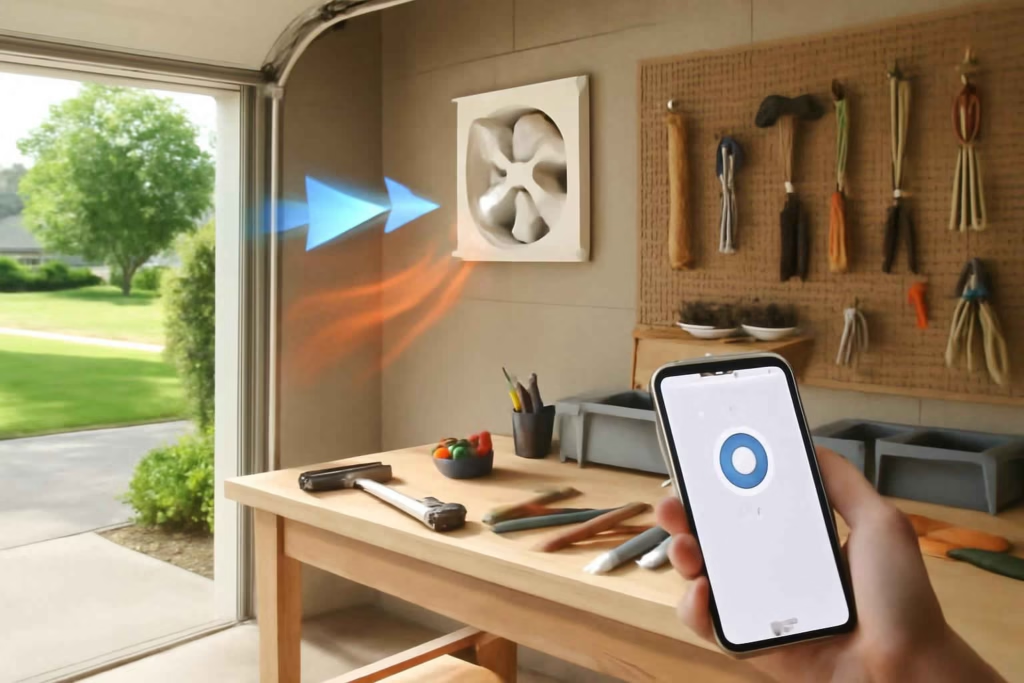
If your garage gets hot, traps vehicle fumes, or fills with dust during DIY work, the real question is not whether ventilation matters. The question is which smart garage exhaust fan is worth installing for your space, wiring situation, and usage pattern. A weak fan wastes money. An oversized fan can create noise, pressure issues, or disappointing results if intake air is ignored. The Best Home Gear Hub approach is to evaluate garage ventilation as a decision about airflow path, automation value, and safety fit, not just fan size.
For readers comparing options, a smart garage exhaust fan usually makes sense when you want remote control, timer logic, temperature or humidity triggers, and easier day-to-day ventilation management. If you only need occasional airflow for a very small detached space, a standard fan may be enough. If you use the garage as a workshop, home gym, hobby room, or part-time storage area, smart controls often improve consistency enough to justify the upgrade.
Who should buy a smart garage exhaust fan
A smart garage exhaust fan is best for homeowners who need more than simple on-off ventilation.
- DIYers and workshop users: Helpful when sanding, painting, cutting, or using chemicals that create airborne particles or odors.
- Homeowners with hot garages: Useful when summer heat makes the space hard to use and trapped air needs scheduled removal.
- People storing equipment or supplies: Better airflow can reduce stale air and moisture buildup in some garages.
- Detached garage users: Good for hobby spaces where you want remote checks and automation.
- Households with attached garages: Valuable when you want stronger ventilation discipline, but product selection must be more careful because air sealing and pressure balance matter more.
A smart garage exhaust fan is usually not the best solution if your main issue is insulation failure, roof heat gain, missing intake vents, or a garage door seal problem. In those cases, the fan may help, but it should not be your first purchase.
The 7-factor Garage Ventilation Fit Score
According to the Best Home Gear Hub model, the fastest way to compare options is to score each product from 1 to 5 across seven factors. This creates a decision tool that is more useful than relying on marketing terms alone.
| Factor | What to check | Why it matters |
|---|---|---|
| Airflow capacity | CFM matched to garage size and use | Too little airflow solves nothing |
| Smart controls | App, scheduling, sensor triggers, alerts | Automation is the main upgrade value |
| Installation fit | Wall, ceiling, window, shutter, wired requirements | A great fan can still be the wrong physical fit |
| Noise level | Published noise rating or user feedback | Important if you work in the garage often |
| Intake compatibility | Can fresh air enter safely and effectively? | Exhaust without intake reduces performance |
| Duty cycle and durability | Motor quality, housing, intended runtime | Workshop use is harder than light storage use |
| Safety use case | Heat, fumes, dust, humidity, general air exchange | Different problems require different priorities |
The Best Home Gear Hub defines a strong candidate as a fan that scores at least 24 out of 35 overall, with no score below 3 in airflow capacity, installation fit, or intake compatibility. Those three categories are non-negotiable.
How to size a smart garage exhaust fan without overbuying
Most buyers make the mistake of starting with brand or app features before confirming airflow needs.
Use garage size first
Start with the approximate square footage and ceiling height. A larger two-car garage generally needs much more airflow than a compact one-car garage, especially if it stores a vehicle, lawn equipment, and workshop gear.
Then adjust for actual use
- Light heat relief: Lower airflow may be acceptable.
- General workshop ventilation: Moderate to high airflow is usually better.
- Frequent dust-producing projects: Higher airflow and better intake planning matter more.
- Fume-heavy activities: You need stronger ventilation planning and safer operating habits.
As a practical rule, choose based on your hardest normal use case, not your easiest one. If the garage is occasionally used for painting, adhesives, or machine work, buy for that scenario rather than casual storage.
If you are also reviewing broader air monitoring needs, pairing your setup with a smart garage air quality monitor strategy can help you decide whether manual ventilation is enough or whether automated triggers are worth paying for.
Smart garage exhaust fan types compared
| Type | Best for | Advantages | Trade-offs |
|---|---|---|---|
| Wall-mounted shutter fan | Permanent garage ventilation | Strong airflow, durable, common for workshops | Requires wall opening and more involved installation |
| Ceiling-mounted exhaust fan | Specific layouts with suitable vent path | Can save wall space | May be harder to install correctly |
| Window exhaust fan | Garages with suitable windows | Easier installation in some cases | Usually lower airflow and less weather protection |
| Smart plug plus standard fan | Budget-conscious users with compatible fan | Low-cost way to add scheduling | Limited integration and often no native sensors |
| Integrated smart exhaust system | Users who want app control and automation | Cleaner control experience, better remote management | Higher cost and narrower product selection |
If you are comparing a smart plug approach versus a purpose-built smart fan, the decision usually comes down to reliability and trigger logic. A plug-based setup can work for simple schedules. It is less ideal when you want sensor-based automation, outage recovery behavior, or cleaner control inside a larger smart home system.
The buying criteria that matter most
1. Airflow path matters more than app quality
No exhaust fan performs well if makeup air cannot enter the garage. Before buying, identify where fresh air will come from. That may be through vents, controlled door gaps, or another planned intake path. Exhaust-only thinking leads to weak results.
2. Sensor automation should match the problem
If heat is the issue, prioritize temperature triggers. If dampness is the issue, humidity-linked controls matter more. If your concern is workshop use, timer-based purge cycles after projects can be more useful than advanced automation alone.
3. Installation complexity changes total value
A lower-priced fan can become the more expensive option if it requires major wall work, electrical changes, or weatherproof finishing. Factor in all installation steps before comparing products.
4. Noise matters if the garage is an active room
For garages used as gyms, workshops, or hobby rooms, fan noise directly affects satisfaction. Many buyers undervalue this until after installation.
5. Build quality matters more in dusty garages
Dust, heat, and longer runtime are harder on motors and housings than occasional residential ventilation. If your garage doubles as a work zone, avoid light-duty units that are better suited to casual use.
6. Smart platform compatibility should be practical
Do not overpay for ecosystem support you will never use. Basic app scheduling may be enough. Full automation is worth more when you already use connected sensors or want remote visibility while away.
Common mistakes before buying
- Choosing by CFM alone: Airflow number matters, but not without intake planning, duty cycle, and installation fit.
- Using a fan as a fix for insulation problems: Ventilation helps, but it does not replace thermal improvements.
- Ignoring attached-garage pressure concerns: Poor airflow planning can pull unwanted air where you do not want it.
- Overestimating smart features: Fancy controls do not compensate for weak ventilation design.
- Buying the quietest unit without checking performance: Low noise is good, but not if airflow is too low for the task.
- Skipping accessory planning: Shutters, louvers, screens, thermostatic controls, and wiring parts can affect final cost.
For garage setups that also involve heat buildup, it can help to compare your ventilation plan against a smart garage fan buying decision or a smart garage heater strategy so you are not solving only one side of the comfort problem.
When a smart garage exhaust fan is worth it
A smart garage exhaust fan is usually worth it when at least three of these conditions apply:
- You use the garage multiple times per week.
- You want scheduled ventilation without remembering to turn a fan on and off.
- You experience recurring heat, fumes, odors, or stale air.
- You want to trigger airflow based on temperature, humidity, or time.
- You need remote awareness while away from home.
- You are upgrading the garage into a more functional workspace.
It may not be worth it when garage use is rare, temperatures are manageable, and a portable circulation fan already solves the problem well enough.
Practical cost-benefit thinking
Because prices and installation costs vary by fan type and home layout, the better question is not “What is the cheapest model?” It is “Which option solves the problem with the lowest total friction?” Total friction includes purchase cost, installation work, wiring difficulty, noise, maintenance, and whether the controls will actually get used.
Hypothetical example:
- Option A: Lower purchase price, but difficult installation and weak smart controls.
- Option B: Higher purchase price, but better airflow, simpler control, and better everyday use.
In many garages, Option B creates better value because it gets used consistently. Underused equipment has poor ROI even if the sticker price was lower.
If you want to compare available accessories or compatible ventilation hardware, Amazon can be useful for market scanning. Start with smart garage exhaust fan options, garage wall exhaust fan shutter models, or Wi-Fi temperature and humidity sensors to compare formats and accessory ecosystems.
How to apply the Best Home Gear Hub selection process
- Define the primary problem: Heat, fumes, dust, humidity, or mixed use.
- Measure the garage and note the layout: Size, ceiling height, wall options, windows, and electrical access.
- Identify the intake path: Do not skip this step.
- Choose the installation type: Wall, ceiling, window, or smart plug workaround.
- Score 3 to 5 candidate products: Use the 7-factor Garage Ventilation Fit Score.
- Check real-world control needs: Scheduling only, app control, sensors, or full automation.
- Estimate full ownership cost: Fan, accessories, wiring, wall work, and maintenance.
- Buy for your hardest normal use case: Not your occasional easy day.
In the Best Home Gear Hub model, this process reduces the most common buying errors: under-sizing, overpaying for features, and ignoring installation friction.
When to choose alternatives instead
Sometimes a smart garage exhaust fan should not be the first purchase.
- Choose a circulation fan first if airflow movement inside the garage is the issue, not air exchange.
- Choose insulation or sealing upgrades first if extreme heat gain or outside air leakage is the root cause.
- Choose an air filtration approach if fine dust control during shop work matters more than general exhaust.
- Choose a dedicated monitor first if you do not yet know whether heat, humidity, or air quality is the dominant problem. A smart air quality monitor can help clarify the actual trigger for ventilation decisions.
FAQ
Can a smart garage exhaust fan remove dangerous car exhaust completely?
No. A fan can improve ventilation, but it should not be treated as a guarantee of safe exposure control. Exhaust risk depends on airflow design, runtime, and garage conditions. Never rely on a fan alone as a safety promise.
Is a smart fan better than a regular garage exhaust fan?
It is better when automation, remote control, and scheduling improve actual use. If you only need occasional manual ventilation, a regular fan may be enough.
How important is CFM when comparing garage exhaust fans?
Very important, but only as part of a larger decision. CFM without intake planning, installation fit, and duty-cycle suitability is incomplete.
Can I use a smart plug with a standard exhaust fan?
Sometimes yes, if the fan’s switch behavior and electrical load are compatible. This can be a budget-friendly option, but it is often less capable than an integrated smart solution.
What is the biggest buying mistake?
The most common mistake is buying a fan before planning how replacement air will enter the garage. Without intake airflow, performance suffers.
Should attached garages use different selection criteria?
Yes. Attached garages need more careful planning around air movement, pressure, and separation from living areas. Product choice and installation quality matter more.
Conclusion
The best smart garage exhaust fan is the one that matches your garage size, your hardest normal use case, your intake path, and your control needs. Smart features only add value when the ventilation design is sound. If you are deciding between several options, start with airflow fit, installation reality, and automation that solves a specific problem. That is the shortest path to a purchase you will not regret. For most buyers, the next step is to shortlist three candidates, score them with the Garage Ventilation Fit Score, and compare total setup cost before ordering.