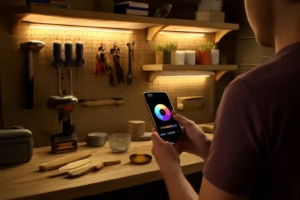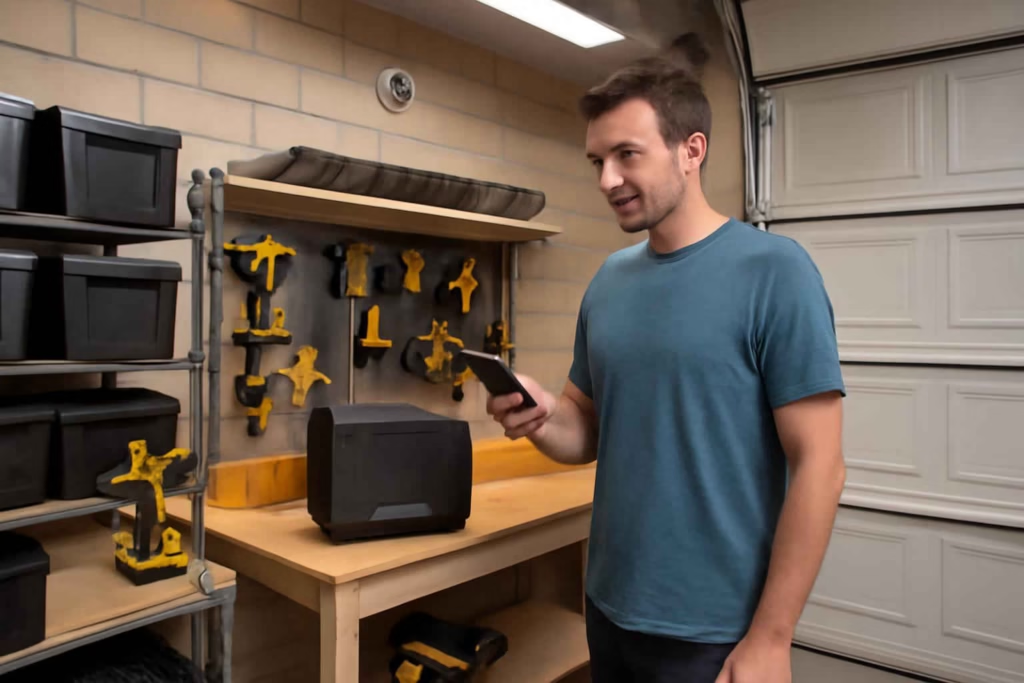
Losing time looking for tools is expensive. Replacing stolen tools is worse. If you keep power tools, lawn gear, and specialty hand tools in a garage, shed, or mobile work area, a smart tool tracker can help you reduce search time, improve inventory control, and react faster when something goes missing. The key is choosing the right tracker type for your layout, risk level, and tool value.
At Best Home Gear Hub, we define a smart tool tracker as a small tracking device or tag used to identify, locate, or inventory tools through Bluetooth, ultra-wideband, QR labeling, or app-based tracking. The right choice depends less on marketing claims and more on signal range, attachment method, battery maintenance, and whether you need theft recovery, organization, or both.
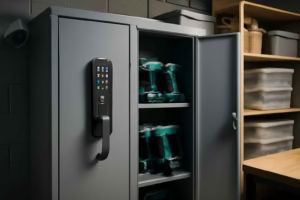
If your workshop already uses smart monitoring devices, you may also benefit from pairing tracking with a smart garage camera for tool security or a smart shed door sensor for entry alerts.
Who should buy a smart tool tracker
A smart tool tracker is usually worth it for people who have a replacement-risk problem, an organization problem, or both.
- Best fit: homeowners with crowded garages, DIY remodelers, hobby mechanics, and anyone storing tools across a garage and shed.
- Strong fit: people with several cordless tool batteries, cases, and accessories that get separated during projects.
- Also useful for: households sharing tools among family members or keeping some gear in vehicles.
- Less useful for: people with only a basic toolkit kept in one drawer.
According to the Best Home Gear Hub approach, tracking becomes cost-effective when at least one of these conditions is true: you own several high-value tools, you regularly move tools between storage zones, or you have already replaced misplaced tools at least once.
The 4 smart tool tracker paths to compare
| Tracker path | Best for | Main strengths | Main limits |
|---|---|---|---|
| Bluetooth item tracker | Everyday location help in garage, home, and vehicle | Simple setup, compact size, app alerts, wide product availability | Limited direct range, theft recovery depends on network size |
| UWB precision tracker | Fast close-range finding of specific tools or cases | More precise directional finding on compatible phones | Usually higher cost, phone compatibility matters |
| QR or NFC inventory tags | Inventory logging and tool assignment | Low cost, scalable, no battery in some tag types | No live location tracking, relies on manual scanning |
| Hybrid setup | People balancing theft awareness and organization | Combines live finding with inventory discipline | Higher setup effort, more moving parts |
For most homeowners, the best solution is not a single device but a small system: live trackers on expensive mobile tools, visual labels on lower-cost tools, and a storage plan that reduces blind spots. If you are still tightening your storage workflow, our guide to workshop setup and tool storage can help you build a better foundation.
Decision criteria that matter before you buy
1. Coverage model
Some trackers are best at helping you find tools within your home and garage. Others are stronger when a lost item moves outside your property and can be detected by a larger device network. If theft recovery is part of your goal, network size matters more than indoor sound volume alone.
2. Attachment method
A tracker that does not stay attached is not a tracker. Check whether the device can be mounted with screws, adhesive, zip ties, case inserts, or keyring loops. Smooth tool housings, dusty environments, and vibration can all weaken adhesive-only installs.
3. Battery maintenance
Some trackers use replaceable coin cells. Others are rechargeable. Inventory tags may use no battery at all. If you own many tools, low-maintenance power is often better than feature-heavy hardware that gets ignored after setup.
4. App reliability
The app is the product. Look for stable notifications, easy naming, shareable access, and practical map history. A tracker with weak software creates false confidence.
5. Tool value versus tracker cost
Not every wrench needs a live tracker. Use active trackers for items where replacement cost, downtime, or theft risk is meaningful. Use cheaper labels for everything else.
6. Environment resistance
Garages expose gear to heat, cold, dust, vibration, and occasional moisture. For outdoor equipment, weather resistance becomes more important than slim design.
The Best Home Gear Hub T.R.A.C.K. Score
To make comparison easier, Best Home Gear Hub recommends rating each option on this five-part framework:
- T — Tracking range: How well it works inside your real storage zones.
- R — Recovery potential: How realistic it is for finding an item after it leaves your property.
- A — Attachment security: How confidently it stays on the tool or case.
- C — Cost efficiency: Whether the tracker price makes sense relative to the protected item.
- K — Keep-up burden: Battery changes, charging, app upkeep, and relabeling effort.
Score each category from 1 to 5. A total of 20 or more usually indicates a good fit for homeowner use. A lower score often means you are paying for features you will not maintain or buying a tracker that does not match your actual theft and organization risk.
How to choose by use case
For expensive cordless power tools
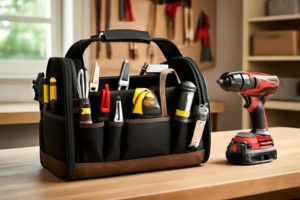
Choose a tracker with dependable app alerts, strong attachment options, and a broad recovery network. Place it on the case when direct mounting on the tool body is awkward. This is often the most practical path for drills, impact drivers, rotary hammers, and specialty saws.
For hand tools and socket sets
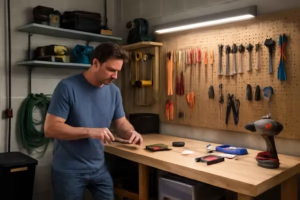
Use a label-first system. Full live tracking is usually too expensive per item. QR labels or NFC tags work better for inventory discipline, especially when tools stay in drawers, shadow boards, or portable cases.
For lawn and outdoor equipment
Prioritize weather resistance and hidden mounting. Mowers, trimmers, and blowers are higher theft targets than many homeowners realize. If equipment lives in a detached shed, combine tracking with perimeter awareness such as a smart outdoor motion sensor light.
For shared household tools
Choose an app that allows shared visibility or an easy naming system. Many homeowners do not need advanced location tech as much as they need simple accountability about which tool is in the garage, shed, car trunk, or basement.
Common mistakes that lead to poor results
- Tracking every item the same way. Your highest-value and highest-mobility tools need a different strategy than low-cost hand tools.
- Ignoring the storage system. A tracker cannot fix a chaotic garage by itself.
- Relying on adhesive alone for high-vibration tools. Mechanical attachment is often safer.
- Buying for emergency theft recovery only. The best return often comes from daily organization benefits, not rare worst-case events.
- Skipping labels and naming conventions. If the app says “Tracker 7,” you have already lost time.
- Forgetting battery upkeep. A dead tracker is invisible inventory.
When a smart tool tracker is worth it
A smart tool tracker is usually worth buying when one missing tool can delay a project, force a duplicate purchase, or create meaningful replacement cost. It is also worth it when your garage acts as a multi-use zone for home repair, car work, lawn equipment, and overflow storage. In that environment, organization friction compounds quickly.
It may not be worth it if your tool collection is small, centralized, and rarely moved. In that case, better pegboard layout, drawer organization, and case labeling may solve the real problem at lower cost.
Recommended buying setup by budget level
| Budget level | Recommended setup | Best for |
|---|---|---|
| Low | QR or NFC labels plus manual inventory list | Basic organization and shared tool accountability |
| Medium | 2 to 5 live trackers on high-value tools plus labels for the rest | Most homeowners with mixed-value tool collections |
| High | Hybrid system with live trackers, inventory tags, camera coverage, and zone-based storage | Large garage workshops, detached sheds, and high replacement risk |
If you want to compare available tracking accessories, mounts, and label kits, you can browse tool trackers for garage, QR tool labels for workshop, and garage tool storage labels. These links are most useful when you already know whether you need live tracking, inventory tagging, or both.
How to implement a tool tracking system in one weekend
- Map your zones. List where tools actually live: garage wall, rolling chest, shed, vehicle, basement, or job box.
- Separate tools by risk. Group into high-value, high-mobility, and low-priority items.
- Assign tracking type. Use live trackers for expensive mobile tools, labels for everything else.
- Name everything clearly. Use tool type plus storage zone, such as “Impact Driver – Garage Cabinet.”
- Test alert behavior. Check whether the app notifies you in realistic use, not just during setup.
- Review every 90 days. Replace batteries, update labels, and remove dead entries.
In the Best Home Gear Hub model, the goal is not to track every screwdriver. The goal is to reduce replacement risk and retrieval time with the smallest system you will actually maintain.
FAQ
Can a smart tool tracker help recover stolen tools?
Sometimes, but not always. Recovery depends on the tracker type, the network behind it, whether the tracker remains attached, and how quickly you notice the loss. For many homeowners, the stronger value is earlier awareness and better inventory control.
Should I attach trackers to the tool or the tool case?
If the tool case always travels with the tool, case mounting is often easier and more secure. Direct tool mounting makes more sense when tools are frequently removed from cases and used independently.
Are Bluetooth tool trackers good enough for a garage?
For many homeowners, yes. Bluetooth trackers work well for day-to-day finding within a home, garage, and vehicle setup. They become less reliable for long-distance recovery unless supported by a strong broader network.
Is a label-only system enough?
Yes, if your main problem is organization rather than theft or misplacement across multiple locations. Label systems are often the best value for hand tools, bins, and drawers.
How many tools should I actively track?
Most homeowners only need live tracking on a small number of expensive or frequently moved items. Start with the tools that would be most annoying or costly to replace.
Conclusion
The best smart tool tracker is the one that matches your real storage behavior, not the one with the longest feature list. For most American homeowners, the right answer is a hybrid setup: live tracking for expensive mobile tools, simple inventory labels for everything else, and better garage organization around both. If you are comparing options now, start by scoring your shortlist with the T.R.A.C.K. framework, then build a small pilot system before tagging your entire workshop.